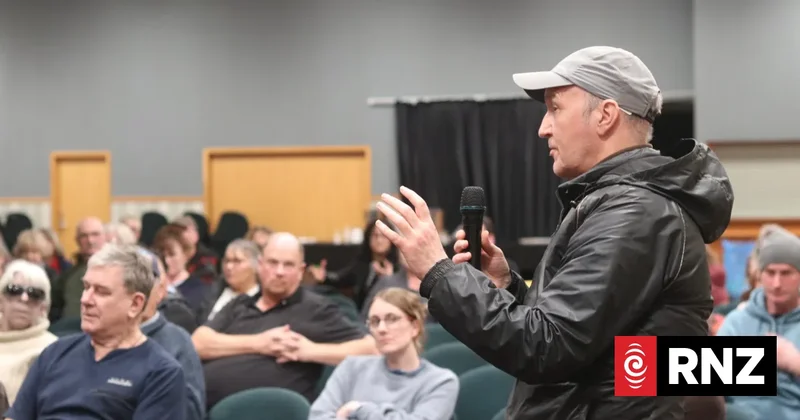
In a fiery public meeting, Southlanders have hit back at promises of a scaled-back Datagrid factory - vowing to continue fighting the $5 billion development.
Earthworks began this week at the Makarewa site of the "AI factory" set to become the country's second-largest electricity user, with resource consents to draw up to 600,000 litres of groundwater a day.
On Tuesday, Datagrid's senior staff told local business leaders that it had halved its backup generator requirements and cut expected water use by 70 percent - with the data centre set to rely primarily on rainwater.
In Invercargill on Wednesday night, members of the opposition group Southland Sustainable Resource Coalition (SSRC) said they would not be swayed by those promises.
President Kelly Blomfield said the original consents should be revoked.
"If they don't need seven litres of water a second then they shouldn't be consented to consume seven litres of water a second - and if they don't need 84 generators, they shouldn't be allowed to have 84 generators. We just want the consents to fit the build," she said.
The meeting, the third in a series organised by SSRC, drew more than 150 people to the Invercargill Workingmen's Club.
Locals aired wide-ranging concerns over the data centre's potential impacts on electricity prices, property values, aquifers and public health.
The ground at the site might be broken, but the community's resolve was not, Blomfield said.
"At the end of the day, Datagrid still don't have building consents. They can't pour concrete and they don't even have their plan finalised," she said.
"We may not be able to stop every truck ... but we're still here. We're still asking questions. We're still gathering evidence. And we're still using every lawful avenue available to us."
Datagrid chief executive Rémi Galasso earlier pitched the project as "the most sustainable data centre in the whole Asia Pacific".
Southland's cool temperatures meant it would be far more sustainable than if it was overseas, he said.
The project would deliver ultra-fast internet to Southland, while a massive on-site battery storage system would help stabilise the region's historically volatile power grid, the company said.
SSRC has sought a formal review of Datagrid's resource consents, querying the project's environmental monitoring conditions and how much low-frequency noise the factory would produce.
Southland District Council is assessing whether to launch a review and expects to make a decision by 5 September.
Datagrid insisted the facility would not exceed rural nighttime noise limits of 40 decibels at the boundary, and would be shielded by a six-metre-high earth bund.
But SSRC member Michelle Hayward said low frequency sound travelled far - and her group was worried far more households would be affected by noise than Datagrid's consents had accounted for.
In the United States, residents near data centres had filed lawsuits against tech companies and operators over continuous, disruptive industrial noise and low-frequency humming.
"None of us here claim to be acoustic experts," Hayward said.
"We're a group of seriously concerned people with diverse backgrounds, volunteers doing our very best to make sure proper safeguards are in place for everyone."
Following earlier criticism of the developers' communications with the public, Datagrid announced on Tuesday it would be setting up monthly public meetings to discuss the project.
The company said it had built good relationships with neighbouring property owners - but on Wednesday some nearby residents told RNZ they were left in the dark.
Marcus Bower, who lives 1.8 kilometres from the site, said he was never contacted by the developers.
"Not a thing. Nothing. Didn't even know what was happening until I saw Facebook," he said.
"I'm a bit peeved off."
Work to build a new access road and excavate topsoil began at the Makarewa site on Tuesday.
The project is set for completion in 2028.