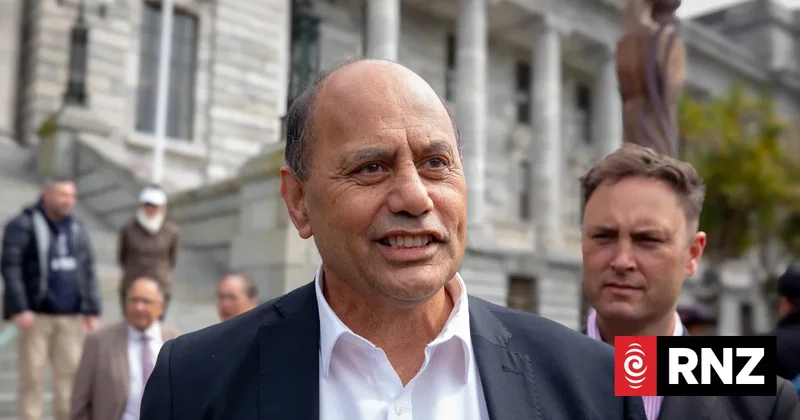
Labour's Willie Jackson - who is running the party's campaign for the Māori seats - has cast some doubt on the party's ability to win them all.
His statements contradict leader Chris Hipkins repeatedly expressing confidence in sweeping all seven of the seats, and may be hard for some of the Labour candidates to hear being broadcast in public.
"I'm not a fool in terms of how hard it is to knock out incumbents," Jackson told RNZ.
He said Te Pāti Māori co-leader Rawiri Waititi's nearly 16,000-vote majority at the last election was "not an easy lead to knock out ... so you wouldn't say we were favourites in the Waiariki, would you?"
The other co-leader, Debbie Ngarewa-Packer would also be the favourite in Te Tai Hauauru, and likewise in Waikato, currently held by Te Pāti Māori's Hana Rawhiti Maipi Clarke.
"We got a heck of a candidate there, if Hana's going to lose to anybody, she'll lose to Kingi Kiriona, but you would say she was the favourite."
Jackson said he was expecting Labour wins in two seats: Ikaroa-Rāwhiti, currently held by Labour's Cushla Tangaere-Manuel and Te Tai Tonga, which he expected Mananui Ramsden to reclaim from former Te Pāti Māori MP Tākuta Ferris.
"The North could go anywhere but Willow Jane Prime has got a high profile, and so you got two [for Labour] and then those other five will probably be a big scrap.
"On a great, incredible day, either side might knock off seven seats - but, you know, I'm realistic. I've been in the game a long time. It's hard to knock off seven seats for either side."
Jackson had pushing back on claims of hypocrisy over his criticism of Te Pāti Māori's strategy of intentionally creating an overhang in Parliament by telling voters to support candidates in electorates - but to vote for other parties in the left bloc.
An overhang can happen when a party wins more electorate seats than the proportion of seats in Parliament it would be entitled to based on party votes, and results in additional seats being added to Parliament.
Te Pāti Māori confirmed the strategy at its campaign launch on Sunday, but Jackson had warned it would risk the legitimacy of the Māori seats in Parliament, saying that "when you start working the system like that" it could lead to backlash and the seats' possible abolition.
On Tuesday - unprompted by reporters - Ngarewa-Packer criticised him, saying he had been happy in 2017 for Labour to "use the very strategy of asking all their Māori candidates and MPs to come off the list".
"So I do think that Labour are very rich - and particularly Willie Jackson - to be talking about Te Pāti Māori's strategy, given that they used the same strategy in 2017," Ngarewa-Packer said.
Jackson denied the situation was the same.
"We weren't talking about voting for an overhang. We weren't talking about voting for people who had different politics from us, all we were talking about was using the system to get more Māori through Labour into the Parliament.
"We always were running a two-tick campaign, but just because they were not on the list doesn't mean that we didn't want the party vote."
That approach had led to getting a record number of Māori Labour MPs into Parliament after the 2017 election, and Jackson said he did not blame Ngarewa-Packer for her comments, but "we used the system in different ways".
"People are saying right now that they're insulting their intelligence because people want to vote on policies, philosophies, and 'does that person have integrity'."
He agreed Te Pāti Māori was also simply trying to get more Māori MPs in Parliament, but denied it was the same.
"I'm not saying it's an outrageous strategy if everyone's on the same waka. If it was a different time and everybody was singing off the same song sheet and there was great synergy between [them], and there was very little between candidates in terms of philosophy, then maybe it's a good idea.
"The difference is, we can't vote for a party that has different views from us ... they've got some wild policies that we don't agree with ... there's some stuff that they will, that we support each other on but there's some policies our people don't want to just vote for.
"They believe in entrenching the [Waitangi] Tribunal vote, for instance. Well, we'd never support that, never."
Te Pāti Māori has a policy of making Waitangi Tribunal recommendations binding on the Crown, and constitutionally entrenching Te Tiriti o Waitangi to prevent changes to Treaty clauses in legislation.
Jackson said Te Pāti Māori was "not wrong to use the system", pointing to National and ACT having done with deals for the Epsom electorate, and said there may be cause for making changes to prevent such deals - but was not looking at that right now.
He said he would be open to sitting down with the co-leaders and strategising together, but that was not something they were planning at this point.
"Whilst we may be critical of each other here, we do have respect and do support each other in lots of other areas.
"When the time comes, if they get across the line - which you know, I'd be surprised if they don't get across the line - then we'll talk."