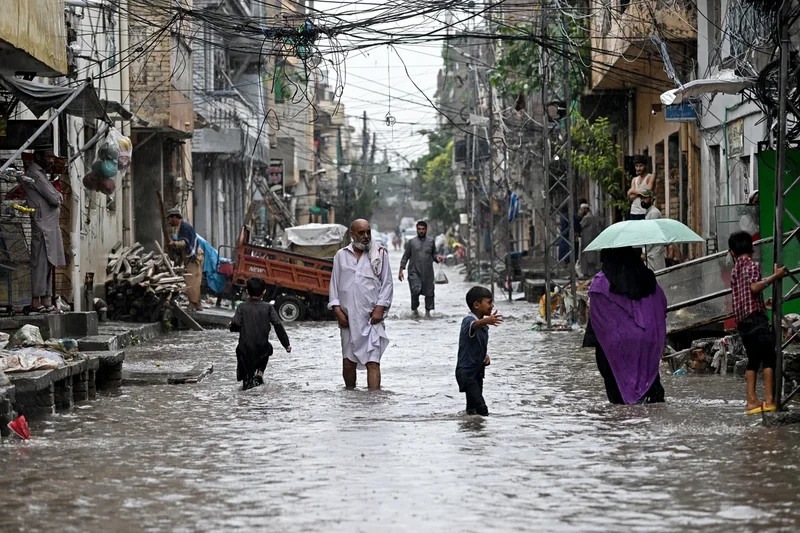
Some of Asia's largest cities are likely to face months of drought while others could be hit by flooding when a “super” El Niño weather event develops later this year, according to research that warns it has no precedent on record.
The analysis, released by WaterAid and carried out by academics at the universities of Bristol and Cardiff, examined 44 years of rainfall in 12 South and South-East Asian cities alongside the strength of past El Niño events, and found that the stronger the El Niño event, the more certain it became that a city's rainfall would swing away from normal.
However, cities swung in opposite extremes, the researchers found, with some pushed towards drought and others, sometimes only a few hundred miles away, pushed towards flooding.
Jakarta and Surabaya in Indonesia; Phnom Penh in Cambodia; Bangkok in Thailand, Kuala Lumpur in Malaysia and Mumbai in India all became drier as El Niño strengthened, with the very strongest events clustering at the driest outcomes in the data.
Meanwhile, Shanghai and Hangzhou in China and Colombo in Sri Lanka went the other way, becoming reliably wetter. Faisalabad and Karachi in Pakistan and Dhaka in Bangladesh sit between the two zones and have swung either way, which makes them the hardest for governments to plan for.
El Niño begins with a warming of the surface of the Pacific and ends up moving moisture around the planet in ways that leave some regions in flood and others in drought, depending on where they sit relative to that movement. It occurs every five to ten years, and its strength is measured by how far sea surface temperatures deviate from normal.
What makes this year different is the scale of the event, which is already being labelled “super” this year. Meteorological agencies and researchers around the world are on high alert that this El Niño has gained strength at an exceptional speed, and could affect every weather pattern.
It could reach as high as 3.6C above normal, against a previous monthly record of 2.75C set during the El Niño of 2015 and 2016. Nothing on record approaches what is forecast, which the researchers say leaves the size of the impact genuinely uncertain.
"Under the unprecedented super El Niño, we are in unchartered territory because there is no event on record as large as what is predicted," the researchers said. "There are definitely uncertainties relating to the magnitude of the impact. However, based on our analysis, there seems to be more certainty related to the direction of the impact. Regions normally prone to drought will highly likely experience drought and regions normally prone to flooding will highly likely experience flooding."
"When we get to territory like a super El Niño, it means that that difference in sea surface temperatures, that anomaly that we're measuring across the globe, is really extreme," said Michael Singer, professor at Cardiff University and one of the lead scientists. "So we're expecting a lot more moisture to be moving around in very specific ways around the planet, leading to in some places, you know, probably really high propensity for flooding, and in other places, a high likelihood of drought."
For the South Asian cities in the drying group, the effect will interrupt a pattern running the other way. WaterAid's earlier research found most of these cities have been getting steadily wetter over four decades, with fewer droughts and more extreme rainfall. A dry spell might sound like relief in a region currently dealing with floods, but Katerina Michaelides, professor at the University of Bristol, said that misreads how long these events last.
"The impacts of an El Niño may last for not just one year or one season. They may be prolonged. They may be a year. They may be two years. They may be multiple seasons of below-normal rainfall back to back, depending on how long the El Niño lasts and the strength of it," she said.
"Unless these places are well equipped to manage and store water from the wet season to use during drought periods, it's never really a good thing to have prolonged drought periods in regions that are used to having a certain amount of seasonal rain come in, where agriculture and livelihoods are tied to a sort of consistent pattern."
A weakening of the monsoon in India or elsewhere that depends on those rains is not necessarily good news, she said, unless those places are equipped to handle a long dry period. Professor Singer added that a less intense monsoon could bring short-term benefit somewhere already flooding badly.
Mumbai falls in the drying zone and should expect drought, Professor Michaelides said, while Dhaka sits in a transition zone and could go either way depending on the atmospheric patterns of the moment.
El Niño is not the only thing shaping rainfall in the region. The researchers point to the Indian Ocean Dipole, the Madden-Julian Oscillation and the Pacific Decadal Oscillation, each of which can amplify El Nino's effect when aligned with it or blunt it when running the other way.
"Rainfall in any one place is shaped by many overlapping climate influences, and El Niño is just one of them," Professor Michaelides said. "But our analysis shows that El Niño's strength is still a strong predictor of whether rainfall is likely to deviate from normal."
The same split shows up in East Africa, where the research found neighbouring cities pulled in opposite directions, with Nairobi and Kampala turning wetter while Addis Ababa dries.
Whichever way a city goes, the consequences run through water. Flooding contaminates supplies and spreads diseases including cholera, while drought empties reservoirs and destroys crops, and both fall hardest on cities where water and sanitation systems are already stretched.
"The chaos of the climate crisis, bringing extreme heat, droughts and floods, has been on our doorsteps for some time now, but this year's super El Niño only puts us more at risk," said Shakeel Hayat, climate change and water, sanitation and hygiene specialist at WaterAid Pakistan. "The data makes clear that some of the world's biggest cities could be left with too much or too little water."
Mr Hayat said water security had become a matter of food, energy, health and economic security, and pointed to rainwater harvesting as a straightforward way of easing pressure on depleted groundwater. "There are solutions, we just need investment," he said.
WaterAid is calling on the British government to make water security, sanitation and hygiene a priority of its G20 presidency next year and at the UN Water Conference this year.
The Independent has previously reported that the super El Niño weather event could see global agricultural output take a $342 billion (£260bn) hit, and pose a critical threat to the world’s 500 million smallholder farmers, new research suggests.
That financial forecast is based on 11 key commodities including grains, oils, coffee, cocoa, dairy and livestock, which have a combined anticipated yield loss of up to 14 per cent during the extreme weather event.
Aid groups are warning that global food crises, which have already been hit hard by plummeting foreign aid flows from wealthy countries, could now worsen further with the super El Niño.
This article has been produced as part of The Independent’s Rethinking Global Aid project