I’m in Tangier, trying to eat my breakfast, but this involves a delicate dance with the bees. They arrive as soon as the waiter brings my semolina pancakes, known as thousand-hole bread here in Morocco, which come with a bowl of honey. The bees perch on the edge of the bowl, dipping their devil-red tongues until finally they topple in. When I fish them out they stagger drunkenly across the table, leaving a sticky trail. I’m sympathetic because Tangier has the same narcotic effect on me. I could become addicted, tumble in and forget to leave.
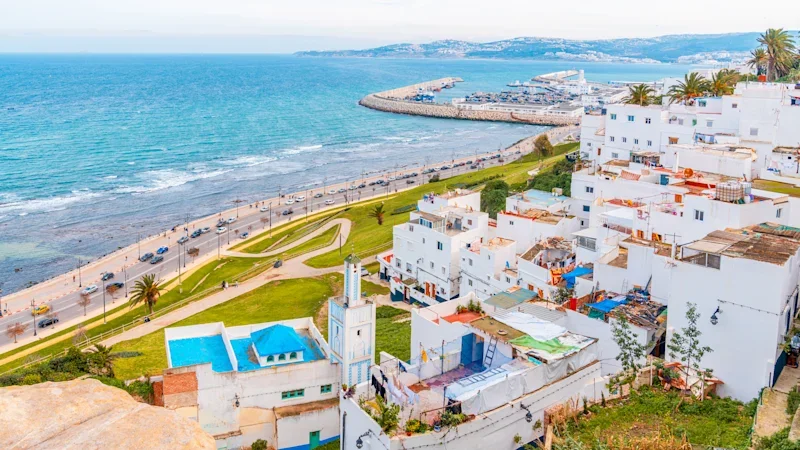
I first set eyes on Tangier aboard the ferry coming from Spain: a huddle of white cubes stacked on hills overlooking the Strait of Gibraltar. A web of alleyways took me upwards through bazaars and tiny squares where men in hooded cloaks gossiped over coffee, finally to my hotel in the kasbah at the top of the city.
I have a weakness for bad reputations, and if you were looking for a devil to sell your soul to, Tangier was once the place. From 1925 to 1956 the city was an international zone, governed jointly by the European powers. Anything went, and Tangier quickly became a refuge for misfits, drifters, grifters, dispossessed aristocrats and anyone with a shady past. The heiress Barbara Hutton, one of the world’s wealthiest women, arrived in the 1940s, bought a house and threw legendary parties for a guest list that featured Jean Cocteau, Ava Gardner, Truman Capote and Errol Flynn.
Writers loved it. Tangier gave them warmth, cheap hotels, the raw material any writer needs and permission to do what they liked. William Burroughs stayed for four years in the 1950s, consumed vast quantities of illicit drugs and wrote The Naked Lunch. Jack Kerouac, Allen Ginsberg, Orson Welles and Samuel Beckett all stayed and played. Its most enduring literary presence was Paul Bowles, who lived in Tangier for more than 50 years, caught by its spell. “The city existed in a dreamlike suspension,” he wrote, and the separation from reality, logic and identity endures.
The bees having won, I’ve drifted down to Cafe Colon on Rue de la Kasbah, once the setting for a seminal scene in Bernardo Bertolucci’s film adaptation of Paul Bowles’ The Sheltering Sky. My friend Ayoub is there, smoking as usual. “I became addicted when I was working in Qatar as a taxi driver, 14-hour days, seven days a week,” he once told me.
Get exclusive travel deals delivered straight to your inbox. Sign up now.
On the front of Cinema Alcazar, opposite the cafe, there’s a poster advertising Francois Ozon’s 2025 remake of Albert Camus’ L’Etranger, my flimsy excuse for another visit to Tangier. I’m trawling the city in search of the places Ozon used for backdrops. Set-jetting, it’s called, and while Camus’ novel was set in Algiers, for security reasons Ozon chose Tangier, its blend of Mediterranean, Moorish and European architecture being the closest thing to 1930s Algiers.
First stop is the Petit Socco, the Little Souk, once the city’s diplomatic and banking zone, and two of the square’s prewar icons, Hotel Fuentes and Gran Cafe Central, still stand. As a hangout for boho layabouts, the city evolved a virile cafe culture which lingers on, but Cafe Central is a tourist hangout, and don’t expect swift service. It’s hard to work out whether Ozon used this area as a backdrop. The film was shot in high contrast black-and-white, and Ozon is keeping quiet about the locations, but Meursault, Camus’ central character, lived much of his life in the narrow, whitewashed streets and tiny squares of Algiers’ medina, and the Petit Socco is a dead ringer.
From here I head for the port, and Ozon used digital manipulation to recreate the grand sweep of Boulevard Zighoud-Youcef on Algiers’ seafront from the port at Tangier. The wind is in from Africa. In October it should be the westerly off the Atlantic Ocean but today it’s the Chergui, a warm, dry wind carrying henna-coloured dust from the Sahara. The fast ferry from Spain’s Algeciras is bucking in the waves.
The kasbah is my next filmic destination and my wandering route takes me through the carpet bazaar and past the bric-a-brac shops, filled with chunky Tibetan necklaces, Burmese lacquerware and Venetian glass, suggesting sacrifices made so happy wanderers could spend another week in Tangier. On Rue du Port, Cafeteria Dopamine is my daily stop for a shot of espresso and a tiny pastry. The pistachio is my favourite but the almond-topped items are pretty good, as is the honey cake – but it’s missing. “What happened?” I ask Ahmed, the owner.
“Not today,” he says. “It’s the wind off the desert, it brings the bees.”