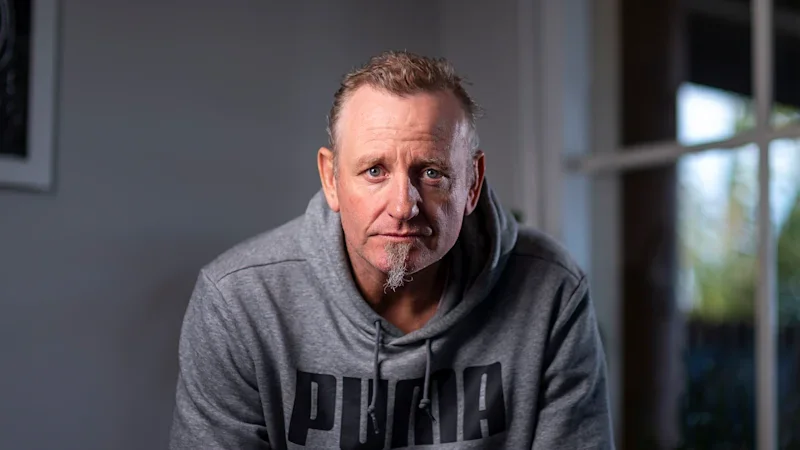
John Barnes struggles to do simple things. He cannot bathe unattended, cook or drive himself to work. His memory is poor and cognitive capacity severely diminished, his doctors believe, from permanent brain injury caused by repeatedly being knocked unconscious while playing football.
About a decade after he ended a celebrated AFL career, Barnes was diagnosed with post-traumatic epilepsy. He takes medication for the condition but can have seizures without warning. Rowena Barnes says her husband is also prone to sudden mood swings and outbursts.
“He can snap at the drop of a hat and go into a rage, which is just not John” she said in a 2017 interview.
Back then, Barnes was the public face of a campaign to force the AFL to improve its management of concussion and accept responsibility for former players suspected to be living with the effects of Chronic Traumatic Encephalopathy, or CTE.
He is now One Nation’s candidate for the seat of Essendon in November.
It is a perplexing choice which, while guaranteed to generate attention in a footy-mad town and, potentially, bring political attention to the concussion crisis in contact sports, raises fresh questions about whether Pauline Hanson’s party is serious about this Victorian election.
Since retiring from football, Barnes has worked as a garbage collector, a union rep and most recently, a local government councillor. A supporter throughout his well-documented battle with acquired brain injury was on Wednesday incredulous at Barnes’ latest career change.
“It is beyond ridiculous,” they said. “If he is put under pressure he doesn’t have the mental capacity to deal with it.”
Barnes, who like other One Nation candidates is currently under a gag order imposed by local party officials, was unable to discuss how he would manage the demands of serving as an MP with his cognitive impairment, noting only that he will no doubt get asked this question a lot.
One Nation’s first big tilt at Victorian politics is slowly cranking into gear. On the day Barnes’ candidacy was announced with a clutch of other One National hopefuls, the party’s national director James Ashby flew into Melbourne armed with an advertising budget and campaign strategy.
Ashby says the party will target 20 lower house seats which, on recent polling numbers, he believes it can win. “We are not here to play games,” Ashby said on Wednesday. “We are here to win seats.”
Nonetheless, nagging doubts remain about Hanson’s true intentions in Victoria.
While more than 70 One Nation candidates were informed of their pre-selections two weeks ago, most are unannounced. The party’s state president and would-be parliamentary leader Warren Pickering has declared he is running to become Victoria’s next premier but so far, One Nation has not put its money where his mouth is.
A little over three months from polling day, social media platforms are clogged with paid ads from the major parties but nothing from One Nation. Letter boxes are being stuffed with political leaflets but not by orange volunteers.
Other than a standing promise to tear up Victoria’s historic treaty with its First Peoples, the party has released no state-based policies. If you go to the One Nation website and try to click onto a policy, you are greeted with a generic message: “update in progress”.
The Parliamentary Budget Office, an independent, taxpayer-funded advisory established 10 years ago to inform public debate in Victoria, publishes an “election tracker” with details of every commitment made by the various parties. As of Wednesday, more than 150 election promises were listed and none were from One Nation.
Then there is the curious case of Pickering. He was One Nation’s candidate for an all-but guaranteed upper house seat right until Hanson came to Melbourne and informed him that, if he wanted to lead the party, he needed to do so from the lower house. With TV cameras rolling and top lip glistening, he announced his candidacy for Pakenham, one of Labor’s most marginal seats.
Hanson’s Victorian party remains an enigma. Somewhere between one in five and one in four people have consistently told pollsters since the start of this year they intend to vote for One Nation. The latest Resolve Political Monitor survey published by The Age this week has their primary support at 23 per cent.
Pauline’s peeps are likely to hold the balance of power in the state parliament’s upper house and potentially, have a say over who forms Victoria’s next government.
Why then, are we yet to see much evidence of a One Nation campaign?
There are three possible explanations.
The first is that One Nation has its own way of doing things. In South Australia, it only announced former senator Cory Bernardi as its party leader just seven weeks before polling day. That approach, while unorthodox, was successful – Bernardi was elected along with six other One Nation MPs and the party secured its biggest share of the primary vote at any state or federal election.
The second is that, by delaying the announcement of candidates and start of seat-by-seat campaigning, One Nation is hoping to minimise scrutiny of its prospective MPs and policies.
The third is that, by scheduling its advertising and other campaign activities closer to the election, the party limits its spend and maximises its financial return. Under Victoria’s public funding scheme for elections, a 23 per cent share of the vote would net One Nation about $10 million.
Then there is a fourth, more banal, explanation. It’s that One Nation’s Victorian operations are still a bit of a shambles, which is why Ashby, Hanson’s most trusted political fixer, is in town for an extended stay. This may also explain why One Nation has no qualms about pre-selecting a retired footballer who likens his prognosis to driving a car without brakes.
Victoria had better buckle up.
Chip Le Grand is state political editor.
The Opinion newsletter is a weekly wrap of views that will challenge, champion and inform your own. Sign up here.