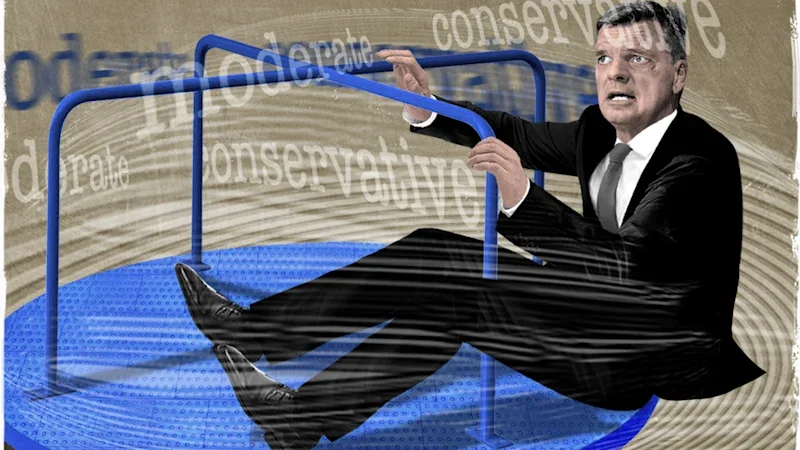
After getting smashed at an election, the conventional expectation is that if you keep plugging away, the supporters will return over time. But what if they don’t? Worse, what if, post-thrashing, even more supporters walk away? This is the situation engulfing the federal Coalition, with One Nation’s post-election rise pushing it into third place. It’s not exaggerating to suggest that the Coalition is in an existential crisis.
Sure, the Coalition parties in their various forms hold office in two states and the Northern Territory and by the end of the year will have also picked up Victoria, making them numerically even with the Labor Party. But at the national level, where most political power resides, the outlook is dire. After switching leaders of both parties within 10 months of the 2025 election defeat, things aren’t looking any better.
The worst thing about getting trounced is that there’s no such thing as a period of respite. Play resumes the next day with a reduced team. Some of the best players are no longer available and those who are left to fly the flag look diminished – either psychologically damaged or refusing to believe things are as bad as they appear.
And if the polls suggest that things are continuing to go the wrong way, as they have, a combination of impatience, panic and “every man for himself” can start to kick in. The first step towards overcoming a bad situation is to acknowledge the extent of the problem and do the work of understanding how the situation came to pass. It’s not altogether clear that every member of the federal Coalition team has taken that step.
Frontbencher Andrew Bragg’s wide-ranging talk at the National Press Club last week was either a wonderful example of the Liberal Party’s dedication to free speech – letting a thousand flowers bloom – or an unnecessary political misstep. Bragg’s description of the compulsory superannuation system introduced by the Hawke government as “one of the biggest public policy failures since federation” was not surprising, given his long campaign against the industry super funds.
But right now, the Coalition needs that sort of talk in a high-profile keynote speech like it needs a hole in the head. Bragg’s speech prompted Pauline Hanson to aver that the super system was broken. That in turn gave Treasurer Jim Chalmers the chance to weld the Coalition and One Nation together on the issue, warning that they would destroy the super system. With a likely effective Labor campaign already forming, Liberal deputy leader Jane Hume had to step in and do some rescue work, declaring that the super guarantee was “here to stay and the treasurer is simply making things up”.
The episode highlighted the confusion and uncertainty that exists within the Liberal Party after its three “lost” terms of office from 2013 to 2019 and its two subsequent election defeats. Chalmers didn’t invent Bragg’s position on compulsory super. Nor is Bragg just some backbencher: he’s the frontbencher in charge of housing policy, a crucial portfolio. Bragg wouldn’t have expounded his highly critical views on the super system unless he felt there was some worth in doing so. That is, if it could eventually have some effect on the Coalition’s stance on the issue.
Just how much genuine internal discussion about its future direction is going on within the Liberal Party? It’s always a difficult path to tread. How much public debate about policy is too much? Observing the Liberals since their fall from office in 2022, it’s been hard to get a consistent sense of the sort of modern Australia they want to make; so much of what they talk about or hint at is about unmaking what already exists.
Even the typology that’s used in the media to describe the philosophical positions of various Liberal MPs is not all that easy to follow. The departed former leader Sussan Ley was often referred to as a moderate, but as leader she oversaw the abandonment of a net zero target for carbon emissions that was adopted as Coalition policy under Scott Morrison. That was not a moderate position. Bragg is also a moderate. As is shadow treasurer Tim Wilson, who is on record as favouring using super balances to buy a home, something that Hanson appears to favour. That was Liberal policy at the last two elections but is now under review.
Surely the biggest challenge for the Liberals now, six months after Angus Taylor was installed as leader, is to stop the drift: to fix itself to a series of forward-looking positions. Since the loss of power in 2022, it’s let itself be pushed around by smaller parties. The Nationals essentially called the shots for the Coalition on championing the No vote for the Indigenous Voice to parliament referendum and on the net zero reversal. Now, the parties seem headed for some difficult conversations about getting immigration numbers down and the impact it will have on backpackers and seasonal workers.
And all the while, they’re both being stalked by One Nation. It’s definitely the case that Hanson and her party are also eating away at Labor’s vote, just not to the same extent. Anthony Albanese doesn’t enjoy personal popularity and the anti-establishment impulse that’s sweeping across the country is destabilising Labor’s hold in many blue-collar communities. The advantage Labor has is incumbency and the ability to create and spend on programs.
If things don’t look up by the end of the year, would the Liberals consider pulling the pin on Taylor and turning to Andrew Hastie? Yesterday, Hastie gave an interview to ABC radio. Under constant attack from One Nation, who want to remove him from his seat of Canning at the next election, he said the only way for the Liberals to recover ground is to stand up to Hanson and not be pushed around by her.
“I think we’ve got to focus on who we are as Liberals, and this is what we’re doing. We’ve got a plan. We’re talking about it,” he said. “It’s lower taxes, cheaper power. It’s cutting migration, building more homes, and then putting Australians first. We’ve got a sovereign wealth fund that we’re going to set up using windfall profits from the resources sector and put that towards nation-building infrastructure.” Concise. Free of self-indulgence. It must be some comfort to the Liberals that they’ve got one more option.
Shaun Carney is a regular columnist, an author and former associate editor of The Age.
The Opinion newsletter is a weekly wrap of views that will challenge, champion and inform your own. Sign up here.
More: