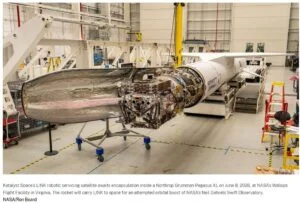
Katalyst Space and NASA concluded today that reboosting the Swift Observatory with Katalyst’s LINK spacecraft will not be possible due to attitude control problems. They still plan to conduct some rendezvous and proximity operations, but not to capture Swift to prevent it from reentering later this year.
NASA Administrator Jared Isaacman said this wasn’t the outcome they hoped for, but doesn’t change why it was worth attempting: “NASA should be willing to move quickly and take smart risks when the potential return is worth it, and that is exactly what we did with this mission.”
Katalyst CEO Ghonhee Lee noted they “designed, developed, and launched an experimental spacecraft to go after an ambitious mission on an aggressive timeline. We took on this high-risk, high-reward challenge and are proud of the milestones we reached along the way.”
NASA gave Katalyst a $30 million contract just 11 months ago to try and rescue Swift when increased solar activity caused the orbit to lower more quickly than expected. Katalyst was already working on an in-space demonstration of its rendezvous, proximity operations, and docking technology prior to a planned 2027 launch of its NEXUS robotic spacecraft. After NASA “raised the alarm” about Swift, the company said they “seized the opportunity to pivot to a live rescue operation which would demonstrate similar capabilities.”
LINK launched from a Pegasus XL rocket after lifting off from Kwajalein Island in the Pacific on July 3, 2026 aboard Northrop Grumman’s Stargazer L-1011 aircraft.
On July 28, Katalyst said LINK had been in a multi-axis spin for 72 hours. Over the next 48 hours, they reduced the spin rate from 9 degrees per second to approximately 4 degrees per second and on August 5 had it down to 1.47 degrees per second. They sent a software update on August 11 with new attitude controllers, but today concluded that the reboost isn’t possible.
Launched in 2004 to study gamma ray bursts, the Neil Gehrels Swift Observatory was not designed to be reboosted and doesn’t have grappling fixtures. The plan was for LINK to maneuver close to Swift and find “capture locations” where at least one of its three “grippers” could attach. Then LINK’s thrusters would boost the spacecraft back to its original 600 kilometer orbit over two to three months.
Without the reboost, Swift is expected to reenter the atmosphere later this year.
Named in honor of Neil Gehrels, the observatory’s Principal Investigator, after he passed away in 2017, Swift looks at the universe in the visible, ultraviolet, X-ray, and gamma-ray bands. The name Swift refers to its ability to quickly repoint itself when a gamma ray burst is detected so the other instruments can study it in the other bands.
NASA Astrophysics Division Director Shawn Domagal-Goldman said: “We were all hoping for more science from Swift. But we knew the takeaways from this mission would be worthwhile either way, and we have gained so much through the series of accomplishments up to this point.”