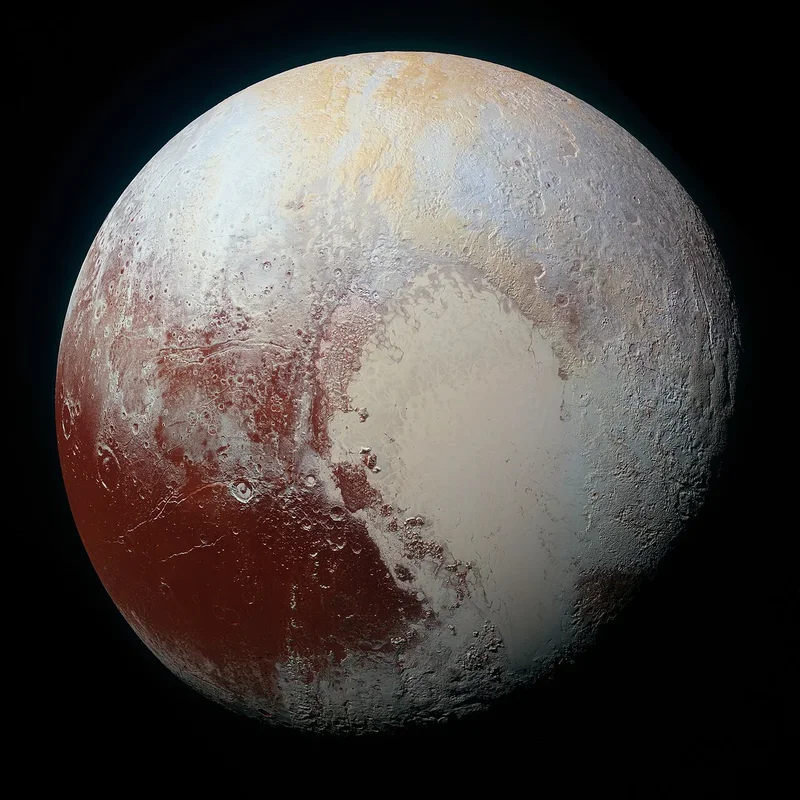
Something's wetting the surface of dwarf planet Pluto along the northern edge of Sputnik Planitia, and planetary scientists may have found a good explanation for it. A recent study of New Horizons images taken during the 2015 flyby reveal evidence that liquid nitrogen is rising up through cracks in Sputnik Planitia's glaciers. That's the giant heart-shaped basin we see in all the New Horizons images. This is unusual, given that the surface temperatures at Pluto never get warmer than about -229 C and the melting point of nitrogen is -209.9 C. So, something is happening to melt nitrogen and bring it to the surface, and scientists want to know what it is and why.
A team led by New Horizons principal investigator and Southwest Research Institute vice president Alan Stern has just published a paper outlining what they found when they analyzed New Horizons imagery and compared Pluto images to Landsat images of regions on Earth that also seem to be flooded by something rising up from below. That's when they spotted some distinct similarities that suggest something interesting is happening on Pluto.
âPluto never stops surprising us,â Stern said, âand this new result certainly does that. In addition to suggesting that liquids have recently expressed themselves on Plutoâs surface, it also suggests a new kind of time-variable feature on Pluto.â
Finding Pluto Upwelling Analogs on Earth
Sputnik Planitia looks smooth from a distance, but it's actually filled with irregular polygons and troughs. This mottled landscape looks like a series of frozen convection cells formed in the nitrogen ice surface. The cells seem to be outlined by thin, dark lines that sometimes appear to be more "wet", likely from outflows of liquid nitrogen. It's coming from below because Pluto's atmospheric conditions don't allow for nitrogen rain to fall from the sky.
The vast nitrogen ice plains of Plutoâs Sputnik Planitia. Image Credit: NASA/JHUAPL/SwRI
The surface patterns in the northern region look very similar to glaciers on Earth that have experienced water rain or water flowing to the surface from beneath the ice. The source of the upwelling nitrogen on Pluto could be from melt going on at the base of the ice sheet. Or, there could be some kind of liquid nitrogen supply hidden deep beneath the surface. Something is producing enough heat to melt the nitrogen (or keep a nitrogen lake liquid).
The resemblance of the northern Sputnik Planitia region to familiar glacial sites here on Earth was good enough that it led the team to look for terrestrial examples of similar-looking terrains. For example, basins in Antarctica and Greenland have shown evidence of meltwater flowing up from below. There, dark narrow surface features have been identified in areas where liquid water occurs on the ice and snow, gathering into ponds and flow channels. The heat to melt the ice in those two regions is likely from geothermal activity (in the case of Greenland) or glacial pressure.
Meltwater channels and ponds on the Greenland ice sheet (Landsat 9 image provided by J. M. Miller, CERES, University of Colorado).
Understanding the Action at Sputnik Planitia
Long before New Horizons arrived to sweep past Pluto, scientists had noticed that the Sputnik Planitia was one of the brighter terrains on the planet. That implied some process that "recoats" the surface. The rise of liquid nitrogen is the most likely culprit, since it rises very easily through the solid nitrogen ice. In some sense, it's a good analog of volcanism, but with ice instead of lava.
Something has to be warming and melting the nitrogen beneath the surface in order for this cryovolcanism to occur. That mechanism isn't well understood, yet. But, it's clear from the SwRI study that something is causing liquid nitrogen to melt and flow upward through small cracks in the ice. It's very likely that the source of nitrogen melt is pressure-induced heating by the kilometers-deep glaciers at Sputnik Planitia. If there's any heating from Pluto's core (possibly from radiogenic decay or other thermal processes), that could also be contributing to the nitrogen ice melt. Once it gets to the surface it ponds and ultimately flows across the landscape, producing the darker features found in the glacial plain. It's interesting that other regions on Pluto don't show this activity. However, the whole planet hasn't been mapped, so it could be occurring elsewhere out of sight.
The evidence from the images suggests that the region is fairly young, compared to other places on Pluto, according to SwRI scientist Kelsi Singer. âThe surface of Sputnik Planitia is quite young, probably less than one million years based on modeling of the surface overturn, and thus these features that we are looking at must have formed since then,â said Singer. âPluto has many unique terrains seen nowhere else in the solar system, and this area of Sputnik Planitia is one of them. Its surface provides a different set of conditions compared to what we are used to on Earth, and exploring that allows us to better understand how materials behave in environments that are difficult to produce on Earth.â
A tour of the convected areas of Pluto's Sputnik Planitia (SP). The northern and eastern portions of Sputnik Planitia; north is to the top. Upper left panel: panchromatic image of SP; arrows point to representative convection cells on the surface. Upper right panel: color image of SP; the direction of north is shown, along with a scale bar in each of these panels. Lower left panel: geological map; the red rectangle box here indicates the region where the upper panels lie. Lower right panel: inset taken from the red boxed area in the upper left panel showing convection cells and callouts for a typical diffuse dark apron (DDA) and a typical dark, narrow feature (DNF). Credit: Stern et al. 2026
Implications for Other Frozen Worlds
The melting, flowing, and refreezing of liquid nitrogen on Pluto's surface has analogs in other places in the outer Solar System, particularly on Neptune's moon Triton. Recall that Triton sports nitrogen geysers across parts of its surface, and similar processes could be at work beneath its icy surface.
Neptune's largest Moon, Triton, shows similar nitrogen ice activity through its surface markings and nitrogen glaciers. Credit: NASA/JPL
More mapping missions are needed to define all the surface units existing on the icy worlds of the Solar System. Given the temperatures and pressures on these places it's worth exploring the behaviors of ices other than water in such cold environments, according to computer modeler Orkan Umurhan of the SETI Institute, who created models that confirmed that nitrogen ice could be melting at the base of Pluto's glaciers.
âI think the great significance of these findings, and the tantalizing picture that it promotes, is a great motivation and reason to further examine solid-state nitrogen physics at very low temperatures,â Umurhan said. âSpecifically, itâs important to examine the physics taking place in solid nitrogen materials under stress and strain, which can cause them to melt. These processes have never been studied in real detail in the laboratory.â
The team has published a paper describing its findings at Pluto in great detail (cited below). Based on their continued study of Pluto's surface units, they suggest that Triton and dwarf planet Eris may well provide further clues to understand the behavior of ice on these frigid worlds.