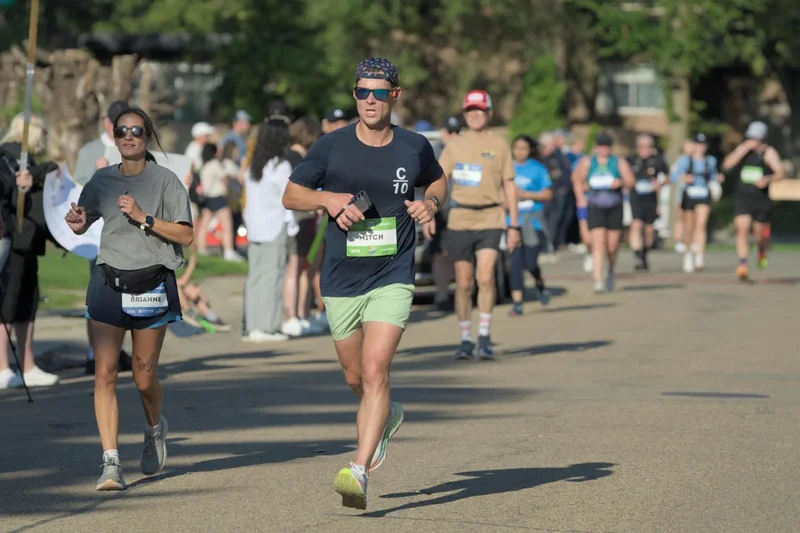
Mitch Walz felt it in his bones – and his pounding heart, depleted mind and battered legs – when he walked away from the finish line on Sunday at the Edmonton Marathon.
Something was off. He had run his race with precision, meeting the kilometre-by-kilometre plan he knew by memory, except for the start where he said he “came out like a bat out of hell.”
To him, there was only one explanation for how he missed his sub-three-hour marathon goal by three minutes and eight seconds: The course wasn’t properly measured.
Mr. Walz, 42, was among the scores of runners who left the Edmonton Marathon wondering if they had run too long.
It turns out they were right.
On Tuesday night, Edmonton Marathon race director Tom Keogh said in a statement that the half marathon and marathon courses were longer than the organizers thought, accidentally adding an extra 647.7 metres to both races.
The day before, Mr. Keogh and Athletics Canada, the governing body for the sport, had rebuffed racers contesting the course measurements, leading a handful of competitors to threaten to remeasure it themselves.
“The Edmonton Marathon’s previous statement detailing confidence in the course certification process was issued with the best information it had at the time,” Mr. Keogh wrote on Tuesday.
The error, he wrote, happened at a detour on this year’s route that was partially, but not fully, offset by changes to the turnaround point for the course.
“The event owns this error, and we take full responsibility,” Mr. Keogh wrote.
Athletics Canada did not comment on the issue on Wednesday.
The error had sparked a furor among recreational and professional runners. For many amateurs, the race – a rare mid-August marathon – was their last shot at qualifying for the Boston Marathon, for which runners often have to slip under the time standard by several minutes to nab a spot in the historic race, owing to its popularity.
Professional racers said the 647-metre mistake added between 90 seconds and two minutes to their final time, and amateurs may have gained in excess of three to four minutes.
The Boston Athletic Association, the organization overseeing the Boston Marathon, said in a statement to The Globe and Mail that it can’t accept adjusted results if the race distance was more or less than 42.2 kilometres, the standard marathon distance.
The mistake also cast a cloud over the half marathon, the national championship race, which brought out swaths of Canada’s fastest all-time distance runners.
Jadyn Keeler, 23, won the women’s half marathon in one hour, 12 minutes and 12 seconds – her debut in the distance. On a regulation-length course, Ms. Keeler would have likely been in spitting distance of Andrea Seccafien’s national record of one hour, nine minutes and 38 seconds.
“I was definitely within that ballpark of being close to it, at least, and I was for sure at least under 70 minutes,” said Ms. Keller, whose time was more than two minutes over that mark.
The runner, a native of Barrie, Ont., said she eased up when she realized in the final kilometre that the course was likely long.
“I was definitely bummed about that whole situation. But at the same time, I do also realize that it was a mistake,” she said.
The men’s winner, Rory Linkletter – the first Canadian man to run a half marathon in less than an hour – figured just past the halfway point that there was an error.
Mr. Linkletter said he built a hefty lead over the top men in the competition between the ninth and 16th km, where GPS data showed him reaching a pace well below three minutes a kilometre.
And yet, the official race time showed Mr. Linkletter slowing down around what was believed to be the 15-km mark.
“Common sense prevails, right? I know I’m not running that slow. Like, I just know,” he said.
Mr. Linkletter said he “disengaged,” knowing he likely had the national championship locked down.
The distance mishap also scuppered some athletes’ goals of pulling into the top-five national rankings that would qualify them for September’s World Athletics Road Running Championships. Men can only qualify if they run faster than one hour, three minutes and 49 seconds. None, including Mr. Linkletter, hit the mark, though many of those top men have run the qualifying time in races earlier this year.
“It basically made the race useless,” he said.
The Calgary-born runner said he was preparing to have locals remeasure the course before officials conceded the error.
In the aftermath of the furor, many runners have offered forgiveness to marathon organizers – but are frustrated the race didn’t acknowledge the flub sooner. Some, like Mr. Walz, are still feeling the sting.
“I was convinced I ran the perfect race, but that time wasn’t there, and it was dejecting and, I don’t know – morale crushing,” he said.
“It was just such an odd feeling.”