Soon after I landed in the federal press gallery in 1989 as a wet-behind-the-ears political correspondent, a call came from the prime minister’s office.
“Hawkie would like to see you,” said a voice.
I grabbed a notebook and in a lather of anticipation, hurried down labyrinthine corridors of the giant new Parliament House.
Was the prime minister of Australia about to deliver me a scoop?
Bob Hawke sat enthroned in a vast office, its walls panelled in the rich wood of a single Huon pine rescued from a flooded Tasmanian valley. He was smoking a fat cigar.
“You won’t need the notebook,” he said.
He simply wanted to welcome me to the political world.
I could, said Hawke, wreathed in smoke, give his office a call any time I might need a useful steer on a story.
It took me days to figure out the canny prime minister’s generosity also included using his famed charisma to try to harness the loyalty of a new press gallery scribbler in town, just in case.
Somebody was always trying to own you around Parliament House.
Still, if politicians hoped to manipulate reporters a bit, the nation’s media tycoons weren’t above hard-edged persuasion, either.
Not far from Parliament House, a mansion sat behind a hedge on the best street in town. It was owned by Kerry Packer’s media empire for use when Packer felt the need to invite a prime minister in for tea and a spot of arm-twisting regarding media legislation.
In a quiet terrace nearby, Rupert Murdoch had a house for the same purpose. One night reporters ambushed Paul Keating as he was driven to what was supposed to be a clandestine meeting with Murdoch. Keating, who wasn’t keen to be seen doing anyone’s bidding, was furious.
The Fairfaxes once had a mansion in the same suburb, too. Prime minister Robert Menzies was said to be a frequent visitor back in the 1960s.
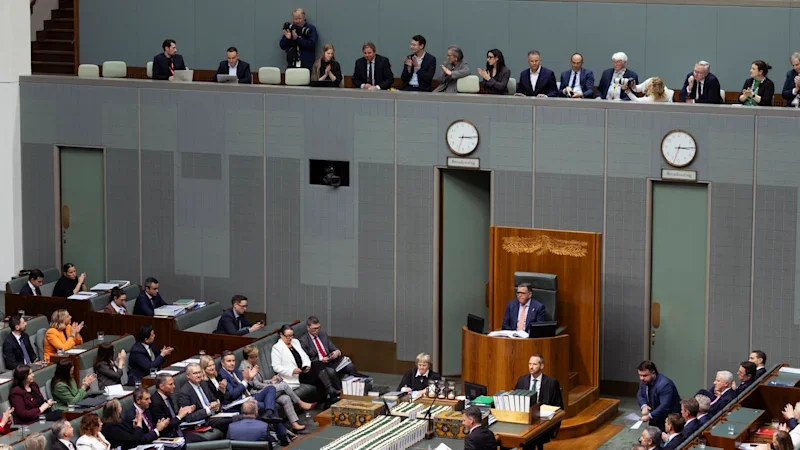
I thought about this ancient history as I wandered the press gallery this week, memories lurking in every corner. Old-time media tycoonery, except for Murdoch’s, has shrunk with the rise of the internet, but there are variations on a theme. As I wandered, the current Prime Minister, Anthony Albanese, was in parliament taking on the new breed of tech billionaires intent on stealing journalists’ work.
Of the 250 or so members of today’s gallery, I could count on the fingers of one hand those who were there in 1989, though Michelle Grattan arrived long before all of us.
The Age sent her to Canberra in 1971 when Billy McMahon was prime minister, and she still occupies a press gallery nook, writing for The Conversation, her words as wise as ever, her accuracy unquestioned.
No politician of today, however, was in parliament in 1989. The inimitable north Queenslander, Bob Katter, currently the longest-serving MP, was elected to the federal parliament in 1993. Prime Minister Anthony Albanese arrived in 1996. He was a bit of a young tearaway, a trait that still occasionally peeks through his prime ministerial caution, with recently unfortunate results.
Some things never change.
More than three decades ago, the Coalition thundered against Paul Keating’s plan to introduce compulsory superannuation. It would destroy business, cried Liberal leader John Hewson in 1992, before Keating destroyed Hewson’s political ambitions.
Now, superannuation is the battle once again. Liberal frontbencher Andrew Bragg likened it to communism a few days ago. Pauline Hanson claimed the super system was broken. Treasurer Jim Chalmers merrily forecast superannuation would be Labor’s chosen ground for the next election.
Hanson, who came to parliament in 1996 and achieved not much but noise in most of the years since, has famously rocketed to consequence lately as her One Nation fills the conservative vacuum left by the implosion of the Liberals’ and Nationals’ coalition.
She had a sore throat and couldn’t talk to reporters early this week. Some scribes unkindly called it a small mercy.
I witnessed Hanson’s first coming to parliament, her inflammatory first speech (“we are in danger of being swamped by Asians”) and the roiling scene that night, September 10, 1996, at a bar known as La Grange not far from Parliament House.
Journalists, politicians, staffers and revellers regularly let down their hair en masse at La Grange. When Hanson turned up, a group of well-oiled young Liberal staffers began heckling her.
A fellow named David Oldfield, who worked as an adviser to Tony Abbott at the time, stepped in to defend Hanson.
She took him off to her room at what was then the Sundowner Motel, built on the site of an old drive-in theatre. According to Hanson, she also took Oldfield into her bed. Oldfield has denied this. Whatever, One Nation was the result, with Hanson and Oldfield as co-founders.
The press gallery has always been a slightly peculiar, high-pressure place, its journalists reporting daily on personalities and decisions that change the way the nation and its citizens live and how our country interacts with the rest of the world.
Parliament House consumed a lot of us. In the years before the internet upended our old craft, many of us worked to midnight gathering and writing stories.
I was fortunate enough to have a life outside. My wife established restaurants – The Lobby and later Water’s Edge – which were popular with politicians and journalists, among others. I could have my expense account and eat it too, colleagues half-joked.
We watched prime ministers and leaders of oppositions come and go, and recorded the turmoil and bitter recriminations that often enough accompanied their triumphs and downfalls.
I saw hard Labor men spilling tears in the corridor after Hawke was toppled by Keating just before Christmas in 1991.
Hawke continued living at the Lodge for a couple of weeks after his downfall and held a final New Year’s Eve party there before vacating it for Keating.
Somehow, I found myself invited. It was a maudlin affair distinguished by Hawke’s growing rage at his fate.
He stood in a marquee in the garden, rain falling, and announced there was plenty of good champagne in the Lodge’s cellar. He urged his guests to drink it all, leaving none for Keating. They finally reconciled before Hawke died in 2019.
The press gallery was my base for 30 years, and I retained my membership after I shifted out of the capital and moved south a few years ago.
This week I began preparing to hand in my membership for good.
I was farewelling a fair slice of my life.
There was too much of it to record here.
There were the Hawke-Keating years of massive economic reform, opening Australia to the world. There followed John Howard’s decade of persuading middle Australia to feel “relaxed and comfortable” about its identity while sending asylum seekers off to purgatory.
After Howard came fractured years for both Labor and Liberals as they jettisoned leaders and struggled to find air and purpose: Rudd, Gillard, Rudd, Abbott, Turnbull, Morrison …
How did we draw breath?
My years advanced now, I reach back to the beginning for my memories.
Truth is, I had no desire to go to Parliament House in the first place. An editor simply told me I was the new chief political correspondent of The Canberra Times. Later I shifted to The Sydney Morning Herald, The Bulletin and The Age.
Politics? Boring, I declared.
Why, just the previous year, 1988, a photographer and I had spent a month driving around Australia. I had travelled to the Soviet Union to report on the rise of dissident voices in the restive Baltic states – Estonia, Latvia and Lithuania – calling for what seemed the impossible at the time: independence.
How could domestic Australian politics compete?
Quite well, it emerged.
A few months into my new job, I was assigned to fly to Kuala Lumpur to attend something called a Commonwealth Heads of Government Meeting (CHOGM).
It involved climbing aboard Hawke’s old VIP Boeing 707 and rocking through the skies in the company of the nation’s best-known political journalists, Hawke up front doing cryptic crosswords.
We lived high in the sky. Meals were served on white napery with real silverware, a fresh rose on every place setting. The wine, glory be, was Grange.
There would have been hell to pay if the taxpaying public found out, I imagined, even though our media organisations paid through the nose for the privilege of putting us aboard the PM’s plane.
Such extravagance, anyway, did not survive Howard’s prime ministership.
He installed a hard head known as “Max the Axe” Moore-Wilton as head of the Department of Prime Minister and Cabinet. Max downsized the PM’s VIP plane to a jet too small to accommodate journalists.
In Kuala Lumpur, it turned out, there was no shortage of stories.
Australia was backing Malcolm Fraser’s bid to become secretary-general of the Commonwealth. He was beaten by a Nigerian diplomat, Chief Emeka Anyaoku, who swept around a glittering reception for Queen Elizabeth II in the gorgeous traditional robes of his people.
Meanwhile, British PM Margaret Thatcher went into furious combat with other leaders, including Hawke. Thatcher was unmoved by the other 48 Commonwealth heads of government who wanted sanctions applied to South Africa’s apartheid regime. I found myself entertained beyond measure when she tossed her head and declared: “If it’s one against the 48, I’m sorry for the 48.”
This press gallery gig was a hoot, I decided.
I never changed my mind as the years, and then the decades, rolled by.
I’ll miss it. What a privileged ride it’s been.