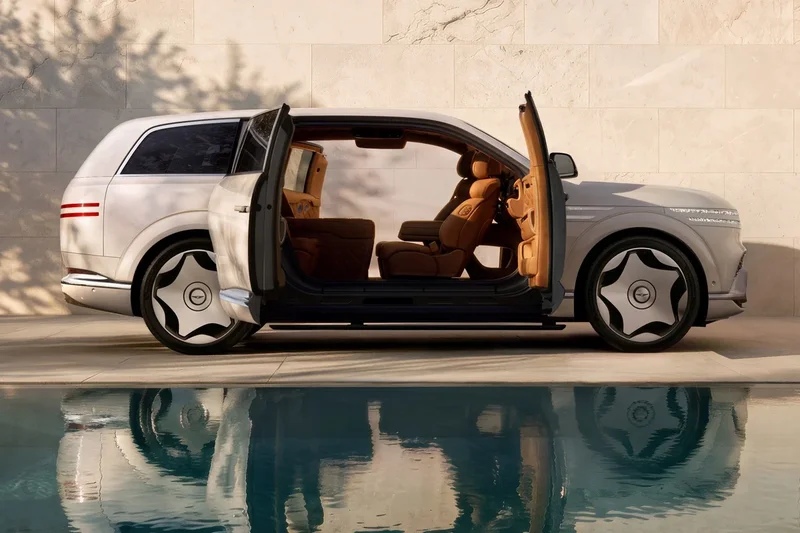
The new Genesis GV90 has finally been revealed, and the Korean firm’s all-electric flagship is heading straight for the top end of the luxury SUV market with huge dimensions, up to seven seats and, in its fanciest form, a spectacular set of pillarless coach doors.
It’s Genesis’s biggest and most ambitious car yet. British prices have not been announced, but expect a six-figure starting point when the first cars arrive here in spring 2027. That puts the GV90 into Range Rover territory, with the Mercedes EQS SUV, BMW iX and Volvo EX90 also among the obvious electric alternatives.
I was among a handful of people invited to see the finished car and climb inside at its lavish global unveiling at the Palace of Fine Arts in San Francisco. Having experienced it first-hand, my impression is that this is the car that will finally put Genesis firmly on the premium car map.
It’s an incredibly impressive expression of Korean luxury, offering something credible and genuinely different from the usual premium-car formula. In its scale, finish and sense of occasion, it reaches beyond the familiar Mercedes, Audi and BMW set and towards the territory now occupied by Range Rover.
At its heart is what Genesis calls its “Son-nim” philosophy, a Korean idea of treating every customer as an honoured guest. That explains why so much of the GV90 is built around the arrival experience and the people in the back, rather than simply giving the driver another enormous screen and adding more leather.
There are two versions: the regular GV90 has conventional doors and can be had with seven seats. The grander GV90 Neolun gets what Genesis calls its Neolun Arch Gate: front doors that open normally, rear-hinged back doors in the style made famous by Rolls-Royce, and no fixed pillar between them.
That turns almost the whole side of the cabin into one enormous opening. It sounds like a concert car party trick – and it was previewed in the Genesis Neolun concept of 2024 – yet this is a production car you’ll be able to buy, assuming you can afford the £100,000-plus price tag.
The rear doors first slide slightly outwards and then rotate open. They can open and close independently of the front doors, and the lack of a centre pillar creates a wide, clear route into the cabin. The powered front seats can even turn through 180 degrees while the car is parked, creating a lounge where front and rear passengers face one another.
Of course, taking a big structural pillar out of the middle of a large and powerful SUV poses some obvious questions. Genesis says two high-strength steel beams are built into the doors in its place. The doors lock into the body, while the passenger compartment has a concealed roll cage with a frame said to be 1.5 times thicker than in conventional vehicles, plus high-strength steel tubes and structural foam.
The company claims the result provides crash protection equivalent to a vehicle with a normal fixed pillar. That claim will ultimately be one for independent safety testers to examine, but the engineering hidden behind those show-stopping doors sounds every bit as important as the way they look.
The safety push continues with 12 airbags, including what Genesis claims is the world’s first roof airbag. In a serious rollover it spreads beneath the panoramic glass roof, with the aim of keeping passengers inside the car and reducing the chance of them hitting the glass. Other airbags are built into the seat cushions, while cameras monitor how people are sitting so the airbags and seatbelts can react in the optimum way.
The front passenger airbag can deploy to different depths depending on how that person is sitting, the curtain airbags extend as far as the third row and the side airbags in the first two rows have been enlarged. The in-cabin monitoring system also checks for incorrectly fastened seatbelts and unsafe seating positions.
The battery gets extra protection, too. Strong steel is used around the sides of the body, while a structure ahead of the battery is designed to guide major parts underneath it in a frontal crash. There is also a system intended to stop heat spreading from one battery cell to the next, backed by cloud-based monitoring that looks for possible faults before they become a problem.
Genesis says it has increased strength without piling on unnecessary weight by using aluminium extensively beneath the car and for many of the exterior panels. A special structure at the front is designed to guide the car sideways in a crash where only a small part of its nose takes the impact, reducing the load around the windscreen and passenger compartment.
The GV90 is a very big car – longer even than a Range Rover and just a bit shorter than a Rolls-Royce Cullinan. The Genesis measures 5,285mm long, 2,030mm wide and either 1,815mm or 1,825mm tall, depending on the wheels. Its wheelbase stretches to 3,245mm, helping to create a flat-floored cabin with plenty of room between the axles. It has real presence, but Genesis has resisted covering it in bodywork slashes, scoops and fake vents.
Instead, the shape is inspired by the Korean moon jar, a simple piece of traditional white porcelain. The clamshell bonnet sits above the brand’s slim and miraculously flush two-line lights, the sides are smooth and the rear does without a spoiler. Even the taillights sit flush with the bodywork. There are 16 exterior colours, ranging from restrained white, silver and grey to more vibrant Jaipur Rose, Vela Burgundy and Baena Green.
“GV90 is the embodiment of the Ultimate Majestic Presence, Genesis’ belief that true luxury is revealed not through addition, but through reduction, until only the essential remains,” said Luc Donckerwolke, president and chief creative officer of Hyundai Motor Group.
Underneath all that luxury is a new electric platform called eMP, developed specially for Genesis flagships. A 123.5kWh battery, the largest yet fitted to a Hyundai Group electric car, feeds one motor at the front and another at the rear. Together they produce 657bhp and 800Nm of torque, although Genesis has not yet revealed a 0-62mph time.
The seven-seat GV90 is expected to cover about 311 miles on a charge, but that figure comes from Genesis’s own development tests rather than the official European test process – a final UK range figure could therefore be different. However, we can confirm that – connected to a 350kW rapid charger – Genesis says the battery can charge from 10 to 80 per cent in 22 minutes.
There is plenty of clever hardware designed to make something this large feel manageable. Systems at the front and rear can send power to whichever wheels can use it best, while air suspension can alter the ride’s firmness and the car’s height. The rear wheels can turn by up to five degrees, tightening the turning circle at low speed and adding stability when travelling faster. And large front brake callipers and high-capacity discs are fitted to rein in the GV90’s performance, although Genesis has not yet revealed the car’s weight.
Genesis has also gone to town on keeping the cabin quiet. Every window, including the windscreen, glass roof and tailgate, uses acoustic glass more than 5mm thick. Sound-deadening material is injected into parts of the body, with further insulation around the bonnet and boot.
The regular GV90 offers a more family-friendly layout, while the four-seat Neolun Executive Suite is aimed squarely at owners who expect someone else to do the driving. It has two large rear chairs, a tall centre console, a fridge and fold-out tables. A partition separates the passenger area from the boot, powered blinds provide privacy and the glass roof can change from clear to cloudy in six separate zones.
The rest of the cabin avoids the usual one-look-fits-all approach. Buyers can choose natural wood, genuine stone or wool cashmere trim, with five colour combinations for the standard GV90 and another five for the Neolun. A recessed section running across the dashboard and doors allows different materials to be layered, while the seats, displays and centre console have been arranged to look more like furniture in a lounge than a car interior.
There is real wood on the floor, complete with radiant underfloor heating inspired by Korea’s traditional ondol system. More heating is built into the armrests, side panels and door trims, while a special windscreen warms the glass itself to clear frost and mist. Each leather seat contains 15 air cells and a pulse function for a more natural-feeling massage.
Then there’s the dashboard theatre: there’s no starter button, just pull a door handle and the car wakes up, then closes the door automatically. Once inside, the column-mounted gear selector turns into position, the trademark Genesis crystal sphere rotates to reveal a controller and the covers over the dashboard tweeters slide apart. All you have to do then is press the brake and the car is ready to go.
The wide OLED screen rises by 90mm when the car is parked, increasing its display area by about 70 per cent for watching films and other content. A large head-up display replaces a separate instrument panel in front of the driver, while the Android-based Pleos Connect system can download apps. An in-car generative AI assistant called Gleo AI is designed to understand natural spoken requests.
Ambient lighting runs from the dashboard into the doors and appears in the roof and console. It is not only decorative: the lighting responds when someone gets in, changes brightness while the voice assistant is listening and can use different patterns to communicate what the car is doing.
The 25-speaker Bang & Olufsen sound system includes Dolby Atmos. Its Virtual Venue setting can mimic the sound of real-world locations, including Boston Symphony Hall and Wembley Stadium – although I’ve never been to Wembley and come away impressed by the sound quality!
Parking software can move the car into or out of a space, while a memory function records the route into a narrow spot or down a country lane, then can retrace the route in reverse – given the car’s size and narrow UK roads, that could be useful.
At the very top of the flagship range sits the four-seat GV90 Neolun First Edition. It brings two-tone paint, body-coloured forged wheels, wool cashmere trim and special logos on the crystal controller, headrests and door openings. Genesis has not said how many will be made or what it will cost, but this will plainly be the version pitched furthest into traditional chauffeur-driven luxury territory.
The GV90 arrives as Genesis begins its second decade. The brand says it became the fastest luxury car maker to reach one million sales, passing that mark in less than eight years. This flagship is meant to turn that early growth into a more established place among the world’s luxury names, especially in the UK where the brand initially struggled with its direct sales approach. The use of traditional dealers, though, is already changing that.
And then there is Marilyn Monroe. Yes, really. Monroe was born in 1926, and Genesis is using the centenary of her birth to draw a link between two names that, in the company’s view, challenged convention and set out to define themselves on their own terms. It is an unusual association for a car launch, but it forms part of Genesis’s attempt to present the GV90 as a cultural statement as well as a new model.
The company opened an exhibition called Manifesting Marilyn at Genesis House New York in June, exploring less familiar parts of Monroe’s story. It is also supporting Flesh Impact, a short film directed by Maggie Gyllenhaal that is due to make its debut at the 2026 Venice International Film Festival. Genesis says Monroe’s ambition and willingness to break with convention echo its own aim of building a global Korean luxury brand. The less said about her demise, the better.
There are still important blanks to fill before British sales begin, including confirmed prices, final UK equipment, efficiency and an official range. Yet after seeing it in San Francisco, there is no doubting the scale of Genesis’s ambition.
The GV90 is not trying to be a cheaper copy of the premium establishment. It is using Korean design, hospitality and some seriously bold engineering to give luxury SUV buyers a very different choice.