Rema, an adoptive parent to a two-and-a-half-year-old girl, is deeply aware of the impact of childhood experiences and parenting style on the development of children. “I keep reading about things and am in touch with other adoptive parents,” she says.
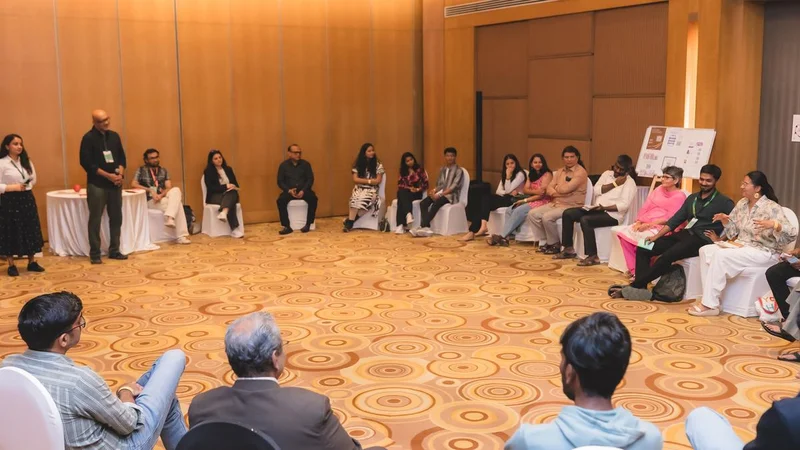
This is perhaps why Rema found a recent sharing circle held in Bengaluru, titled The Adoption Conversation: When do you begin? How do you continue?, interesting. “I wanted to hear how other people are tackling the same situation.”
Having a platform like this, where everyone is on the same page, made it easier for her to walk in and share her thoughts, without judgement, explains Rema, who prefers to go by only her first name. “Every parent’s story is different, so having a space to share was beautiful.”
These sharing circles are part of a series organised as precursors to Manotsava 2026, an annual mental health festival co-hosted by Rohini Nilekani Philanthropies (RNP), NIMHANS and the National Centre for Biological Sciences (NCBS).
In addition to adoption, this series will also include conversations about family expectations, finding support systems, reflecting on midlife, negotiating difficult family dynamics, and supporting caregiving, among others, in a safe, accepting space.
“I’ve always felt it to be powerful when you are able to speak your mind to someone and say what’s on your mind without being judged or having someone jump in and try to help you,” says Lakshmi Pattabi Raman, one of the sharing circle’s facilitators and an adoptive parent herself. This is especially true, Lakshmi believes, when the other people in the room already get it.
“It is cathartic to speak with other people who share the same experiences, not with the intent of solving things, but because hearing it out sometimes lightens it. And there is also the sense of finding community, knowing that you are not alone and that there are people holding similar questions that puzzle, trouble, or stress them out,” Lakshmi says.
The idea for these circles emerged at the previous edition of Manotsava, according to Natasha Joshi, Chief of Strategy at RNP and the festival’s programme curator. “The idea was to essentially marry neuroscience and clinical expertise with lived experience and put together a credible format for discourse on mental health,” Natasha says of the festival, which is co-curated every year through an open call for proposals. However, some of the proposals they received covered pertinent topics, but did not necessarily have a clinical angle or neuroscience lens, points out Natasha.
So they decided to ask the people who suggested these topics whether, instead of speaking about them on stage in a talk format, they could hold space and do it as a much more intimate sharing circle, led by lived experience, Natasha says.
“It was a risk, in the sense that we didn’t know whether there would be a demand for it and how it would actually play out in the festival. But we discovered it was superbly well-received,” says Natasha, recalling how they ended up having to turn hundreds of people away since every sharing circle was running at maximum capacity, with 50 to 80 participants.
“We had this whole experience of not just realising that the demand is greater than the supply, but that absorption capacity for this kind of thing is greater than what one imagines.”
This positive reaction to the sharing circles led the team to take it beyond the confines of the festival. “We got feedback from not just the participants, but also the facilitators, who had people reaching out to them even after, saying that they didn’t know such a space existed and that they wanted more of it,” says Yashasvi Murali, Portfolio Manager, Mental Health and Gender, RNP, who has played a crucial role in putting together these sharing circles.
Given that the facilitators, too, saw a lot of “value and potential, and given that they were willing to give their time to do more of something like this, we built on this,” Yashasvi says.
The Manotsava team began by reaching out to many of these facilitators, taking their feedback to understand what worked and what did not before getting into programming, explains Yashasvi.
“One of the constraints at the festival is that there is only so much time and so many circles we can have. That is when we started thinking of having it pre-festival, expanding the window right from August with three months to follow,” Yashasvi says.
They also worked with facilitators to better understand how to bring diversity into these circles, not just in terms of themes and languages, but also trying to address the concerns and interests of people across age groups which move beyond mental distress or illness to experiences that are common but difficult to talk about. “It is an entire spectrum, and we tried to cater to different kinds of conversations about things people may experience and want to have.”
The sharing circles, which kicked off on August 1 and will run until October 31 at various locations in the city, are led by both people with lived experience of the issue and trained mental health professionals.
“We have around 19 circles this time in Bengaluru, and about half of them are entirely lived-experience-led, while the other half is being facilitated by a therapist or professional in some trained capacity,” says Yashasvi, pointing out that who leads a circle depends on the topic being addressed at the circle.
Irrespective of who is facilitating the session, there will be a clinician in the room, on standby for support, in case someone needs help, Yashasvi further adds. “While we may be looking at broader questions and themes, for a lot of people, it is the first time they’ve opened up, and this really unlocks emotions they haven’t tapped into in the past. In some cases, having this support is good.”
The larger goal of the initiative, in Natasha’s opinion, is to break through the loneliness and isolation of modern society. “Not to jump the gun, but my hunch is that there is no other place that these participants have found where these conversations are happening like that,” she says. With the resounding response to the sharing circles initiative, the founders now hope to further expand the initiative, both within the city and beyond. “We would love for sharing circles to serve as an example of self-organising spaces that every community can build” says Natasha.
To know more, log into nationalmentalhealthfestival.com/sharing-circles
Published - August 20, 2026 08:33 am IST