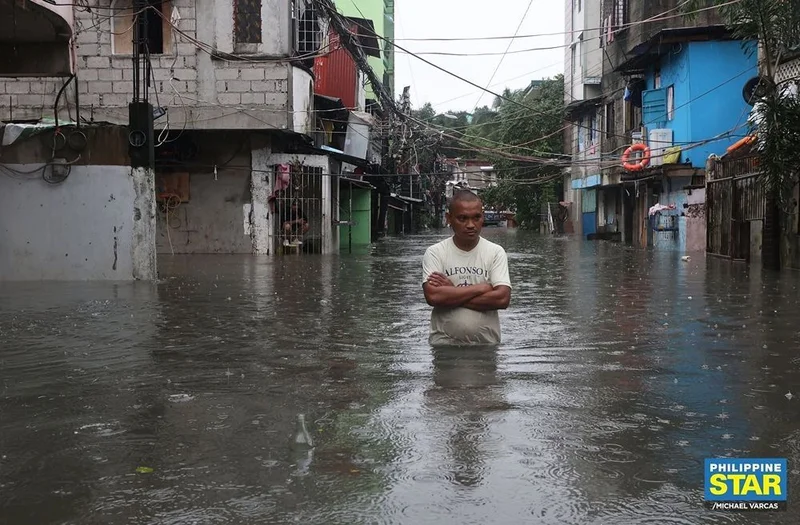
Marcos: Gov’t eyes 30 sites for underground cisterns to curb flooding
MANILA, Philippines — The government is planning to build underground cisterns at 30 sites in Metro Manila as part of its efforts to establish long-term solutions to flooding, President Ferdinand Marcos Jr. said on Wednesday evening, August 19.
Marcos announced the plan in a press statement at the Metropolitan Manila Development Authority (MMDA) command center in Pasig after conducting a situation briefing with concerned government agencies about the impact of weeks-long southwest monsoon rains, or habagat.
He said the effects of the habagat rains were “severe and widespread,” so the government has tapped the help of experts from the Netherlands to determine potential solutions, such as establishing underground cisterns to store floodwaters beneath existing facilities.
“Maghuhukay tayo sa ilalim ng mga existing facilities. Halimbawa, ‘yung mga football fields, ‘yung mga open fields, kahit na may building puwede namang hukayin ‘yun,” Marcos said. (We will dig under existing facilities. For example, football fields, open fields, and we can dig even under buildings.)
Some of the identified areas are Rajah Sulayman, Rizal Memorial, Camp Aguinaldo and the University of Santo Tomas.
“Within this month, matatapos na ‘yung detailed engineering. ‘Pag natapos na ‘yung detailed engineering, titingnan namin, ipa-prioritize na namin, sisimulan na namin ang paghukay,” Marcos said.
(Within this month, the detailed engineering will be finished. Once it’s done, we will look into it, we will prioritize this, and we will start the digging work.)
The government is currently discussing the plan with local government units of the identified areas, according to the president.
Impact of water management works
Meanwhile, Marcos reported that the water management actions undertaken by the government in the past six to seven months have helped curb the recent flooding.
“Nakita natin may mga lugar na talaga namang tinamaan pa rin ng baha pero mas bawas na. Kung dati ay two storeys ang baha, ngayon siguro hanggang tuhod na lang. ‘Yung iba hindi na nabah,” Marcos said.
(We saw that some areas were still affected by flooding, but the flooding was reduced. The floodwater used to reach two storeys, but now it only reaches knee level. Other areas were no longer affected.)
He added that the floods subsided faster because of expanded drainage systems, continuous dredging, and the 73 pumping stations and 11 mobile pumping equipment that were used to remove floodwaters in affected areas.
Several areas in Metro Manila and nearby provinces have been swamped due to continuous heavy rains since last week.
On August 17, 201.7 millimeters of rainfall were recorded within five hours, causing up to chest-deep flooding in some low-lying areas.
Reusing floodwaters
Marcos said the government is also exploring ways to reuse the water that will be collected by the planned underground floodwater storage.
“Sabi ko pag-aralan natin na imbes na itapon ‘yung tubig sa dagat ay sana makahanap tayo ng sistema. Gagawa tayo ng sistema para kung anuman ‘yung nakolekta na tubig ay magamit din,” Marcos said.
The president suggested reusing the collected floodwaters for household, irrigation and industrial use, noting that the amount of rain that fell on August 17 is equivalent to 50,000 Olympic-size swimming pools.
- Latest
- Trending