On June 29, the Faizabad Bar Association was reported to have resolved that none of its members would represent the eight men arrested in the Ram Temple donations embezzlement case. Any lawyer who wished to represent them would first have to deposit Rs 5 lakh fine per accused into the association’s account.
The reason given by its president and secretary was that the alleged theft had hurt members’ sentiments.
The association has since denied that a resolution was ever passed, saying instead that lawyers chose individually not to represent the accused because they are devotees of Ram and their sentiments are hurt by the alleged theft.
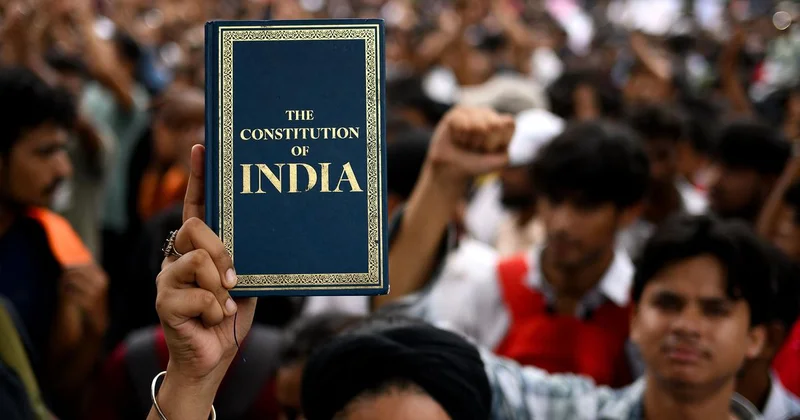
The constitutional problem is the same either way: a coordinated withdrawal of legal representation on grounds of religious sentiment is still a denial of a fundamental right.
Such withdrawals of legal representation are constitutionally indefensible. The Supreme Court’s 2010 judgment in AS Mohammed Rafi v State of Tamil Nadu settled this: such withdrawals are “wholly illegal, against all traditions and professional ethics”. Article 22(1) guarantees every arrested person the fundamental right to counsel of their choice.
Functionally, the denial of legal representation is closer to a religious and moral verdict – delivered as the individual choice of lawyers in Faizabad. The suspects are assumed guilty, instead of being presumed innocent until proven guilty.
By the accusation alone, the lawyers have placed the suspects outside the pale of fundamental rights. That is the logic of “dharma rakshati rakshataha” (those who violate the sacred order forfeit its protection), even though the association has not explicitly invoked dharma.
The Gita and the Constitution
The Mohammed Rafi judgment is correct on the constitutional principle. But its reasoning must be read carefully, because it reveals something about the court’s own normative architecture.
To establish that lawyers must defend even the most reprehensible accused, the judgement marshals an unusual range of authority: Thomas Erskine, who defended Thomas Paine in Britain in 1792 at the cost of his position as Attorney-General; Powell v Alabama, in which the wrongful capital convictions of nine Black teenagers in 1930s Alabama established a constitutional right to counsel; the Indian National Army trials in the 1940s and the case of Binayak Sen, the doctor accused of aiding Maoists.
Then, closing the judgement, the Bhagavad Gita: “It is the duty of a lawyer to defend no matter what the consequences, and a lawyer who refuses to do so is not following the message of the Gita.”
Article 22(1) of the Constitution appears, but as one instrument among several – flanked by British legal history, American constitutional law, Indian nationalist legal tradition and finally the Gita. The Constitution shares space with a post-colonial Anglo-Saxon tradition supplying the aspirational examples, and dharmic duty supplying the ultimate ground of obligation.
Institutional habit
This is an institutional habit, as suggested by the judiciary’s most recent public statement on the subject.
Speaking at a conference in Stockholm on 29 June, Chief Justice of India Surya Kant argued against the view that the rule of law and judicial independence are “purely Western, post-colonial imports gifted to the Global South”.
Rule of law and judicial review, he said, are not the same as judicial supremacy, and the judiciary must observe its own institutional restraint even as it holds other branches to theirs. Then, as evidence that these values are not foreign to India: “In the Indian consciousness, the supremacy of Dharma over personal or dynastic power has been an enduring principle for thousands of years, predating the common law tradition.”
The chief justice’s point, read in full, is more careful than a simple claim that dharma outranks the Constitution. It is an argument that dharma is India’s own prior warrant for the rule of law, not a rival to it, offered against the charge that judicial independence is a colonial graft.
But the move is still worth noticing: to defend a constitutional value, the chief justice reached past the constitutional text to an older, extra-constitutional authority, on the grounds that the older authority is more authentically Indian. The Constitution in that account is not discredited but it is also not where the argument’s force comes from.
A shared condition
The Faizabad bar association and the Mohammed Rafi bench reach opposite conclusions from the same position: neither treats the Constitution as sufficient, on its own terms, to settle the question before it. The bar reaches for sentiment to withhold legal representation. The bench reaches for the Gita and Erskine, to compel it.
The chief justice, speaking at an international conference, offers dharma as India’s own deeper warrant for values the Constitution also holds. The Constitution is present in each.
The collective choice of Faizabad lawyers fails the constitutional scrutiny and rule laid down in the Mohammed Rafi case.
But the deeper problem is that a bar association which can deny representation claiming hurt sentiments, and a court that can explain the duty to represent by reaching for the Bhagavad Gita are saying the same thing: the Constitution has not yet secured, even among lawyers and judges, the status of grand norm as it should.
Sumit Baudh is Professor and Executive Director, Centre on Public Law and Jurisprudence, OP Jindal Global University. Views are personal.
We welcome your comments at letters@scroll.in.