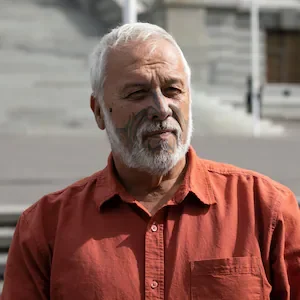
Climate activist Mike Smith says new legislation passed in Parliament was “expressly designed” to prevent his case against big businesses from proceeding to trial. Photo / Johnny Blades, VNP
Legislation that will stop a climate activist’s lawsuit against New Zealand’s biggest emitters has passed its third reading in Parliament.
The minister in charge, Paul Goldsmith, said it gives businesses certainty, but climate activist Mike Smith said it was a “darkday for democracy”.
The legislation has come under scrutiny after revelations a staffer from the Prime Minister’s office received a lobbying document, which was not subsequently disclosed as part of an Official Information Act request.
The Climate Change Response (Tort Liability) Amendment Bill passed with 67 votes to 53 on Tuesday night. It prevents lawsuits against companies for climate-changing emissions under tort law.
Goldsmith said the law would confirm the role of implementing policy in respect of greenhouse gas emissions “sits with the elected Government and the Parliament”. He said it was necessary to avoid uncertainty as Smith’s case navigated the courts.
He said it wouldn’t “take existing rights away from Mr Smith”, in reference to Smith’s case against the likes of Z Energy and Fonterra.
“The bill has not altered the law, rather, it will remove the prospect of finding out what the common law might eventually say.”
Labour’s Camilla Belich challenged that notion, saying “no matter what the minister says” in terms of his allegation that rights will not be removed, “rights certainly will be”.
“In fact, if they were not to be removed, it is hard to know why this piece of legislation has come with such urgency to this house to be passed to prevent Mr Smith from following through on those exact rights.”
Belich suggested the Government could have let the case go through the courts.
“Tonight, the guillotine will fall on Mike Smith’s case, and he will be prevented from pursuing his case that he has fought so long and hard over after tonight.”
She said democracy, “in terms of our certainty of law and in terms of our principles against retrospectivity”, was under attack.
Green MP Steve Abel said the bill amended legislation “designed explicitly to protect the stability of our atmosphere, that vital necessity of life”.
He said the Government acted “so intentionally against the public interest”, ignored Ministry of Justice advice, and excluded the most impacted party, Smith, “while receiving the solicitations of the vested interests”.
Abel referenced a report from Exeter University saying if 2C of warming was achieved by 2050, “the consequence will be two billion dead. That’s 24 years away”.
He then referenced Hannah Arendt’s “banality of evil”, and suggested that, while not personally “transporting human souls to the gas chambers”, the corporate emitters and “complicit politicians” were “gassing our whole planet towards an inconceivable human and animal death toll”.
Act’s Simon Court raised a point of order, saying it was unhelpful to liken members to those who perpetrated the Holocaust.
The Deputy Speaker suggested Abel not use that comparison again, but acknowledged the picture he was trying to build.
Abel continued, saying the polluters had stood and made arguments against Smith in court, “and they lost”. He said the companies then “cheated” by calling on the Government to extinguish the case.
He said judgment from the “finest legal minds” of the Supreme Court was “burned by this law today”, and the “banality of evil wins the day”.
Court then spoke on behalf of Act, saying his party supported the bill because it answered the question of who should make the laws of New Zealand.
Court said the lawsuit the bill responded to “could result in a parallel and contradictory climate regime”.
“What we should not have is activists attempting to achieve through litigation what they failed to achieve through the democratic process.”
Court said it wasn’t an attack on Smith nor an attack on the judiciary, it was Parliament “doing its job”.
New Zealand First also spoke in support of the bill, with MP David Wilson saying it was in the public interest not to “let the spurious case cause a domino effect of other spurious cases, just to prove a point”.
He also said he took offence to the member who called Fonterra “dirty polluters that cheated”.
“Yet at the same time our dairy farmers are the most climate efficient in the world,” Wilson said as he was heckled by a member saying “that’s actually a myth”.
“Oh, another myth, of course. You mean like climate change happened last week when it was cold,” Wilson said in response.
“In the 70s, I remember what we were all going to die from from the climate activists at that time was an ice age.”
Te Pāti Māori co-leader Debbie Ngarewa-Packer spoke against the legislation, saying every part of it was “rotten”.
“This bill has been designed, without a doubt, to protect the largest corporate emitters in Aotearoa from being held accountable.”
She referenced the briefing documents from Z Energy and Fonterra to the Prime Minister’s office, “which just happened to land there without anyone knowing how they landed there”.
Ngarewa-Packer said the documents “became exact replica of what the Government announced in its decision to change the law”.
“If there is nothing rotten about that, then we are all in denial, just as much as this side of the house is in denial of climate change.”
Mike Smith responds
Smith said Tuesday, August 18, 2026, would be remembered as a “dark day for democracy, the rule of law and climate accountability in Aotearoa New Zealand”.
He said the legislation was “expressly designed” to prevent his case from proceeding to trial, calling it “extraordinary”.
“The legislation would impose a statutory bar on tort liability for emissions-related climate change effects and apply that bar to existing proceedings that have not been finally determined.
He said the Government was changing the law before that trial can occur, and that should “concern every New Zealander, regardless of where they stand on climate change”.