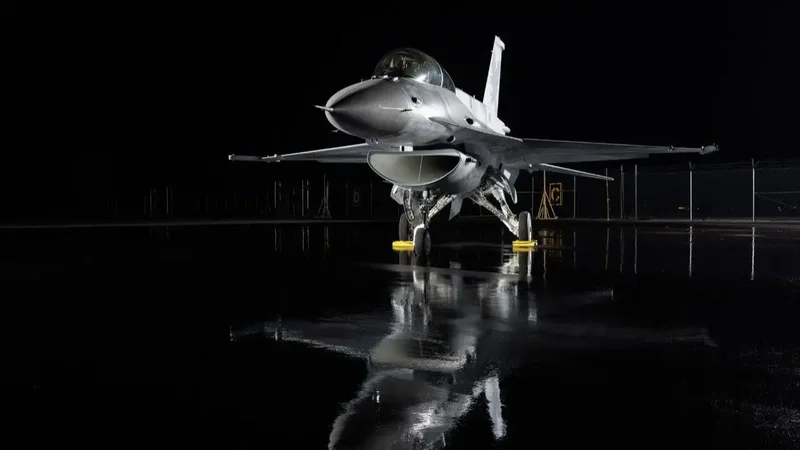
Taiwan is set to receive its first new F-16 fighter jets under a long-delayed US deal, strengthening the island's air power as China continues to expand military activity around Taiwan.
The first two of Taiwan's 66 F-16V Block 70 fighters were recently sighted at Lockheed Martin's facility in Fort Worth, Texas, according to FlightGlobal. The aircraft are now preparing for their eventual delivery to Taiwan.
The $8 billion deal for the 66 F-16C/D Block 70 fighters was approved by the US in 2019. Delivery has been delayed by several years from the original schedule.
Taiwan is already one of the world's major F-16 operators. It bought 150 F-16A/B Block 20 fighters from the US in the 1990s and later chose to upgrade much of that fleet rather than replace all of the ageing aircraft.
Under its Phoenix Rising programme, Taiwan upgraded 141 F-16A/B fighters to the F-16V standard. The modernisation included new avionics, an AN/APG-83 AESA radar, mission computer, electronic warfare systems and cockpit improvements.
The new Block 70 fighters will add a further layer of modern combat capability to Taiwan's air force as Beijing continues to increase air and naval operations around the island.
Why Taiwan is buying more F-16sTaiwan's decision to acquire new F-16s reflects both its familiarity with the aircraft and the need to expand its modern fighter fleet.
The F-16 is already deeply integrated into Taiwan's air force, meaning the arrival of new aircraft does not require the country to create an entirely new training, maintenance and logistics ecosystem.
The Block 70 is also far removed from the F-16 that first entered service. The latest version incorporates modern sensors, computers, avionics and electronic warfare systems, allowing the decades-old platform to remain relevant in contemporary air combat.
For Taiwan, the F-16V also offers a multirole fighter capable of performing air-to-air and air-to-ground missions while operating alongside the country's existing F-16 fleet.
Why the 50-year-old F-16 remains popularThe F-16 first flew in January 1974 and entered US Air Force service in 1978. More than five decades later, the aircraft continues to attract new customers.
Its longevity is partly due to the fact that the F-16 has repeatedly evolved rather than remaining the same aircraft throughout its service life.
The latest F-16 Block 70/72 features the AN/APG-83 AESA radar, an upgraded mission computer, modern avionics and a digital cockpit. Lockheed Martin also lists a structural life of up to 12,000 flight hours for the aircraft.
The platform gives countries a modern multirole fighter without the cost and infrastructure demands associated with operating a fifth-generation aircraft across an entire fleet.
For countries that already operate US-made military equipment, the F-16 can also offer an easier transition. Existing pilot training, maintenance expertise, weapons, communications systems and support infrastructure can be adapted to new aircraft.
Global support network gives F-16 an edgeThe size of the F-16's global fleet is another reason for its continued popularity.
Lockheed Martin says about 2,800 F-16s operate across 29 countries. That large user base has created an extensive ecosystem for maintenance, spare parts, training, weapons integration and upgrades.
The aircraft is also compatible with a wide range of US and allied weapons and communication systems, allowing operators to integrate it into existing military networks.
This established ecosystem can be particularly valuable for countries that want a capable fighter without taking on the financial and logistical burden of introducing a completely new aircraft type.
China pressure adds urgency for TaiwanFor Taiwan, the F-16 deal comes as the military balance across the Taiwan Strait continues to shift.
China has increased the frequency and scale of its military activities around Taiwan, including aircraft and naval deployments. The pressure has forced Taipei to maintain a high state of readiness while modernising its armed forces.
The arrival of the new F-16V Block 70s will therefore not simply replace ageing aircraft. It will expand Taiwan's inventory of modern fighters while adding aircraft equipped with advanced radar, avionics and electronic warfare capabilities.
The F-16 may be more than 50 years removed from its first flight, but Taiwan's latest purchase shows why the platform continues to have a place in modern air forces. Its combination of continuous upgrades, relatively established operating costs, broad weapons compatibility and a global support network has allowed the fighter to remain relevant long after its original design was introduced.