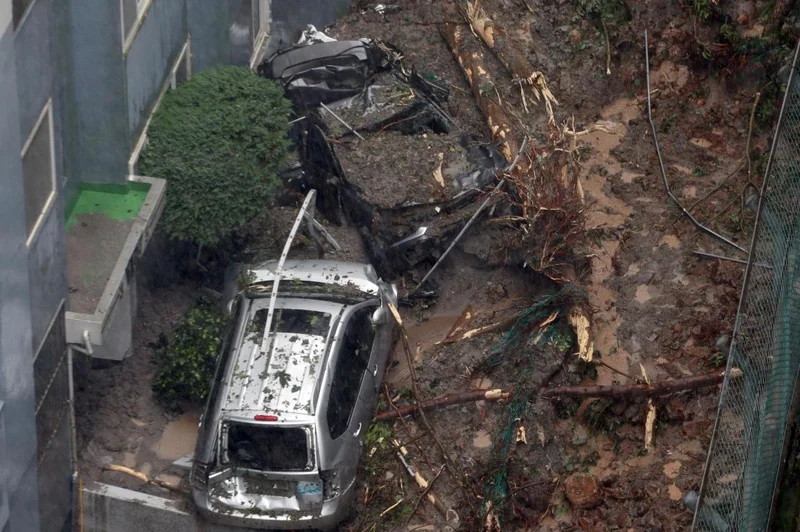
Following the historical rainfall of nearly 1,000 millimeters dumped on Geoje over three days, urgent calls are made to change the country's weather disaster response system as such extreme rainfall is starting to become an annual event.
During a Cabinet meeting on Tuesday, President Lee Jae Myung instructed officials to devise measures to revamp the country’s response system, citing the urgent need to modernize a system built around past climate conditions.
Extreme rainfall becoming more frequent
According to the Ministry of the Interior and Safety, a total of 968.1 millimeters of rain fell over Geoje over three days beginning last Saturday. At its peak, some 124.5 millimeters of rain fell just over one hour starting at 1:32 a.m. Monday, an intensity statistically expected only once every 200 years. Nearby Tongyeong also received 777.8 millimeters of rain between last Saturday and Tuesday.
A climate analysis report released by the ministry showed that the number of incidents of heavy rainfall exceeding 50 millimeters per hour during a decade in the 1970s was ten; the number steadily grew over time, and reached 31 from 2020 to 2025. Based on a simple annual average, the extreme downpours became five times more frequent over five decades.
Some regions experienced rainfall exceeding 100 millimeters per hour, including Jindo County, which recorded 112.2 millimeters on Sept. 21, 2024; Seosan, which recorded 114.9 millimeters on July 17 last year; and Gunsan, which recorded 152.2 millimeters on Sept. 7 last year. Just last month, Suseong District in Daegu recorded 89 millimeters of rain per hour.
Experts stressed the urgent need to reexamine evacuation manuals and alert systems in the face of increasingly frequent extreme rainfall.
“Rainfalls at a climate disaster level that overwhelms the currently existing countermeasure capacity is starting to become an everyday occurrences, hence making it necessary for people to learn practical evacuation procedures,” said Yeom Kun-woong, a professor in the Department of Fire Service Administration at U1 University.
“To this end, the Ministry of the Interior and Safety, local governments and other relevant agencies should establish a real-time automated warning system that delivers alerts directly to residents.”
An upgrade to existing infrastructure, designed to withstand the once-in-200-year rainfall, is also necessary, but the task would take considerable time and resources. In the meantime, the country needs to establish a comprehensive evacuation system and strengthen close coordination among agencies, extending to frontline disaster responders, according to Yeom.
Currently, the Korea Meteorological Administration (KMA) sends out two different rainfall warnings, a heavy rain emergency alert and a disaster-level rainfall emergency alert, based on hourly and cumulative rainfall.
The disaster-level alert is issued when rainfall exceeds 85 millimeters in one hour and 25 millimeters in 15 minutes, or when it reaches 100 millimeters in one hour. When issued, the alert immediately sounds on mobile phones at 40 decibels or louder, even when they are in vibrate mode, accompanied by a text message urging recipients to evacuate immediately to a safe location. It is followed by another alert from local government that informs designated evacuation sites.
“But the problem is that ordinary people often see warning texts as noise or spam,” Yeom said, stressing the need for effective public education on emergency response guidelines and efforts to change how people perceive disaster risks.
A siren is also used during a disaster-level rainfall to urge evacuation. In Geoje, the siren went off at 1:20 a.m. Monday.
“Traditionally, using sirens for weather-related warnings was considered unthinkable, as they were regarded as being reserved for wartime emergencies,” an official from the interior ministry said. “This was the first time a siren was used to warn residents of a climate-related danger.”
Local disaster response falls short
Still, problems linger. One issue raised is that frontline disaster countermeasures do not fully function as intended. In theory, extreme rainfall, unlike earthquakes, can be forecast at least two days in advance, giving heads of local governments time to take preemptive measures. Based on the legal authority granted to them under relevant laws, they can order the evacuation of residents in landslide-prone areas or low-lying areas susceptible to flooding.
In reality, however, evacuation orders are often issued with hesitation because officials are concerned that the KMA forecast might be wrong, fear criticism for causing unnecessary alarm or are reluctant to take responsibility for the decision.
“The KMA originally forecast that the rainfall would be concentrated in the mountainous areas around Jirisan, but the weather front shifted southeastward, catching Geoje off guard,” a ministry official said. The city is located 80 to 90 kilometers from Cheonwangbong Peak on Jirisan.
Experts also point to inadequate disaster-response capabilities among heads of local governments, who serve as commanders during crises, and frontline officials, as well as weak coordination between local governments and relevant institutions.
“The nationwide disaster management system is well designed at the national and regional levels under the Framework Act on the Management of Disasters and Safety. But it is a different story when we look at the disaster management systems of basic local governments,” said Moon Hyun-chul, a professor in the School of Public Safety Administration at Honam University.
He said much of the problem can be traced to the absence of a coordinated operational mechanism among the entities involved in disaster response, which range from local governments, the police and fire departments to electricity and telecom companies and education offices, as well as military units.
“It is imperative that improvements be made in that regard,” Moon said.
The ministry official said neither upgrading disaster-prevention infrastructure nor strengthening evacuation procedures can be prioritized over the other.
“But seeing how infrastructure alone cannot prevent all damage from extreme rainfall, the ministry will focus its administrative capabilities on advancing evacuation procedures that encompass everything from preemptive evacuation to confirmation that people have actually evacuated,” the official said.
This article from the Hankook Ilbo, the sister publication of The Korea Times, is translated by a generative AI system and edited by The Korea Times.
Explore More
- Q.
- Q.
- Q.