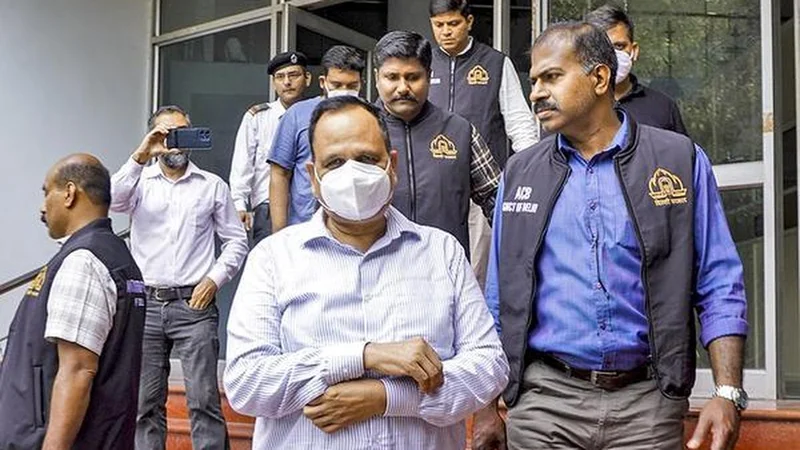
On August 18, 2026, senior Aam Aadmi Party (AAP) leader Satyendar Jain, who was Delhi’s Water Minister and chairman of the Delhi Jal Board (DJB) during the AAP’s tenure, was arrested by the Anti-Corruption Branch (ACB), along with five others.
Also Read | ED attaches ₹7.44 crore assets of companies ‘beneficially owned’ by AAP’s Satyendar Jain
The five others are former DJB CEO and IAS officer Udit Prakash Rai; former contractual consultant of the DJB Ankit Srivastava; Euroteck owner Raja Kumar Kurra; Nagendra Yadav, proprietor of AN Enterprises; and Pankaj Verma, proprietor of Srijanhar. On August 19, a Delhi court sent Mr. Jain and four other accused to 14 days’ judicial custody, while Mr. Srivastava was sent to two days’ police custody.
What is the case?
The case concerns alleged irregularities in the tendering process for the augmentation and upgradation of Sewage Treatment Plants (STPs) of the DJB, when the AAP was in power. The tenders, issued in 2022, covered 10 existing STPs in Delhi and involved four contracts.
The ACB registered an FIR on May 11, 2024, following a complaint from the Directorate of Vigilance, alleging irregularities, manipulation of tender conditions and a criminal conspiracy involving public servants and private entities.
At the heart of the case is the allegation that the tender conditions were manipulated to favour Hyderabad-based Euroteck Environment Pvt. Ltd. by incorporating “restrictive” technical specifications and conditions that allegedly limited competition.
Also Read | Medical procurement scam files destroyed, claims AAP
The case subsequently acquired a money-laundering dimension, with the Enforcement Directorate (ED) taking up a separate investigation on the basis of the ACB FIR. In December 2025, the ED filed a prosecution complaint against 14 accused persons and entities, alleging that the tender manipulation generated proceeds of crime and that illegal commissions were paid through intermediaries.
What are ‘irregularities’ in the tender process?
The principal allegation is that the tender specifications were made restrictive in a manner that gave a particular technology provider an advantage.
According to the ACB, a proposed pilot study to assess the technology was not conducted. Despite this, restrictive conditions concerning the technology and media to be used were incorporated into the tender documents. The agency also found that essential parameters relating to the quality of treated effluent were excluded and that technical specifications were subsequently changed.
The ACB alleges that these changes narrowed the field of eligible bidders and gave a particular technology provider an advantage, with significant financial implications for the government exchequer.
Investigators have further alleged that the manipulation did not happen in isolation. Private persons were allegedly in regular communication with public servants and intermediaries about the tender. Analysis of electronic evidence showed exchanges of restrictive tender conditions and other related documents, which the ACB says were subsequently incorporated into the DJB’s official tender documents.
The ED, in its separate money-laundering investigation, examined the same tender process and alleged that the specifications were manipulated to require the use of ‘IFAS technology with fixed media’, effectively making Euroteck the sole technology provider eligible for the requirement. The ED said the original estimated cost of the four tenders, around ₹1,546 crore, was subsequently increased to about ₹1,943 crore.
The ED further alleged that the manipulation resulted in an undue profit of about ₹9.96 crore for Euroteck and that illegal commissions or bribes totalling about ₹6.73 crore were paid through banking channels and cash.
What evidence has been unearthed so far?
The investigation has so far pointed to two broad categories of evidence: communications relating to the tender process and the alleged movement of money.
The ACB’s analysis of electronic evidence revealed communications between Raja Kumar Kurra, Nagendra Yadav and Ankit Srivastava concerning meetings, tender conditions and other matters linked to the STP contracts. Investigators allege that some of the restrictive conditions discussed in these communications later appeared in the official tender documents.
The money trail identified by the ACB primarily concerns former DJB CEO Udit Prakash Rai. The agency alleges that ₹1.52 crore was transferred to Rai and his relatives through banking channels from AN Enterprises, a proprietorship concern of Nagendra Yadav, as a bribe. The ACB further alleges that the money was ultimately sourced from Euroteck and that part of it was used to purchase immovable property.
The agency’s stated allegations against Jain relate to his role as the then Water Minister and DJB chairman in the alleged conspiracy surrounding the tender process.
The ACB will now continue its investigation, including examining the money trail, the roles of the accused and the involvement of any other persons.
Why is the case important?
Born out of the India Against Corruption (IAC), the AAP’s anti-corruption pitch appealed to the people of Delhi and the party formed its first government in Delhi in December 2013, barely 13 months after the party was founded.
It came back to power in 2015 with a brutal majority by winning 67 out of 70 seats in the Delhi Assembly and again in 2020 by winning 62 out of 70 seats.
But the party lost the 2025 Delhi Assembly election.
The loss was particularly stinging for the AAP as party chief Arvind Kejriwal, his trusted deputy Manish Sisodia, and also Mr. Jain lost the election. One of the key factors that played against the AAP in the run up to the election was its top leadership, including these three leaders, being arrested in corruption cases, tainting its anti-corruption crusader image to an extent.
Mr. Jain was arrested by the ED in May 2022 in a money laundering case on the charge of assets disproportionate to known sources of income acquired during 2015-17 when he was a Delhi minister.
Mr. Kejriwal and Mr. Sisodia and others were arrested in an alleged scam in the Delhi excise policy. But after the Delhi election result, 23 people, including these two leaders, were discharged by a Delhi Court in the Delhi excise policy case. Pulling up the CBI, the court observed that the case relied on hearsay evidence, had major procedural lapses, and violated constitutional principles.
The AAP used the court verdict to amplify its message that the BJP was using the investigating agencies to target them for political gains in the run-up to the Delhi Assembly election and claimed that they were “staunchly honest”.
But an appeal against this order by the CBI is pending in the Delhi High Court.
What is the politics now?
Within months of the Delhi loss in 2025, Mr. Jain was made co-incharge of the AAP in Punjab, where the party is currently in power, and he was playing a key role in the party and the governance of the State.
With Punjab set to go to polls in early 2027, the current arrest has been seen by the AAP as an attempt to paint their leaders as corrupt yet again ahead of a crucial election. But the BJP has dismissed the AAP’s claims and maintained that the ghosts of their past corruption has come to haunt them.
Winning Punjab is crucial for the AAP as a loss could mean losing their ‘national party’ status too.
Published - August 20, 2026 12:02 pm IST