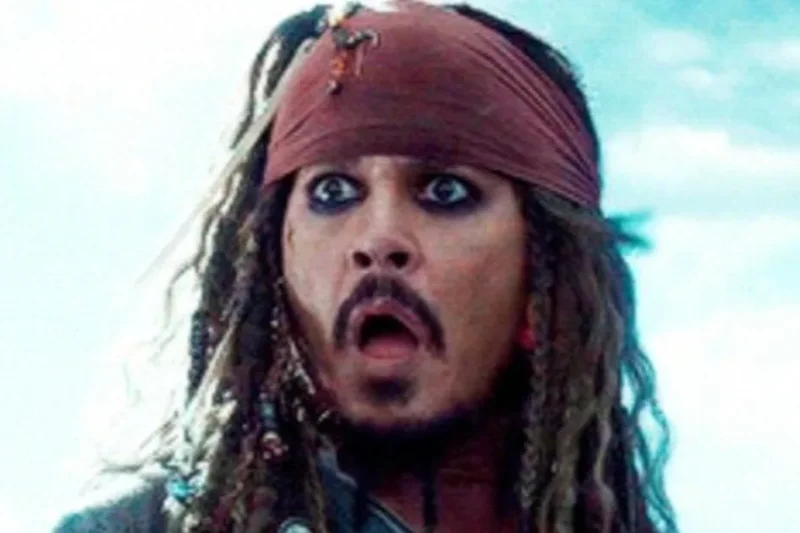
Is it a sixth voyage on the seven seas for Johnny Depp? According to superproducer Jerry Bruckheimer, the controversial American actor is in talks to reprise the role of Captain Jack Sparrow in a new Pirates of the Caribbean movie – a deal that would herald a full-on Hollywood comeback for Depp after half a decade in the cinematic wilderness.
During court proceedings in 2022, Depp testified that Disney had dropped him from the Pirates franchise, claiming that he would refuse to rejoin the series even if he were offered “$300m and a million alpacas”. While it’s not known how much money – or indeed how many alpacas – Disney may or may not be willing to offer him, the assumption among many is that a return could be very much on the cards. (Orlando Bloom, who fronted the original Pirates trilogy in the 2000s alongside Depp and Keira Knightley, hinted last year that he was interested in a reboot.)
Talk of a sixth Pirates of the Caribbean film comes weeks after the first trailer debuted for Depp’s other “comeback” project, an adaptation of Charles Dickens’ A Christmas Carol. “It’s good to be back,” whispers Johnny Depp, in the meta-referential first trailer for Ebenezer. The film, out later this year, isn’t Depp’s first foray into cinema since his highly publicised, career-derailing legal battle with ex-wife Amber Heard, but it is his first back in the Hollywood system.
While no one but the Ghost of Christmas Future can be sure of Ebenezer’s fortunes, Bruckheimer’s comments are the strongest suggestion yet that studios are ready to re-embrace Depp. Back in the shabby pirate garb of Captain Jack, Depp would be reprising the biggest role of his career. Are the public on board? It seems that studios are ready to start betting on it.
For Depp, a sixth Pirates film would be a return to the franchise that made him a bankable blockbuster star after spending years struggling to crack the mainstream. As shambling, sauntering pirate-with-a-heart-of-gold Jack Sparrow, Depp created for himself an inimitable breakout character; audiences loved him, and so did critics. (It was Pirates that won Depp his first Oscar nomination.)
The magnitude and turbulence of Depp’s 21st-century fame make it easy to forget that he started out as a teen pin-up, thanks to his role in the TV hit 21 Jump Street – and Hollywood success was initially elusive. The 1980s and 1990s saw him work with a slew of lauded filmmakers – among them Wes Craven (in Depp’s debut film, the horror classic A Nightmare on Elm Street), John Waters (in Cry-Baby), and Terry Gilliam (in Fear and Loathing in Las Vegas). He produced much of his best work in collaboration with Tim Burton – as the Chaplinesque monster in Edward Scissorhands, and the titular schlock filmmaker in Ed Wood.
Many of these films, however, were box office bombs. Depp was an actor with arthouse cachet, but no mainstream bankability; he was arguably best known at the time for his string of glamorous off-camera romances (with actors including Jennifer Grey, Sherilyn Fenn and Winona Ryder, and the model Kate Moss).
“I went through 20 years of what the industry basically described as failures,” Depp said, at a 2009 press conference. “For 20 years I was defined as box office poison.”
When he landed the lead part in Burton’s Sleepy Hollow (1999), his biggest pre-Pirates hit, it was as a last resort; while the director had wanted Depp from the get-go, Paramount pushed a number of other names (Brad Pitt; Liam Neeson; Daniel Day-Lewis) before accepting. Dreamy France-set romance Chocolat was another success the following year, making $152.7m, more than six times its budget.
Then in 2003 came Pirates of the Caribbean: The Curse of the Black Pearl. Adapted from a long-running theme park ride, the film was widely expected to be a commercial disaster, but ended up a juggernaut: the first film made $650m (£478m). Over the next four entries (released across the span of 14 years), the franchise would go on to make more than $4.5bn from box office takings alone, with Depp’s shabby sea captain quickly promoted from a supporting role to the undeniable star attraction.
Disney may have reason to believe there’s treasure buried somewhere within a hypothetical sixth Pirates film: the most recent entry, released in the UK as Pirates of the Caribbean: Salazar’s Revenge, made just shy of $795.9m, despite poor reviews and a cast switch-up. (Bloom and Knightley left after the third entry, with only Geoffrey Rush remaining of the main cast – Penelope Cruz and Javier Bardem were the star additions for the fourth and fifth films respectively.)
A major point of contention in the Depp v Heard court case was that Heard’s allegations of domestic abuse – which Depp claimed were defamatory and false – had jeopardised his career. (A jury in Virginia ultimately ruled in Depp’s favour, awarding him damages.) A previous British court ruling over The Sun report labelling him a “wife beater” had immediately precipitated his firing from another major franchise, the Harry Potter spin-off series Fantastic Beasts; taking the stand in 2022, his manager stated that Disney had nixed a prospective $22.5m deal to bring him back to the Pirates franchise. If they are now willing to reverse that decision, it suggests a significant sea change – either with regard to Depp himself, or the public’s willingness to overlook his scandals.
What cachet Depp has retained through the reputation-damaging trial is uncertain. Polling by the National Research Group earlier this year placed Depp seventh in a ranking of actors who would most convince respondents to watch a film. “I do see a path for him, particularly because Hollywood needs this comeback,” Miranda Banks, a professor of film, television and media studies at LA’s Loyola Marymount University, recently told The New York Times. “There’s an incredible lack of compelling A-listers who can open movies on a worldwide basis.”
The dearth of viable movie stars – actors who can, in industry terms, “open a movie” on their own appeal – is a documented modern phenomenon, despite the ascendence of young box office draws such as Timothée Chalamet and Zendaya. Disney may be influenced by the success of actors such as Brad Pitt, who last year marked his highest-grossing movie ever (Apple TV’s racing drama F1) despite myriad headlines about his personal life and abuse allegations from ex-wife Angelina Jolie. (Pitt has consistently denied the abuse allegations.) It may be that audiences don’t know; it may be that they don’t care.
Since the trial, Depp has appeared in just two films. The first is the 2023 French-language drama Jeanne du Barry. (The film’s director, Maïwenn, spoke positively of Depp in a 2023 interview with The Independent, though claimed: “It’s difficult to shoot with him... all the crew were scared because he has a different kind of humour and we didn’t know if he was going to be on time, or if he was going to be OK to say his lines.”) The second is a 2024 children’s film titled Johnny Puff: Secret Mission, in which Depp provides noises – but not words – for an animated puffin. It’s a reprisal of a role he played in 70 episodes of the Apple TV+ series Puffins a few years prior.
To this end, Ebenezer is an unlikely lifeline; another Pirates outing would constitute a comeback of tremendous magnitude. But studios have reasons for caution that go beyond Depp’s damaged personal reputation. Across the 2010s, Depp’s success with the Pirates franchise was tempered by a slew of ignominious box-office flops – among them the woozy Bruce Robinson jaunt The Rum Diary (2010), errant adventure throwback The Lone Ranger (2013), and the woeful comedy Mortdecai (2015). Though his reputation as a box-office draw was sustained through his work as Jack Sparrow (and other sporadic successes like Alice in Wonderland and Murder on the Orient Express), Depp’s allure was demonstrably faltering long before he was supposedly “cancelled”.
With nine years having passed since the last Pirates film, the world’s enduring fascination with the exploits of Captain Sparrow are a matter of pure conjecture. Even leaving aside Depp’s personal appeal, it’s uncertain whether the moment has passed. These are, after all, family films, and those people who were the prime age demographic when the last film came out have now grown up. It’s no surprise the sixth film is being talked of as a reboot (with the rumoured involvement of Margot Robbie as the lead). It will inevitably seek to split the difference – courting an audience of children unfamiliar with Depp, while appealing to those adult fans who grew up with him.
It is unlikely that such a film wouldn’t, at the very least, be profitable. But the bigger question is whether Depp can endure without the idiosyncratic draw of Jack Sparrow. If Depp was once “box office poison”, Captain Jack proved to be his antidote. Whether it will work again remains to be seen.