Sign in. It’s quick, free and it’s up to you.
An account is an optional way to support the work we do. Find out more.
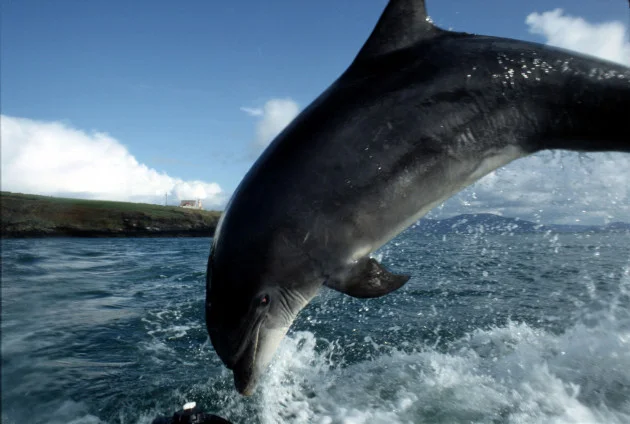
RESEARCHERS HAVE FOUND that Fungie, the famous bottlenose dolphin who made his home off Dingle for decades, was the product of crossbreeding between two different genetic groups.
Scientists at the Atlantic Technological University in Galway have analysed the genetic make-ups of 140 Irish dolphins that fell into three distinct groups.
They confirmed the existence of an offshore group that lives out at sea and two coastal resident populations: the Shannon Estuary and the Connemara-Mayo-Donegal groups.
The researchers used DNA taken from a wetsuit worn during swims with Fungie and found that he was a mix of the offshore and Shannon Estuary groups.
Fungie first appeared in Dingle in 1983 and resided there until he disappeared in 2020.
He was a solitary bottlenose dolphin, which is unusual for such a sociable species, and of all the solitary individuals studied he was the only one who was not 100% descended from the offshore population.
But like other solitary dolphins, he frequently interacted with humans.
Gathering DNA was a challenge for the researchers, who used a variety of methods to obtain it.
In Fungie’s case, they used samples taken from a wetsuit worn by Denis O’Regan, a member of the Irish Whale and Dolphin Group who often swam with the Dingle dolphin.
To embed this post, copy the code below on your site