As Israel’s military advances its yellow line, Gazans fear they’re being pushed to the sea
Edge of military control in Gaza has marched west since October ceasefire
On a Gaza seaside that looks more like a beach resort than a battleground, Palestinians splash in the sun. This crowd is grateful for peaceful pauses in a war that’s dragged into its third summer.
But despite talk of peace negotiations and withdrawals, very few believe it’s over.
“This war has taught me to be afraid of hope,” said Tamer Al-Sheikh. “We’ve hoped a lot through four or five truces, but the conflict continues.”
With only a few pauses, Israeli airstrikes hit Gaza almost daily as Israel says it is targeting wanted Hamas militants.
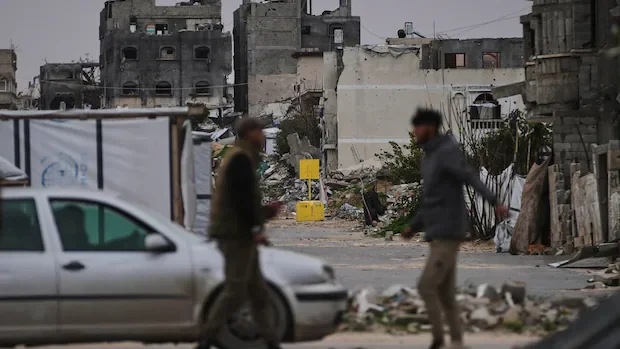
At the same time, Israeli troops have continued creeping west, expanding their military footprint and squeezing two million Palestinians into an ever smaller area, forcing a scramble for survival toward the Mediterranean Sea.
Under the Gaza peace agreement last October, Israel accepted that it would pull back its troops behind what’s known as the “yellow line,” the edge of Israeli military control inside Gaza. That would amount to less than 50 per cent of the territory along its border. But Israel’s army now controls more than 60 per cent, saying the new boundary is necessary for “operational security”.
Israeli Prime Minister Benjamin Netanyahu said he’s told his generals to keep going to 70 per cent.
Earlier this month, he rejected a U.S. plan to phase out both Israeli military and Hamas militant control of Gaza, saying Israel “will not carry out any withdrawal until Hamas is disarmed.” The militant group has agreed to give up weapons only in tandem with a phased Israeli pullback, leaving a deadlock.
CBC’s visual investigations team has verified the near constant forward movement of Israeli troops and expansion of the yellow line using satellite images. Eyewitness accounts and video captured by freelancers on the ground in Gaza have confirmed the military advances.
The impact on Gaza’s civilians has been profound.
Blocks move without warning
Palestinians regularly wake up to find the yellow cement markers sitting right next to their homes, nudged metres or hundreds of metres closer overnight. Israeli forces aren’t far behind.
“Suddenly, at 6 a.m. I saw the stones had moved,” said Hala Mustaha, pointing to bright yellow blocks in the middle of Salah al-Din Street in Gaza City. “My neighbours were already moving their things, but I have no idea where I can go.”
Essam Dawla had to transplant his family four times.
“The tanks came day after day to shoot at us,” he said, describing the days after the yellow blocks appeared. “Then came the Apache helicopters, with bullets flying into our house. You can’t imagine the panic.”
In the north, satellite images show how the yellow line has moved from October to July, with the nearby Halawa tent camp growing more than 20 times larger as displaced Palestinians are pushed here from their previous shelters.
In the camp, Ismail Al-Barsh sits in front of his tent with a grandson on his lap. He lost another grandson when the boy’s classroom was hit by an Israeli airstrike near the yellow line.
He’s afraid the same will happen here.
“Now even Halawa isn’t safe,” Al-Barsh said. “Every day, we see more gunfire, to advance the yellow line, again.”
More than 1,200 Palestinians have been killed here since the ceasefire started last fall, according to UN figures. That brings the total of Gazans who have died since this conflict started on Oct. 7, 2023 to more than 70,000, a figure compiled by Gaza officials and reportedly accepted by Israel.
‘Defensive measures’ says Israel
Israel insists its movement of the yellow line is consistent with the ceasefire deal.
In a written reply to questions from CBC News, the Israel Defence Forces (IDF) said it is working “to clearly and visually mark the location of the Yellow Line on the ground in order to reduce friction” with Palestinians.
“Defensive measures,” it said, “are intended to prevent infiltrations and hostile activity, and to protect both the troops and surrounding communities” in Israel.
Those IDF measures include the construction of a berm — a dirt barrier piled high — that the UN says now stretches 23 kilometres, along or behind the yellow line. It towers in the distance over many of the tent camps.
And, increasingly, Israel is building fortified compounds that look like permanent Israeli military bases.
Gaza’s neighbourhoods flattened
Satellite images show one of those military compounds — well inside Gaza — about half way between Israel’s border and the sea. It has permanent guard posts, multiple structures and a paved parking lot — all protected by tanks. Another one, further south in Jabalia, is even larger, and seems more established. Several others are under construction.
Still, Israel isn’t just digging in. It is also tearing down.
Many of Gaza’s neighbourhoods were destroyed during active fighting between Israel and Hamas over two years of war. This came in response to the Oct. 7, 2023 attack on Israel which left approximately 1,200 Israelis dead.
But as satellite images show, many more homes have been systematically flattened by Israeli forces since last October, after most conflict stopped.
Near the Indonesian hospital in northern Gaza, buildings which were still standing last November are now gone. And in Shejaiya, next to Gaza City, entire swaths of housing that are seen in images from October were blown up or bulldozed by April — on both sides of the yellow line.
UN experts have denounced “the systematic detonation of residential buildings,” as “re-engineering the geography of illegally occupied Gaza” by Israel.
Palestinians who have watched their homes destroyed say there’s a plan.
“Israel is trying everything to push the people to leave Gaza,” said Alaa Hajjaj. “To make people’s lives miserable.”
Hajjaj is a teacher, now living with his family in a tent in northern Gaza. The rubble of his house sits well behind the yellow line, a place he’s not sure he will ever be able to reach again.
“But for myself, I am not going to leave Gaza, whatever happens,” Hajjaj said. “This is my home. This is my land. I was born on this land and I have memories here and I have everything in this land.”
‘Gaza is ours,’ Israeli groups claim
Officially, the Israeli government denies it is trying to push out Palestinians or annex Gaza.
But there is strong political pressure to do exactly that, including inside Netanyahu’s party and coalition cabinet.
- Hamas must disarm for Israel to pull out of Gaza, Netanyahu says
- Cancer patients are dying faster in Gaza since the war began
Extremist settler groups like Nachala have repeatedly marched to the Gaza border, running public relations campaigns with videos underlining their demands.
“The people of Israel will cross this fence, and establish settlements here,” Nachala leader Daniella Weiss said, pointing through the barrier into Gaza.
They have been joined by cabinet members from far-right parties. National Security Minister Itamar Ben Gvir is seen yelling “Gaza is ours,” and Finance Minister Bezalel Smotrich told supporters “there will be no victory” until Jewish settlements are established in Gaza.
Even prominent members of Netanyahu’s own party, Likud, support annexation.
“We are preparing to take hold of the northern part of Gaza,” said Economy Minister Nir Barakat at the border.
Netanyahu himself has skirted the issue, telling one supporter who asked why the IDF should control 70 per cent of Gaza and not all of it, “First 70 per cent. We’ll start with that.”
That may be just talk.
With Israeli elections two months away, and Israeli media predicting Netanyahu is in a tight fight to stay in power, some of that may be political rhetoric aimed to please his own base.
Israel may also be taking a hard line in international negotiations, to pressure Hamas militants to give up their weapons, a move the group has been slow to adopt despite agreeing to it in October’s ceasefire deal.
But for Palestinians moved by yellow markers — and menaced by the guns behind them — there’s a real fear they’re being pushed into the sea.
With files from Mohamed El Saife