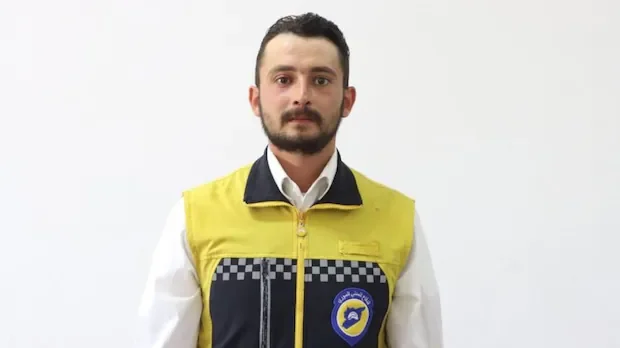
Who is Mohammad Ghamira and why has his death, alleged abuse ignited outcry in Syria?
Syrian families and rights groups call for transparency, accountability over mistreatment in detention centres
Syrians took to the streets this week to call for justice over the death of Mohammad Ghamira, a Syrian man who died in hospital after alleged abuse by security forces while in detention — less than two years after the new government vowed to break away from the systemic, arbitrary detentions and abuse that was common under the ousted regime.
Ghamira's family said they told police that the 29-year-old father of two suffered from hemophilia, a rare genetic disorder that impairs the body's ability to make blood clots, which can lead to prolonged bleeding.
He was held in detention for three days before being released on Aug. 9 and taken immediately to hospital. He died a week later.
For Syria’s new government, Ghamira’s death has become somewhat of a litmus test of whether its promises of accountability will translate into action after the fall of the Assad's iron-fisted dynasty, which ruled the country for more than 50 years.
Ghamira's death sparked a series of peaceful sit-ins and protests in the country this week, but rights groups say his case is only one of many reports of alleged mistreatment at detention centres that have come out since the new government took power.
"The death of Mohammad Ghamira raises exactly the concerns we have been documenting since the transition began: detention practices that are not yet governed by a unified, judicially supervised system," Fadel Abdulghany, executive director of Syrian Network for Human Rights (SNHR), told CBC News.
"Syria’s transition will be judged on whether accountability for cases like this becomes systemic, not selective."
Family warned police of dire medical condition
Ghamira was a former volunteer with the White Helmets, also known as the Syria Civil Defence, which was formed in 2013 and operated during the war in opposition-held areas. The group's role shifted from an independent rescue group to part of the country's formal state emergency services after the collapse of the former regime in 2024.
The Latakia Internal Security Command said Ghamira was detained regarding an allegation "that he stole a sum of money." It did not provide any further details.
While in custody, his family was unable to visit or contact him, and was told only that he was “under investigation," according to the SNHR.
His uncle, Issam Ghamira, told state news agency SANA the family had informed the police chief in al-Haffah that his nephew had hemophilia and warned against hitting him. Despite that, he said, his nephew was hit while in custody.
Ghamira died at the Latakia University Hospital on Sunday after being released from jail.
- Syria's former president Bashar al-Assad sentenced to death in absentia at trial
- FRONT BURNERHow Syria's former first lady aided the bloody regime
Syria's Minister of Emergency and Disaster Management Raed al-Saleh mourned the death of his "brother, friend and young colleague."
Al-Saleh, who was previously head of the White Helmets, said on X that Ghamira had died of "complications from cerebral and gastrointestinal hemorrhaging" that "resulted from a beating he sustained after being detained at the al-Haffah police station."
"I affirm to his family and all Syrians that the new Syria is a state of law and justice…. The Syrians have sacrificed throughout 14 years to reach a Syria that upholds their dignity and preserves their humanity, and there will be no impunity in the new Syria," Al-Saleh said.
Government launched investigation
Ghamira was buried Monday in his hometown of al-Haffah in Syria's coastal Latakia province.
Syria's Interior Ministry announced on Sunday an investigation into Ghamira's death. It said seven Interior Ministry personnel were detained for questioning but did not provide any other details.
SNHR's Abdulghany said anyone detained must be informed of the reasons for arrest, brought promptly before an independent judge and able to challenge the lawfulness of detention, in accordance with Article 9 of the International Covenant on Civil and Political Rights.
Abdulghany questioned whether the internal investigation would be enough to provide accountability.
"What matters now is whether the case moves to an independent criminal investigation and prosecution, not an internal disciplinary process alone, and whether the outcome — and the forensic evidence behind it — is made available to the family and the public," Abdulghany said.
Syria's Interior Ministry spokesperson Noureddine al-Baba acknowledged "shortcomings and deficiencies" in some of the country's police departments but said others were doing "exceptional" work.
"God willing, this painful incident will serve as a catalyst for positive change in the operations of the Ministry of Interior," he told reporters on Monday.
CBC News reached out to the Interior Ministry but did not receive a response.
Accountability 'not enough,' families say
Syrians whose loved ones disappeared or died in detention centres during Assad's rule say they were disturbed to hear of ongoing abuse.
"What happened to [Ghamira] reopens the wounds of torture and death in detention for thousands of Syrian families — practices that Syrians have struggled for years to end, and whose recurrence today cannot be tolerated," Families for Freedom, a group representing relatives of detainees, said in a statement written in Arabic on Monday.
The group said it is calling for an "independent and transparent" investigation, along with a publication of the investigation's findings and a formal apology to Ghamira's family.
The organization added that prosecuting abuses after they occur is "not enough," calling instead for systemic reforms to prevent mistreatment, strengthen oversight of detention facilities and ensure such abuses are not repeated.
"A new Syria cannot be built with the old tools of oppression."
Abuses persist in detention centres, rights groups say
When insurgents unseated Assad in December 2024 after a nearly 14-year conflict, they opened the country's notorious prisons. During Assad's rule, thousands of prisoners were killed in mass executions or died from injuries and disease. Detainees were subjected to torture, beatings and rape, according to rights groups that have documented the abuse.
When Syria's transitional government took over, it vowed to uphold the "rule of law" and ensure fair trials and proper judicial oversight during arrests.
Officials with the government of interim President Ahmed al-Sharaa have promised accountability in Ghamira's case, but rights groups say it is not an isolated incident and that abuses persist in detention centres.
In a new report published last week, Syrians for Truth and Justice, a human rights organization that tracks abuses, said "severe beatings, electric shocks, humiliation, threats, deprivation of basic necessities, and deaths in custody continue to be common practices at the hands of multiple security and military actors."
- 6 siblings forcibly disappeared in 2013 by Assad regime confirmed dead, family says
- Syrian authorities arrest suspected leader of notorious Tadamon massacre
The group concluded that the incidents were too widespread to treat as isolated incidents but there was not evidence of a "single centralized system equivalent in structure and direction to the torture apparatus entrenched by the Assad regime."
"It is somehow widespread, but it's not structured," Bassam Alahmad, the group's executive director, told The Associated Press on Monday. "For us, there is no evidence that these orders came from the commanders to torture people, but still [the authorities] have a responsibility to stop this behaviour."
In an earlier report released in March, the United Nations Independent International Commission of Inquiry on the Syrian Arab Republic said it had documented "torture and ill-treatment" in 18 official detention facilities and 12 "makeshift facilities" in different areas of Syria between January and October 2025.
With files from The Associated Press