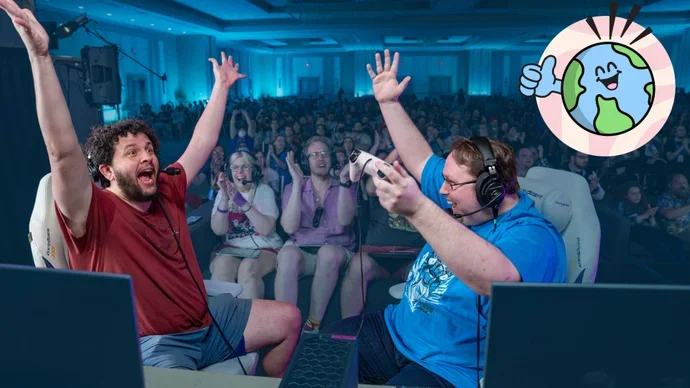
If you read a lot of gaming news - or work with it, like I do - you cannot help but become a little cynical sometimes. 2026 has been a brutal year for the industry, following an equally galling 2025. Beset by layoffs, harried by studio closures, and somehow staring down the barrel of the console wars again, it's easy to feel the jaded fingers of cynicism creeping in. But, twice a year, I can feel my cup fill up in realtime, my belief in the games industry - and humanity at large, honestly - buoyed by seven days of the most wholesome, hopeful people in the world coming together to prop each other up, and raise millions for charity while they're at it.
Games Done Quick, often referred to by its acronym GDQ, is a speedrun marathon dedicated to raising money for charities - most commonly Doctors Without Borders/Médecins Sans Frontières and the Prevent Cancer Foundation. Its main events run twice a year (Awesome Games Done Quick around the new year, and Summer Games Done Quick in June), and these are supplemented by more frequent mini-events that raise money for other charities. The single largest amount ever raised by a single Games Done Quick event, to date, is $3,416,729 - achieved by Awesome Games Done Quick 2022 Online. Given that the first ever event, way back in 2010, raised about $10,000, you can see how far the marathon has come.
But these individual numbers are small fry compared to the overall figure raised by the collective over the course of its 16-year history. "We currently stand at $62m raised for charity since we began," says Matt Merkle, co-owner and director of operations. And you only need to take a look at the Prevent Cancer Foundation's research page to see what a direct impact the money GDQ has raised is having. At the time of writing, eight research grants and fellowships name Games Done Quick as the reason they can carry out their research - funding studios into HPV-related cancer in dental settings, cervical cancer screening initiatives, improving the efficacy of vaccinations for childhood cancer survivors, improving the tech for prostate cancer screening, and much, much more besides.
"We initially picked the Prevent Cancer Foundation because we were interested in donating to a cancer charity, but we wanted to do something that was unique. Prevent Cancer Foundation doesn't just look for a cure; they look for ways to treat cancer before it starts. This is something I think could really help people now, even before we find a cure," explains Merkle.
Then there's Médecins Sans Frontières, a non-profit organisation that operates in over 70 countries around the world, providing healthcare support and life-saving care to the people that need it most. MSF delivers emergency medical humanitarian assistance to people affected by armed conflict, epidemics, natural or man-made disasters, and exclusion from healthcare, based solely on need and without regard to race, religion, gender, or political affiliation. In July 2026, GDQ raised over $2m for the charity, and over $27m has been donated to MSF to date.
"We picked Doctors Without Borders because they are an excellent international charity, and we wanted to include all of our global viewers," says Merkle. "This has been a great partnership, and we really believe in their mission." If you want to see the sort of impact the money raised at Games Done Quick has, watch the video below. It's emotional, it's distressing, but it's essential. I'd like to shout out GDQ regular and superstar host Spikevegeta here, who is moved to tears by the content of the video. You can see how much it means to the people in the show to be part of raising money for this cause. "Every single dollar you put in, every word that you send, means so much to people around the planet," he says through tears, "and you are doing good. I appreciate you all, I love you all, I am proud to be part of this community."
- Return to Gaza, A Short Video from MSF
Games Done Quick keeps getting bigger; this year, the initiative has a presence at Gamescom for the first time ever, and recently GDQ expanded to stream live on Youtube, as well as Twitch. But its organisers are reluctant to lose sight of the marathon's origins as it continues to grow. "I think the biggest takeaway over the years is that we try to remain grounded in the grassroots efforts of GDQ’s origin, and honouring the community in how events are structured," says Ashley Farkas, co-owner and business director of GDQ, when I ask how the organisation's experiences to date have influenced where it'll go next. "Without the staff, volunteers, runners, partners, and community at large, these events wouldn’t have the impact they do. There are challenges in fundraising, especially in peer-to-peer events where it can feel a bit transactional - and the GDQ teams work tirelessly to create a moment in time where we’re building an experience that people want to be a part of. GDQ creates the infrastructure, but the community gives the events their character."
As well as raising money for charity online, Games Done Quick also offers something very special in the games space as a physical entity: a sense of safety and intimacy. You only need to glance at an hour or so of a stream to realise that this is a community. People here know each other, respect each other, support each other. Volunteers, organisers, runners and staff coexist with an easy rapport, the chemistry and good vibes so palpable you can feel them through your monitor.
"Absolutely," replies Merkle, when I ask him if this sense of community is part of the reason the marathon is so successful. "The volunteers have been an immense help, and I don't think we could pull off this event without them. The community has been wonderful over the years. You can see just how much they support the charities when you see the crowd celebrating and cheering when we crack a new goal."
I find GDQ a sort-of North Star for what gaming communities and spaces should feel like. As well as the good it does for charity - you can't argue with those numbers - it is also a haven for speedrunners. A lot of the runners, commentators, organisers and visitors of Games Done Quick events are trans. Online and IRL spaces are often hostile places for trans people, yet GDQ has become a space where 'trans rights!' is shouted every 10 minutes or so (at the very least!) and you routinely see people sporting the trans flag, and see trans people supporting each other in livestreams or live, right there on the couch.
But this sense of safety didn't happen by accident. GDQ has a very stringent set of rules that attendees must follow, both in the physical spaces the marathons occupy or in the chats alongside the Youtube or Twitch streams. I must specifically shout out the no-nonsense moderators GDQ and its hosts use here: there is absolutely no tolerance of hatred or bigotry, and that has resulted in this space where queer and trans people are free to exist as they please, free from the threat of intolerance that is so prevalent around the world in 2026.
Aside from charity fundraising and becoming a hub of community safeguarding, indie game developers benefit from the show, too. I've been watching the marathon for over 10 years now, and I have picked up god knows how many games as a result of their being featured as part of the livestream. A highlight is Small Saga, an indie RPG reminiscent of the Redwall books mixed with Final Fantasy Tactics, somehow. I saw Queuety speedrun this game, made by solo developer Darya Noghani, and picked it up immediately in January of this year. Bat to the Heavens, an indie platformer, has also seen the impact that GDQs 60,000 to 95,000 concurrent viewers can have. "Right after the AGDQ run [of Bat to the Heavens], there was a large burst in sales and wishlists I haven't seen since I initially released the game," developer Ceroro told The Verge earlier this year.
So what's next for GDQ? To me, it feels like there's a sense of optimism in Farkas and Merkle - that the seeds they're planting can inspire others in the gaming space, too. The organisers of course want the GDQ marathons to continue well into the future, but there's also a desire they share for the games industry to better supplement the work they're doing. "I would like to see philanthropy in gaming continue to grow in general, and GDQ will always strive to be a part of that - but we ultimately want to see more companies and organisations engaging the community at large in meaningful ways," says Farkas. "GDQ is a home for anyone, and if we look ahead in 10 years, I hope more people see GDQ as a place where they are always welcomed."
"Despite everything that is happening in the industry and the world, the community hasn’t lost their compassion for one another," adds Merkle. "The communities around games continue to be creative, generous, and willing to show up for each other. That kindness doesn’t just disappear because the industry is going through a tough time. As long as people continue to find connection through games, I think there’s a lot to stay hopeful about."
This piece is a part of Optimism Week on Eurogamer - a week of features either about optimism itself or those which hope to inspire it. For more articles like this, you can visit our Optimism Week hub. Thank you as ever for reading!