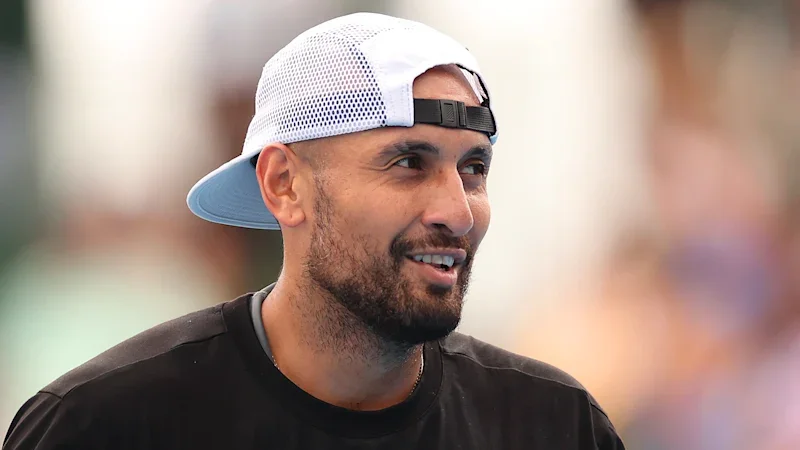
The end of Nick Kyrgios’ tumultuous, eminently watchable career is rapidly approaching.
His positive test for cocaine, which both Kyrgios and the International Tennis Integrity Agency announced on Wednesday night (AEST), may hasten that end.
Whenever it comes, there will be a tinge of sadness.
It’s been written plenty of times before that Kyrgios has failed to realise his potential. How, if he stuck with a coach, worked as hard as Lleyton Hewitt or Alex de Minaur, and was as dedicated and disciplined as Novak Djokovic, he could have achieved more.
But there is more nuance to Kyrgios’ situation than that. It comes down to understanding – or trying to understand – who he is, and isn’t.
It’s easy to focus on Kyrgios’ potential: blistering serve and forehand, ridiculously easy power, natural athleticism and hand-eye coordination.
But a tennis player’s success, particularly when it is sustained beyond one match or tournament, owes to so much more than just the raw physical tools. The intangibles – such as desire, motivation, mental strength, resilience, and even support team and environment – are an incredibly important part of the entire package.
Kyrgios beat all of Djokovic, Roger Federer, Rafael Nadal and Andy Murray – “the Big Four”, and best players from his prime – which is why people struggle to understand why his grand slam resume counts just one final (2022 Wimbledon) and three quarter-finals.
Let’s be clear – making even a single major final is a great effort. But Kyrgios’ intangibles never matched his physical gifts, like, say, Jannik Sinner’s do.
The 31-year-old’s relationship with tennis is complicated, to say the least.
He touched on that in his apology on Wednesday to his family, friends and fans, saying: “I’ve always said I didn’t choose tennis – tennis chose me. But letting go of something that has been my whole life is one of the hardest things I’ve ever had to face.”
Knee and wrist injuries curtailed Kyrgios’ career, just when he appeared to have found his own formula to succeed.
He played only 10 singles matches across the past four years since he made the Wimbledon final and US Open quarter-finals within months of each other.
Kyrgios makes no secret of his pride at his Wimbledon achievement, but referenced the challenging period afterwards with his failing body as context, rather than a total excuse, for why he took cocaine.
Throughout Kyrgios’ roller-coaster tennis journey, he said he preferred basketball, at times had a “hate” for tennis, and did not always fit into the sport’s culture.
But Kyrgios also readily, and rightly, admits he owes his fortune and celebrity to tennis. As above, it’s complicated.
We have all seen the photo of him as a pudgy Canberra kid wearing a Wu-Tang shirt and wielding a racquet in his right hand. He has regularly referenced that photo to illustrate the point that he never thought he would scale the international tennis world.
Kyrgios went on to be a world junior No.1 whose life was arguably never the same from the time he defeated Thanasi Kokkinakis in the 2013 Australian Open boys’ final.
If it wasn’t altered for good then, it certainly was by the time he stunned Nadal in the fourth round at Wimbledon barely 17 months later as a 19-year-old wildcard.
Very few of us can ever relate to being that well known and carrying such great expectations at such a tender age. We might think we would handle it perfectly while shaking our fists in fury as Kyrgios spoke crudely to Stan Wawrinka, smashed numerous racquets and generally behaved poorly.
Not everyone can be as mature as Ash Barty, but even she took a sabbatical from the unforgiving tennis tour and never stopped struggling with spending months away from home.
I will never forget walking past a sobbing Barty, then coached by Jason Stoltenberg, after she lost a second-tier match in Burnie, Tasmania, mere months before she took a break.
It is not a coincidence that Barty’s least-successful slam was the US Open, the last of the four majors each year. She retired from tennis a second and (almost certainly) final time at the peak of her powers at age 25.
Kyrgios’ revelations four years ago about his previous self-harming and substance abuse while experiencing depression were raw insights into the challenges he has faced, and went some way to explaining his path and decision-making.
Kyrgios and Barty are polar opposites in personality and temperament, but shared similar struggles in the sport they both excelled at to varying degrees.
Neither is particularly fond of journalists – and they are far from alone there. But Barty was generally a media darling, whereas Kyrgios was an easy target for figurative bullets because he provided so much material and was a one-man clicks factory.
He is a renowned doom scroller who never hesitated to type his name into X to find a keyboard warrior he could go to battle with, just for the sake of it.
Some of Kyrgios’ social media and real-life jabs at peers, such as “boring af” Casper Ruud, were as childish as they were unnecessary, and he remains sensitive when others do the same to him.
That said, Nadal’s coach and uncle Toni’s comment in 2019 that Kyrgios was “not good for the sport” lacked perspective.
Kyrgios attracted fans who previously never cared about tennis, filled stadiums, sparked major TV ratings, and is a born entertainer who was spectacular to watch when he was on song – and even when he was not.
It is sad that Kyrgios had such a difficult time playing tennis at the top. It is also sad that his last major headline as a player might be a negative one.
If you or anyone you know needs support, contact Lifeline on 131 114, or Beyond Blue on 1300 224 636.