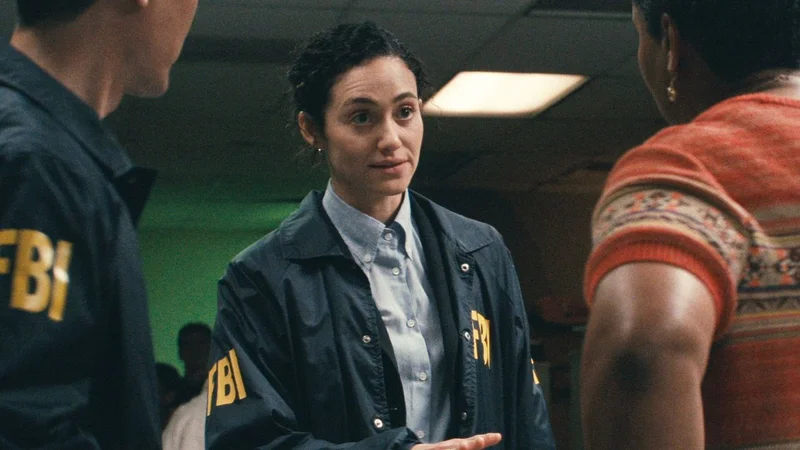
If you've been watching Furious on Hulu and Disney+, you'll know that Steve Way's character Alden is clearly the breakout star of the show.
If you haven't been, you're sorely missing out. The overarching plot follows FBI agent Alice Black (Emmy Rossum) as she hunts Catherine Grace (Lola Petticrew), a calculating sex-trafficking survivor turned serial killer.
Along the way, we find out that Catherine has a job as a home care aide for Alden (Way), whose mother has recently died. Way has muscular dystrophy, with the part of Alden being specifically created for him after showrunner Elizabeth Merriweather met him on a panel while speaking about her previous series, Dying For Sex.
As soon as you see Way on screen, you understand why. Not only do his stand-up comedy chops mean that his timing and sense of humor are impeccable, but his presence on screen is so enigmatic that you're never watching anyone else that's in the same shot.
I was expecting to be in stitches when the chance came up to interview him — and trust me, I was — but to my surprise I also came away with an entirely new perspective on AI, thanks to how much it's helping disabled actors behind the scenes.
'It's something no business, corporation or boss would ever give us'
"I use technology every second that I'm awake," Way tells me. "I'm on my laptop, writing, I read my scripts on big PDFs. I had to zoom in to a table read. I use AI almost as an assistant. It helps me keep track of my schedule and what I'm working on.
"When I'm out, I use Text to Speech to make phone calls or send messages... I've been doing that since I was 14. Assistive technology is a huge part of disabled people's lives. I use an on-screen keyboard to type where I never thought I'd be able to. It's the little things like that that make my career possible."
Sign up for breaking news, reviews, opinion, top tech deals, and more.
It's as Way says this that I wonder if I've approached the ongoing AI debate, especially concerning its place in the entertainment industry, all wrong. I've always been of the belief that the less AI is used in general, the better, but I've never considered the arguments from someone else's perspective.
We normally think of the other person in the debate as a creator who's decided to reproduce classic films using AI software, or somebody unnecessarily using ChatGPT while ignoring how much damage its data centers are doing to the environment (mostly through water consumption).
But actually, they could be someone who's life is being transformed for the better because of AI's accessibility. "AI is not going anywhere, and I think we have to embrace it in some capacity," Way adds.
"When emails first came out, people said, 'Oh, I don't want to use that. That's not the future.' But where would we be today without emails? I think there's a balance, but for me, and disabled people, but AI can help us a lot.
He continues, "It can help us with our workflows, our day-to-day routines, it can help us make money because we lose out so much potential with jobs. There are AI jobs out there that weren't there two months ago, and those jobs that allow us to work from home on our own schedule. We're not burnt out. We're not exhausted. We can work at our own pace, and that's something that no business, or corporation, or boss would ever give us."
I've watched all of Furious so far thinking that I want to see even more of Way on our TV screens... and if a larger use of AI across the industry is what allows that to happen, then maybe I need to think twice before I judge.
Jasmine is a Streaming Staff Writer for TechRadar, previously writing for outlets including Radio Times, Yahoo! and Stylist. She specialises in comfort TV shows and movies, ranging from Hallmark's latest tearjerker to Netflix's Virgin River. She's also the person who wrote an obituary for George Cooper Sr. during Young Sheldon Season 7 and still can't watch the funeral episode.