‘I’m gonna die of this’: The hidden cost of former Socceroos captain’s greatest gift
Save
You have reached your maximum number of saved items.
Remove items from your saved list to add more.
AAA
For as long as he can remember, former Socceroos captain Paul Wade has had a gift.
When he was 11 years old, newly arrived in Australia from England, he realised he could head a football harder, cleaner and more accurately than the other kids he would play with.
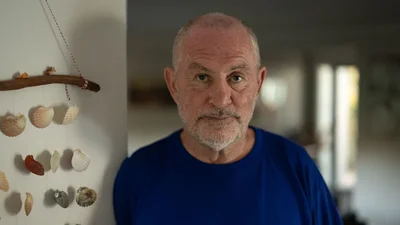
Paul Wade at his home on the Central Coast.Wolter Peeters
“Goalkeepers always kicked the ball into the air back then. Nobody threw it out,” he said.
“And because I was in midfield, I was probably one of the very few that was willing to head it. Right from the start, I knew I could head a ball - even if it was on the top of my head, where it hurt.
“I just felt that this was something I can do. And as I got older, the more I did it, the more accurate I got with my headers, the more people went: ‘Yeah, Wadey can head a ball. This is really cool.’ And then I just loved it.”
Wade would go on to win 84 caps for the Socceroos, wear the captain’s armband more often than almost anyone, and build a reputation as one of Australia’s most fearless competitors. He retired in 1997, but continued to endear himself to generations of Australian soccer fans through his work in the media, becoming one of the game’s most recognisable faces and voices.
Diego Maradona (right) and Socceroos captain Paul Wade walk onto the Sydney Football Stadium for the first leg of a World Cup qualifying tie in 1993.Getty
Not that he thought much about it at the time, but Wade’s willingness to put his body - and his head - on the line was the foundation for his legendary career. Every time he was split open by a stray elbow in an aerial contest, Wade could feel the adulation from supporters, teammates and coaches, and it made him walk taller.
“It was a badge of honour. And I fed off it,” he said.
“They cheered for me and they had respect for me when I went back into the dressing rooms. And for the rest of my career, I didn’t mind getting it done: stitches at halftime, coming off concussed and then saying, ‘Right boss, I’m ready to go back on.’”
Wade, now 64, cites the motto that he and so many footballers of his vintage used to live by: never let them know you’re hurt.
Former Socceroos captain Paul Wade has been diagnosed with probable CTE.Wolter Peeters
“That’s what kept me out there,” he said. “And it didn’t matter what happened, who hit me, if I fell on somebody - I didn’t make it an issue.”
Little did he know his greatest attribute would cause him so much grief later in life.
These days, Wade’s memory is not as good as it once was. It has never been great: he was diagnosed with epilepsy during his playing career and underwent brain surgery in 2002 to remove a scarred section of his temporal lobe, and that history made it easier for him to dismiss the concerns of those closest to him whenever he forgot an appointment, or couldn’t find something he had put down only 30 seconds earlier.
But there were also changes to Wade’s behaviour which didn’t track with the person they knew. Eventually, those changes became serious enough for his family and friends to intervene.
“There were a couple of incidents where Paul’s behaviour was not appropriate,” said his wife, Val.
“And when I say not appropriate … he spoke to people and did things that were just not OK. We nearly lost a friendship over it. That was the turning point. That’s when we sat him down and said, ‘You’ve got to go and see a neurologist. There’s something wrong, this is not you.’
“It still took probably a year to get him to do it, because he still didn’t think that there was something wrong with him, and he just kept putting it off.”
After speaking to his GP, Val began researching his symptoms and saw signs consistent with CTE, or chronic traumatic encephalopathy, a degenerative brain disease associated with prolonged exposure to repeated head impacts.
Definitive CTE diagnoses can only be made after death. But late last year, Wade was told by Dr Rowena Mobbs, one of Australia’s leading concussion experts, that he had probable CTE - the highest level of diagnostic certainty possible in a living patient, based on his history as a footballer, neurological symptoms and specialist assessment.
Wade can’t point to a single, major concussion incident which changed everything for him, like his former Socceroos teammate Warren Spink. But CTE is also associated with prolonged exposure to repeated head impacts, including sub-concussive blows that may not produce immediate or obvious symptoms. In football, that has focused attention on the cumulative effect of heading the ball over the course of a career, or lifetime.
“When I found out, the girls [his daughters] were very concerned. I said, ‘Don’t worry. I haven’t changed. It’s just that they’ve given me a headline,’” Wade said.
“But when the neurologist said, ‘It’s terminal. Go and make some memories,’ that’s when reality kicks in. All my mates have been going, ‘Yeah, but we’re all terminal, Wadey.’ But I’ll never forget those words when she said them, that it’s terminal.
“I’m gonna die of this. I might not die for 20 years, I might get hit by a bus, but there is no cure. And that was the moment I thought, people have got to understand … you don’t have to have a concussion to have CTE.”
Wade doesn’t blame anyone and has no regrets. That’s just what he and so many others who loved football did, and still do. But he is hopeful that, by going public with his story, greater awareness of the dangers of heading the ball can be raised, and the risks can be mitigated.
England has prohibited deliberate heading in matches for children aged under 12, while limiting heading in training for older junior age groups. Mobbs wants Australia to introduce similar restrictions, and Wade would also like to see that happen.
“I just want people to know that if you want to continue to do thousands of headers, these could be the consequences,” Wade said.
“And for those who are making the rules or should be applying the protocols, do it. Do it now. Don’t think about the consequences of that if you can save a few thousand lives.
“Because if I die in the next five years, all those doubters will go, ‘Wow, we’ve just wasted five years.’”
Save
You have reached your maximum number of saved items.
Remove items from your saved list to add more.