Stories of pirates are full of swashbuckling, daring-do, and grog. But Limbic Entertainment's city builder Corsair Cove reveals those hijinx are only a sideshow: logistics is the star. As the proud owner of a tropical island surrounded by high seas dotted with patrolling Spanish galleons, pirate hunters, and kraken, your focus is squarely on building the infrastructure to support pillaging, rather than taking a firsthand approach to the scallywaggery.
To keep your pirate populace happy, initially they'll only need basic food, drink, and shelter. In time, though, they'll start asking for finer things, like leather boots, jolly roger flags, and turtle soup. All of which you'll need to produce by rinsing the resource deposits on your island. Keep them happy, however, and they will set out on the ocean, crewing your vessels, and risking their lives against the threats that circle your enclave.
As a fan of the Anno series, the first hours of Corsair Cove were enthralling, but the sheen did begin to rub off after eight hours or so. Right about the time my pirates started to hate me.
In Corsair Cove, instead of spreading your town out, as in other city builders, you must construct upwards. Space is at a premium on your island, with only a few flat beaches and level clifftops. That's not an issue for your pirates, though, as these are people who spend half their seadog lives climbing rigging and swinging on ropes between ships. (Or, at least, so I presume from famous seafaring media, such as Pirates of the Carribean, the Pirates of Penzance, and Captain Pugwash.) As your city grows, you'll litter the cliffs around your island with cobbled together cabins, galleys, sawmills, all connected together by rope bridges, ziplines, and rickety pulley-operated elevators.
It's a canny choice artistically, making Corsair Cove look distinct from everything else in Hooded Horse's growing catalogue of city builders, but it has function, too. As you sprawl across the island, exploiting the land's natural deposits, you'll quickly find that for your pirate sanctuary to thrive, you must optimise the pathing between your resource mines, refineries, production facilities, and distribution areas. If you have a woodcutter on one side of the cove and a lumberyard on the other, you could have your workers skirt the cliffs on a path, but it's much more direct to string a rope bridge across the bay. As your game goes on and your production chains become more complex, you will see your island become a mess of interlacing paths. It captures the chaos of the pirate fantasy, while remaining an essential element of good play.
I want to stress how much of a production game Corsair Cove is because to look at it, you might presume something that's more genre light. However, if you don't master the interlocking parts of your pirates' economy, as you move into the mid and late game, you will find your people frequently on the brink of an outright revolt. And, undoing the steps that got you into those figuratively shark-infested waters can be very difficult.
It's only after you've built your first ship that things begin to get more complicated. With a crewed vessel you can explore the seas surrounding your island, where scattered among the waves and archipelagoes, you will find smugglers, shipwrecks, and other events where you can earn hefty rewards.
Your success or failure in these missions is determined by a simple card game where each move costs you supplies from your ship's hold. On most turns, your opponent in a mission, say a Spanish galleon that is trying to catch smugglers, will threaten to damage your ship or your crew. If either of those resources reach zero, you fail the mission and lose the ship. So, you might have an objective to sail 3000 metres under cover of night, and your opponent is threatening to damage your crew that turn. You could play a card that prevents crew damage, or one that progresses your ship 1000 metres. Run out of supplies to play your cards in a mission and the only way to get more is to sacrifice some crew or ship's health. Every mission is constructed as a series of these resource choices and, until you build more advanced ships, you'll need to return to port after most jobs, just to repair your hull and replenish your crew.
As you complete missions you will earn points that can be invested in upgrades, unlocking new buildings and production lines back on your island. You'll leave behind the low yield campfires and replace them with buccaneer grills. Though, for the superior kitchen to work, you'll also need to build a pig herder. Once you've a swine farm up and running, you may also want to send some of those pigs to the tanner, turning them into leather, which can be used to make boots and other clothing. But, the tanner also needs salt, so if you've not got that you'll need to expand your territory on the island with a new pirate camp and build a saltern on top of a salt deposit. That new pirate camp will need its own galley and tavern and shelters to keep your workers happy. And, of course, if you want all of these buildings to work efficiently, you'll need to build warehouses across the island that keep raw resources stocked up near the production facilities that use them, and more warehouses to store the finished articles, and distribution buildings to make sure they're getting out into your pirates' hands.
This is how Corsair Cove becomes increasingly complex. The more buildings you unlock and the more resources you need to collect, the further you spread across the island, and the further your goods have to travel. Limbic have done a great job of communicating efficiency, showing the route your items take between buildings, highlighted in green, yellow, or red to indicate how good (or bad) a job you're doing. That's good when the cost of hungry/thirsty/unsheltered workers is that satisfaction in your pirate camps will begin to plummet.
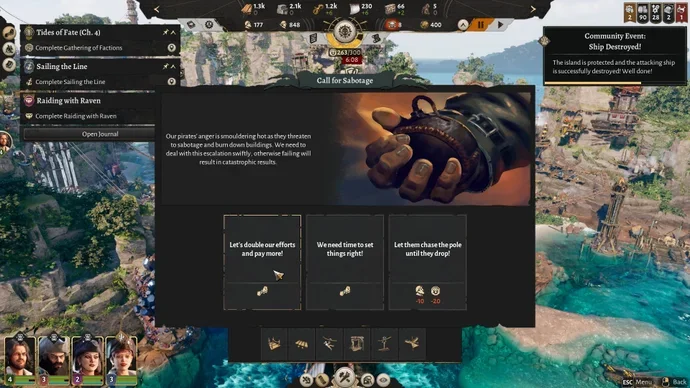
If your pirates' satisfaction hits zero it will start a timer. And if you don't satisfy their need before it reaches zero then your whole island's cohesion will fall. If that hits zero then it's game over for your camp. Early in the game, dissatisfaction is usually a fast problems to fix: you've built too many resource structures, but not enough shelters for the workers, or you're not producing enough food for all the hungry mouths, or your grog supplies are low. Plonk down some tents, a new campfire, or a brewery and satisfaction will start to rise.
It's only when you start building more advanced ships – ones which are crewed by specialist sailors with fancy tastes – that things get challenging. After making do with a single ship for a few hours, I decided to expand my fleet. With each pier only able to support a single ship, I built a series of pirate camps to expand my settlement over more of the island, constructed additional docks, and set my workers to building three more vessels. Each ship's crew demanded special goods – boots, eyepatches, hard tack, rum. While I had buildings producing these goods on the island, none of the buildings were placed with thought to the future, and so they were nowhere near the piers where the ships and their demanding crew were docked. The satisfaction in the pirate camps began to drop as my picaroons, bombardiers, and buccaneers stared into their empty holds.
The challenge is not just making the goods and getting them to the pirates, but doing it at a rate that they don't get through them all before you've been able to restock. I don't know how my pirates are burning through eye patches as quickly as they do, perhaps they're using them as slingshots or single-use coconut carriers. Currently my island is a constant stream of alerts, telling me my pirates are unhappy.
As each advanced ship has a different kind of crew, if I'd been thinking with my city planner's hat on, I would have built the ship at a pier better located to all the goods its eventual crew would need. But, I have misplaced my city planner's hat and holding that many goods and production chains in my head while also trying to find a spot to build a pier is well beyond me. Instead, I need to look at what has been built already and look for ways to optimise its route across the island.
This is where Corsair Cove begins to try my patience. After hours of building out my settlement, I'm now poring over the island, unpicking what I made. I'm deleting walkways and ziplines, replacing them with faster cliff paths and elevators. Where I had built one sawmill, I'm now finding space for a second, to up production from the logger's output. What makes this tedious when in other games it can be part of the pleasure is that deleting buildings and walkways is fiddly. You can't select multiple structures at once, or drag out your delete tool. You're deleting buildings and segments of walkway one by one and it can often be unclear both what you're clicking on. It's not difficult, but it's messy and I don't find it pleasurable in the same way as I do laying down paths in other city builders.
Meanwhile, when I can crew a ship and put it to sea, I'm now wishing that I could automate the card game quest. With more ships, it means more missions, meaning much more of the same fundamental activity with little variation. You have to complete quests to progress your campaign, but while the rewards you earn are necessary, they aren't rewarding to play.
The opening hours of Corsair Cove were engrossing. Spreading a city across beaches and cliff faces, and watching as your workers race around its rope bridges and dart across its ziplines, was delightful. But twelve hours in I've hit a sticky middle where the activities at sea are no distraction and back home on the island, I'm stuck untangling a net of production lines while pirate camps blare at me that my populace are unhappy. I'm going to try and push through and hopefully refind that earlier pleasure, but Corsair Cove has lost its gleam.