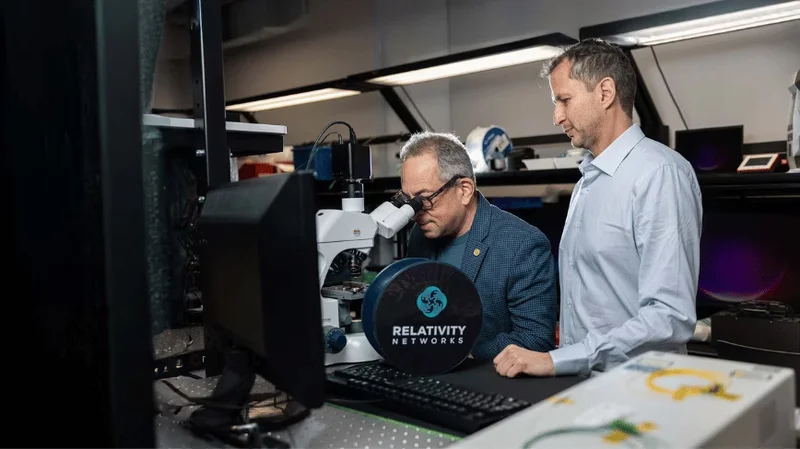
Relativity Networks has raised $22mn and landed a $40mn order from a large cloud provider. The company is pitching a faster kind of fibre for AI data centres. The Orlando-based company announced the funding and the commercial deal on Tuesday, in a press release.
The money came in as a $22mn SAFE. That is a form of investment that converts into shares at a later priced round. It came in at more than double the original target, the company said. New backers include Rhapsody Venture Partners, Bell Ventures and Faster Than Glass. The company did not disclose a valuation. A SAFE note is a standard tool for early-stage rounds, TechCrunch reported.
The $40mn order is a follow-on from a hyperscaler that the company did not name. The customer placed it after testing Relativity’s ChronoCore technology on a link between two data centres, the release said. The order is a follow-on, which the company presented as a sign the technology had cleared a real-world trial rather than a lab demo.
What the technology does
Relativity sells hollow-core fibre. Conventional fibre sends light through solid glass. Hollow-core fibre sends it through an air-filled channel instead. That lets the light travel closer to its speed in a vacuum.
The company puts the speed gain at roughly 47% over solid glass. TechCrunch reported a figure of 50%. Chief executive Jason Eichenholz gave TechCrunch a rough measure. A signal takes about five microseconds to cross a kilometre in normal fibre, he said, and about three and a half in hollow-core.
The gain matters over distance. Relativity produced its densest cable yet with Prysmian, a large fibre maker: 24 fibres in a single 10-millimetre cable. In tests with the supplier Dura-Line, the cable went into standard microducts. That shows the dense cable is ready for real deployment, the company said.
Why speed of light is now a constraint
The pitch rests on where AI data centres can be built. Operators are running short of electrical power, not computing chips, according to the company. So they are spreading a single system across several sites to reach the power that exists.
That spreads the chips further apart. When AI ran on one rack, the delay in the fibre was easy to ignore, Eichenholz said. Now a campus can sprawl across dozens of buildings, and the distance between chips has grown. The delay light takes to travel that distance becomes a real cost.
Relativity calls this shift the “AI Geography Era”, and the delay the “Propagation Tax”. The terms come from a white paper the company published alongside the funding. It argues that geography is now a first-order limit on how far AI can scale. Switches and software cannot remove the delay of distance, it says.
“AI is no longer scaling inside a data center. It is scaling across geography,” Eichenholz said in the release. He said the challenge is making thousands of scattered GPUs behave like one machine, even when the power they rely on is miles apart.
Eichenholz co-founded the company with Rodrigo Amezcua Correa, its chief technology officer. Amezcua Correa is a professor at the University of Central Florida who developed the hollow-core designs behind ChronoCore, according to Relativity. Eichenholz previously co-founded the lidar firm Luminar Technologies, the company says. The pair started the firm on the premise that power, not computing, would become AI’s limiting resource, forcing data centres to spread out.
The investors’ case
The backers framed the technology as a way to build in more places. Faster light means distant sites can sit farther apart within the same delay budget, they argued. Carsten Boers of Rhapsody Venture Partners said that more than doubles the area an operator can build in.
“Relativity Networks changes where AI infrastructure can be built,” Boers said in the release. He said the technology is deployed today and validated with partners like Prysmian, and that the order book is ahead of expectations. The claims are the company’s and its investors’, and it has not named the hyperscaler.
Bell Ventures made a similar case. “New approaches to infrastructure will be needed to support growing performance, scale and connectivity requirements,” said Martin Cossette, its head, in the release. Relativity also points to uses beyond AI, including 5G mobile networks and high-frequency financial trading, where even small time savings can matter.
A crowded race to wire AI
The funding lands in a busy market for the plumbing of AI. Investors have poured money into the links between chips, as faster processors strain the wires around them.
Others are chasing nearby problems. Point2 raised $136mn this month to work on the same wiring problem, and London’s OLIX is chasing an optical approach. Relativity is betting on the fibre that runs between the buildings, rather than the wiring inside them.
Hollow-core fibre itself is not new, but it is rarely deployed, TechCrunch noted. Relativity’s cable is produced at Prysmian’s plant in Eindhoven in the Netherlands and cabled at its site in Claremont, North Carolina. Prysmian is also expanding elsewhere in the AI supply chain, having bought Atkore this month.
The backdrop is a vast buildout. Data centre developers are expected to spend as much as $4 trillion by the end of the decade, TechCrunch reported, and are already limited by power and politics in where they build. Whether faster fibre changes that maths will depend on how many operators adopt it, and how far apart they choose to build.
Get the TNW newsletter
Get the most important tech news in your inbox each week.