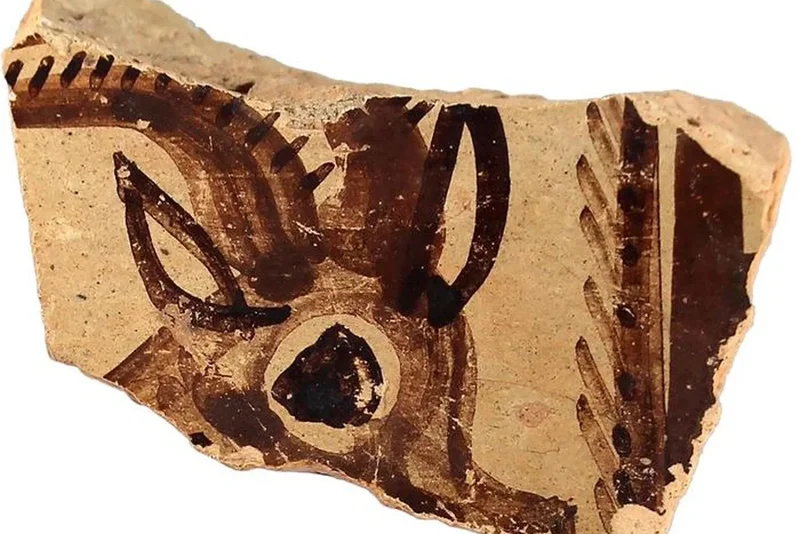
An oasis in Northwestern Arabia was once a popular centre 3,200 years ago, where “brands” of distinct, much sought-after pottery were sold, archaeologists have discovered in a new study.
At the oasis of Qurayyah in Northwestern Arabia, researchers found evidence of the production of distinct “two-colour painted pottery”.
The 3200-yr-old ceramic vessels were painted with distinctive black-and-red geometric designs, stylised animals, and human figures.
"Our discovery sheds light on how even in the arid environment of desert oases, where essential resources such as clay, water and fuel were scarce, local communities already in the Bronze Age were far from marginal,” said Marta Luciani, lead author of the study published in the journal PLOS One.
“Oasis-dwellers were resourceful and inventive enough to create their own ceramic repertoire: to cherish at home and eventually export abroad," said Dr Luciani, an archaeologist from the University of Vienna.
In the study, researchers probed into several facets of the found ceramic fragments, including their visual identity, chemical composition and consistency, technological continuity, production, export circulation, imitation, and cultural reputation.
“We investigate branding not through the analysis of added markers and/or packaging but through the development of commodities manufactured with culturally specific production modes and unmistakable visual properties,” scientists wrote.
"Thus our study's implications stretch beyond archaeology and the long-term relationship between humans and natural resources in climatically extreme regions into fields such as the economic mechanisms mediating producer-consumer relationships across time and space,” Dr Luciani said.
Archaeologists found that the first set of Qurayyah Painted Ware was produced 3,600 years ago.
The pottery production continued for centuries, constantly evolving into a flourishing repertoire of painted animals and human rituals by 3,200, the study revealed.
“This became the brand that was exported over hundreds of kilometres north to the Southern Levant, to sites like Tell el-Kheleifeh and even the Timna sanctuary of the Egyptian goddess Hathor, and south to North Arabia,” said Doralice Klainscek, another author of the study.
“But Qurayyah's potting tradition did not stop and continued to be based in the oasis for another thousand years well into the final Iron Age,” she said.
Overall, the study reveals surprising new insights about trade during the Bronze Age and shows that brands are not a modern invention of capitalism. It also offers a method to understand how ancient objects mediated producer-consumer relationships across time and space.