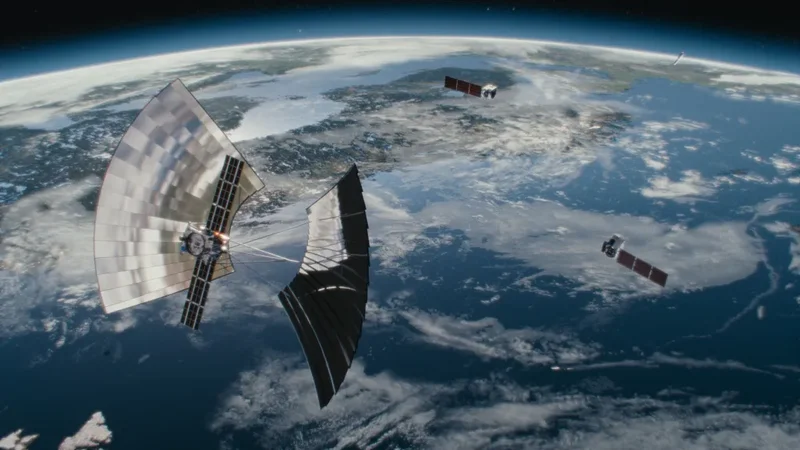
WASHINGTON — Portal Space Systems has acquired a Falcon 9 to launch its first Supernova spacecraft and will offer excess capacity on the vehicle for rideshare payloads.
Portal announced Aug. 20 that it signed a contract with SpaceX for a 2028 Falcon 9 launch of its first Supernova spacecraft, which uses solar thermal propulsion to offer high maneuverability.
The mission, called Motus Via Sol, or “movement with the sun,” will primarily test the Supernova spacecraft, which the company says offers high thrust as well as up to 6 kilometers per second of delta-v.
Portal said it is partnering with Maverick Space Systems, a launch aggregator, to sell excess capacity on that launch for secondary payloads. The companies did not disclose how much capacity is available for rideshare payloads but noted it will be able to accommodate ESPA-class satellites and larger “cake-topper” satellites, so named because they are placed on top of the payload stack.
The partnership comes at a time when many satellite operators are scrambling for rides to orbit because of concerns that SpaceX will end its own dedicated rideshare program in the next few years. Several companies said SpaceX is not accepting new reservations for rideshare missions beyond late 2028 or early 2029.
“This mission creates an extraordinary opportunity for rideshare customers,” said Vidur Kaushish, chief operating officer of Maverick, which has arranged launches of more than 225 satellites, many on SpaceX rideshare missions. “We’re designing an optimized payload stack for Portal and bringing additional rideshare payloads to the mission, helping reduce launch costs for all mission partners.”
Jeff Thornburg, chief executive of Portal, said in an interview that his company was among those struggling to find rides. “We saw launch as a commodity that the industry thought was solved, or not scarce, suddenly becoming potentially more scarce,” he said, citing limited capacity in the launch market.
He said Portal, along with Maverick, saw an opportunity to use the excess capacity on the Falcon 9 launching Supernova to carry secondary payloads. “While we were negotiating this with SpaceX, it just became more and more obvious that there was going to be a lot of people that needed access to orbit that weren’t going to be able to capitalize on rideshare because there’s not as many of them.”
Under the partnership, Maverick will be responsible for coordinating and integrating the secondary payloads, while Portal manages the overall mission and works directly with SpaceX.
Supernova’s high maneuverability will also give the companies the option to change orbits after launch to deploy some of the rideshare payloads. “If we have a predominant rideshare partner that absolutely has to be somewhere, we can accommodate that and still meet our mission needs,” Thornburg said.
“Portal’s ability to maneuver on orbit gives us the flexibility to select orbits that are truly valuable to rideshare customers. That’s what makes this strategy work,” Kaushish said.
Thornburg, though, said that the mission’s top priority is to test Supernova. “My number one obligation is to our mission, our investors and our customers, and so that was really the driving factor here,” he said.
Portal continues to develop and test technologies needed for Supernova. In March, the company flew Mini-Nova, a hosted payload on the Vigoride-7 spacecraft from Momentus, testing avionics needed for future spacecraft. Thornburg said those tests have been “flawless,” and the company is considering extending them for an additional six months to collect more data.
Portal’s first spacecraft, Starburst-1, is scheduled to launch in October on SpaceX’s Bandwagon-5 rideshare mission. Starburst is an ESPA-class satellite with 1 kilometer per second of delta-v. The company, which raised $50 million in April, is moving into a larger production facility in the Seattle suburb of Bothell, Washington, and expects to have 80 to 100 employees by the end of the year.
Thornburg said he is encouraged by the U.S. military’s interest in “sustained maneuver” in space that he argues both Starburst and Supernova can provide. “The momentum is only building for this rapid maneuverability, sustained maneuver capability, so it’s the perfect time for us to be locking in launch opportunities to demonstrate this over the next couple of years.”
He added that the agreement with Maverick is intended to be a long-term partnership, with the potential to arrange rideshare opportunities on future Supernova launches on Falcon 9 or other vehicles.
Thornburg, who worked for several years at SpaceX, including leading development of the Raptor engine that powers Starship, declined to speculate on the long-term future of SpaceX’s rideshare program or even the Falcon 9, which many speculate may be gradually phased out in the coming years as Starship launches ramp up.
“I’m excited to see what Starship brings,” he said. “To have a Portal spacecraft on a future Starship powered by Raptor engines that I helped architect and develop at SpaceX would be an awesome personal milestone for me and a heck of a lot of fun.”