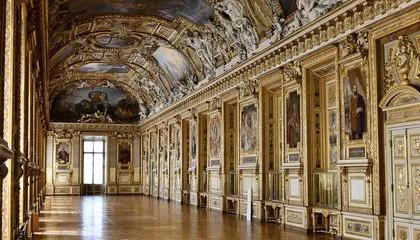
For the first time since thieves shocked the world by brazenly stealing crown jewels worth some $100 million from the Louvre last autumn, the museum reopened the scene of the crime to the public.
Officials say they hope visitors will appreciate the gilded Apollo Gallery, now devoid of display cases, as a work of art in and of itself.
“It will be an opportunity for visitors to better realize that they are inside a palace,” Christophe Leribault, the Louvre’s new director, told journalists this week, the New York Times’ Catherine Porter reports. “It’s a bit strange to see it empty in this way, but that was actually its function. It was a grand state reception gallery.”
Did you know? From palace to museum
The Louvre was originally a 16th-century royal palace built on the site of a 12th-century fortress. It was established as a museum in 1793.The space has a history of adversity and reinvention dating back before it showcased jewelry belonging to French royalty. In 1661, a fire destroyed its predecessor, a room known as the Petite Galerie, which featured decorations celebrating the kings and queens of France. That prompted Louis XIV to conceive of a new room, named for a Greek god, in 1662.
The hall became a sort of “laboratory for aesthetic and architectural experimentation,” according to the Louvre’s website.
Inside the gallery, vaulted ceilings are covered with scenes of Apollo leading his chariot across the sky, while carvings and additional images of the zodiac, cosmic symbols and mythic scenes adorn tall walls. It wasn’t until the mid-1800s that the space was completed with epic finishing touches, including wall tapestries depicting monarchs and artists and a nearly 40-foot-wide painting on the ceiling, Apollo Slaying the Serpent Python, by Eugène Delacroix.
The Louvre opened as a museum in the late 18th century, and the Apollo Gallery started displaying artworks in 1797. Items from France’s royal collections were exhibited there starting in 1861 in specially designed cases.
Most of the crown jewels stolen from the Apollo Gallery are still missing, reports Dominique Vidalon for Reuters. Other jewels formerly on display there will be relocated elsewhere in the museum, officials say, per the Times.
“That sinister day, when iconic pieces were taken, cannot be forgotten, and indeed, I believe, should not be,” French Culture Minister Catherine Pegard told the media, the Associated Press reports. “It was a trauma for the entire world, which, for several days, expressed its shock and sadness in every language. It was a trauma for us, discovering the fragility of a place we thought unshakeable, and which, like so many others, proved vulnerable.”
Some of the first people to explore the reopened gallery expressed hope about the Apollo Gallery’s future.
“It’s the most beautiful room in the Louvre, and we’ve been deprived of it since Oct. 19,” Benjamin Randow, a 64-year-old visitor, tells the Times. “I am still eagerly looking forward to these display cases being filled with objects again. It must not just be a hallway that people walk through.”