Everyone agrees you have to build with AI now. That argument is over. The unsettled questions are what a product built on agents is supposed to measure, and what stops a foundation model from doing to you next quarter what you just did to your own category.
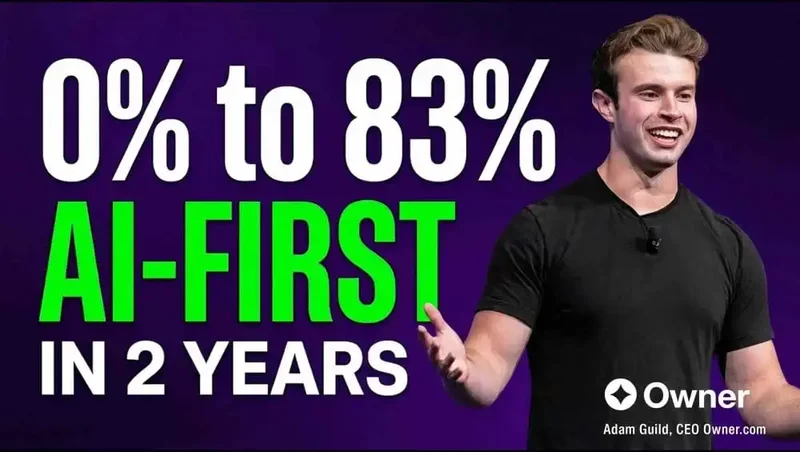
Adam Guild has been running that experiment at Owner for three years, and he brought the results to the SaaStr AI stage. Owner is a Shopify for restaurants: websites, online ordering, marketing automation. More than 83% of new customers now start their journey inside the free AI product, up from 0% two years prior. They grew faster YTD 2026 and in 2025 than they did in 2024. They’re accelerating after $100M ARR.
His three product conclusions cut against most of what B2B founders were taught, and one of them will make your board deck look worse.
Top takeaways for B2B founders:
- Logins are now a failure signal.If a customer is in your dashboard manually fixing what your software did, the software didn’t do its job. DAU, WAU, and MAU should go down as the product starts doing its job.
- Agents only pay off on top of an extremely opinionated product.Users don’t experience it as a better interface. They experience software that produces the outcome without them configuring anything, which only happens if the product has a point of view and enforces it.
- That opinionation is the insulation from Claude and ChatGPT.A foundation model builds a decent restaurant website today. What it can’t know is which components on that specific site correlate with sales growth. Enforce one system across the base and you generate that data. Let every customer configure their own and you learn nothing transferable.
- Growth metrics are a lagging indicator of a platform shift.Owner’s numbers were excellent the entire time the ground was moving under them.
- The wrong question is how many fewer people you need.Guild’s argument for why “same plan, smaller team” is a choice about ambition rather than an inevitability.
1. The threat was two-sided, and neither side showed up in the numbers
Starting in early 2023 and into 2024, Owner faced pressure from two directions at once:
- The first was AI-native startups doing things that weren’t possible a year earlier: generated websites, AI phone answering and ordering for restaurants. They were growing fast and aimed directly at Owner’s product surface.
- The second was worse. The large public companies in the restaurant tech category noticed Owner’s momentum and responded the way incumbents respond: hundreds of engineers thrown at cloning the product, then distributing the clone into installed bases of hundreds of thousands of similar customers.
Guild’s read was that without a change, Owner would bleed out slowly and not have a business in a few years. That conclusion was available to him well before any of it appeared in a growth chart. The metrics kept saying everything was fine.
2. Three groups of smart people, three good reasons not to move
Seeing the risk wasn’t the hard part. The hard part was that nearly everyone informed and invested disagreed.
- Investors:“This is CEO thrash. We can’t invest millions in a new product direction and pull people off something that’s working and growing efficiently. Layer it in gradually.”
- His own team:PMs and engineers pointing out they personally knew 100 customers asking for specific things the roadmap already covered. Pulling those people onto something unproven to chase an AI fad was hard to justify to anyone who had to look those customers in the eye.
- The industry experts:the people who’d spent entire careers in restaurants, telling him that if there was one thing they knew, it was that restaurant owners are terrified of AI, and pivoting would alienate the customer base.
Each objection was reasonable on its own terms. Two of the three came from people whose job was to be closest to the customer. That’s what makes this failure mode dangerous: it doesn’t feel like resistance to change, it feels like discipline.
3. What broke the tie was a poster nobody planned to bring
The moment came at the International Pizza Expo.
Guild showed up early, laptop set up, ready to run his usual demo of the websites and online ordering product. The doors opened. The first few pizzeria owners walked past the booth. Then one of them craned his neck at something behind Guild, walked to the back of the booth, and pulled out his phone.
He was scanning a poster one of Owner’s PMs had brought as an afterthought. It advertised an upcoming product that was, at that point, an embarrassing MVP: analyze everything broken about your restaurant online, then fix it with AI. There was a QR code.
Joe, a 55-year-old pizzeria owner from Pennsylvania, was fascinated by it.
Then it happened all day. Across dozens of conversations, AI became the single most common thing owners wanted to talk about, at a booth where almost none of the collateral was about AI. How do we use it to drive customer discovery? How do we use it to drop labor costs?
The customer discovery interviews from three months earlier had produced the opposite answer. So had the industry veterans. What changed in between was that ChatGPT had reached small business owners, not just the tech industry, and they’d decided AI was an advantage they wanted before anyone asked them about it.
Owner went all in that day, including neglecting real fires elsewhere in the product to do it.
4. The rebuild: from “book a demo” to “type in your restaurant name”
Before the change, Owner was 100% sales-led. Inbound lead, book a demo, talk to a salesperson, then talk to an onboarding specialist, then get a website built.
The question they asked was how much better that entire journey could get now that generative AI existed. The answer was a free product where a restaurant owner types in the name of their restaurant and the agents do the rest. In under five minutes, it:
- Crawls every place the restaurant appears on the open web
- Pulls in nearby competitors so the owner can see their competitive position
- Audits their Google Business Profile settings, descriptions, and keywords
- Reads all of their reviews to learn what customers actually love about the place, then rebuilds the site content around that
- Runs a photo quality analysis and an AI photo shoot, upscaling images and correcting lighting and color
- Adds motion with Veo 3 to produce a hero video
- Checks roughly 90 SEO and CRO factors
Guild demoed it live on a Thai restaurant whose existing homepage was a photo of napkins under the words “Welcome.” Five minutes later: dish spotlights pulled from what people were saying on Reddit, Instagram, and Facebook, a photo gallery, bar and cocktail detail, and a video the owner had never seen before.
The tech community found this two weeks ago and gave it more than 2 million views on X. In the restaurant world it’s been compounding for two and a half years.
The results: more than 83% of new customers now start their journey in the AI product, up from 0% two years prior. Faster growth YTD 2026 and in 2025 than in 2024. Approaching $100M ARR.
5. Product lesson: agents only work on top of an extremely opinionated product
What makes an agent feel magical to a user is that, for the first time, software drives the outcome the user wants without them manually intervening to configure it correctly. The value is the time saved and the expertise no longer required to operate the product.
That only works if the product has an opinion. If the software has to ask the user what to do at every fork, it isn’t driving anything, it’s a form with better copy. The generated restaurant site is powerful because sales go up when the owner turns it on, not because it looks better. The system encodes best practices learned from powering thousands of restaurant websites and the behavior of tens of millions of consumers on them.
6. That same opinionation is what insulates you from Claude
Guild named the fear directly: getting rolled over by the foundation models.
Point Claude Code or Codex at that Thai restaurant today and ask for a beautiful new website, and you’ll get something far better than what was there. That’s true, and pretending otherwise is how founders lose two years.
What the model doesn’t have is which components on that restaurant’s page correlate with sales growth. Which call to action converts. Where the navbar goes. What homepage structure gets that particular kind of restaurant to the top of Google in that particular market. The models are trained on the corpus of restaurant websites that exist, most of which are bad, plus general UI best practices.
Owner has the outcome data because they enforce one system across their entire base. Opinionation is what generates that data, and the data is the moat. If every customer gets a bespoke configuration, you never learn anything transferable, and you have nothing a general model can’t replicate.
7. Logins used to be the health metric. Now they’re the failure signal.
In the old B2B model, DAU, WAU, and MAU in the dashboard meant an engaged user base and a working product.
Guild argues closer to the opposite is now true. If agents are valuable because they drive the outcome without constant manual intervention, then every time a customer logs into the website builder to fix how the software set up their restaurant online, that’s a failure. The user is solving problems the software created.
The target is an experience low-touch enough that the customer doesn’t need to be in the dashboard at all, because the system knows the best practices and executes them continuously on their behalf.
This one has real teeth for anyone whose board deck leads with engagement. If the product is working, some of your headline metrics should go down, and you need that story ready before the quarter it happens.
8. Owen: the internal agent that removed 90% of builder coordination work
The product change forced a change in how Owner builds.
It started with Will, one of those rare people who is a strong product mind, design mind, and engineer at once, and the first person on the grader product. As it took off, more engineers, PMs, and designers moved onto it, and Will started absorbing all the coordination overhead that comes with a larger team: keeping Linear and Notion current, daily standups, status chasing. That work is accepted as normal in product development and it lands hardest on the most leveraged ICs in the company. No great builder wants to do builder busywork.
So he applied the same logic that produced the product breakthrough to the development process itself, and built Owen.
Owen listens continuously to GitHub, Slack, Notion, Linear, and Google Meet transcripts via Gemini, then keeps the team aligned automatically. Will no longer sits in meetings asking for status, because the state of every project is available in real time.
The second thing Owen does is more directly useful. When someone posts a bug or a visual issue in Slack, say a screenshot of the agentic chat with a note that the bullets look too small, Owen calls Claude Code, which has full visibility into the codebase, and opens a first-draft PR immediately. The old path was a ticket in Linear, a front-end engineer picking it up, finding the component that controls bullet size, and shipping the fix. Across a large product surface, that class of work consumes an enormous amount of expensive attention.
9. The Product Insight Command Center, AI-native finance, and AI-native sales
Three more internal builds, each replacing a lossy human process:
- The Product Insight Command Center.Owner’s co-founder and CTO Dean was spending hours every month interviewing support, sales, and CS, reading tickets, and talking to customers to figure out what mattered most to build next. It’s a slow process that loses fidelity at every hop. The command center pulls continuously from Salesforce, Intercom, Momentum, Talkdesk, and everywhere else customer-facing interaction happens, grabs the transcripts, and flags every time a prospect asks for something that doesn’t exist or contacts support because of a bug. The output is real-time visibility into where friction is costing revenue.
- Finance running in Claude instead of Excel.About 18 months ago, Owner’s CFO and finance team made Claude the primary financial artifact rather than the spreadsheet. The use case that sold it: an investor asks how Q3 rule of 40 compares to Q4, or how CAC has moved over specific periods, and instead of “great question, let me get back to you,” the model gets queried in the moment. Every founder knows the version of this where the answer arrives four days late and the moment is gone.
- Pre-call research and automated qualification.Reps were spending 20 to 30 minutes before every demo researching the prospect, because restaurant owners are busy, overwhelmed, and skeptical, and showing up unprepared gets you dismissed. Owner’s CRO, go-to-market AI lead, and BizOps team built a system that fires the moment a lead enters: it runs the full grader report on the prospect’s current online presence to drive problem awareness, identifies the nearest highly successful Owner customer for social proof, and produces an estimated gross payments volume for that restaurant accurate to roughly $250. That last number lets them prioritize and qualify without a BDR working through a script. Results over three years of tuning: more than a 90% increase in call volume and rep time with customers, plus a substantial lift in close rate.
There’s also a smaller build worth stealing. Selling is emotionally brutal even with a great product, because rejection is constant. Owner’s marketing team wired Momentum into every post-sale customer touchpoint, and any time a customer says something positive, which happens multiple times a day, the exact quote goes to the team. The rep who signed that customer sees that the owner has driven $150,000 in additional sales and has never had an issue. Constant, specific evidence that the thing you’re selling works is a real input to a rep’s conviction.
10. The CEO has to build, not mandate
Guild’s sharpest observation on the psychology was about a failure mode he sees in peers: telling a team something like “if you don’t 10x your productivity with AI you’re out of here,” and then not doing much with it personally. Scary statements without personal example don’t work.
He’s not a technical CEO. He describes his prior experience as being a mediocre script kid building Minecraft servers, and he hadn’t written production code in Owner’s history until recently.
Then a customer, Juliana, who runs a Oaxacan restaurant, told him she’d spent $2,000 and half a day on a commercial photo shoot for her menu, then added new spring items she couldn’t afford to bring the photographer back for. Her iPhone photos looked bad enough next to the professional ones that she almost didn’t want to add the new dishes to the menu at all.
That conversation was on a Friday. By Saturday afternoon, after about six hours, Owner Photographer existed. The owner uploads the bad photo, picks a style, and in under 30 seconds a chain of models describes the photo in precise detail and feeds it to Nano Banana with a set of anti-prompts specifically tuned so the food doesn’t land in uncanny valley, which is the failure mode that kills this category. Juliana’s blurry taco photo came out matching the exact style that had cost her $2,000.
Hundreds of customers use it. It’s one of five things Guild has personally built in the past two months.
11. The wrong question: “how many fewer people do we need?”
The conclusion Guild thinks most leaders are getting backwards: now that people are more leveraged, asking how many fewer of them you need to execute the original plan.
His argument is that the right question is how much more you could build, how many more customer needs you could meet, and how many high-agency people could help compress ten years of roadmap into one or two. Jevons paradox applied to headcount: as the resource gets more efficient, it becomes rational to use more of it. AI is a golden era for high-agency builders, and shrinking to run the original plan with fewer people is a depressing use of the moment.
Reasonable people land differently here, and plenty of very good operators are running the opposite play with real results. What isn’t in dispute is that “same plan, fewer people” is a choice about ambition, not an inevitability, and it should be argued rather than assumed.
The 5 failure modes Adam Guild called out
Two of these he nearly walked into himself. Three he sees in peers right now.
- Trusting customer discovery over customer behavior.Owner’s interviews three months before the Pizza Expo said restaurant owners didn’t want AI. A guy scanning a QR code off an afterthought poster said the opposite. Behavior was right and the interviews were worthless, three months apart.
- Letting deep industry expertise veto the bet.The people with the longest careers in restaurants were the most confident and the most wrong. Category expertise is a description of how the category used to work.
- Mandating AI without building anything yourself.Telling a team “10x with AI or you’re out” and then shipping nothing personally. The team reads the gap immediately, and the statement stops meaning anything.
- Treating engagement as product health.Carrying DAU, WAU, and MAU forward into an agentic product measures how often your software fails to finish the job.
- Asking how many fewer people you need.Guild’s view is that leverage should raise ambition, not shrink the org chart, and that “run the original plan with fewer people” wastes the opening.