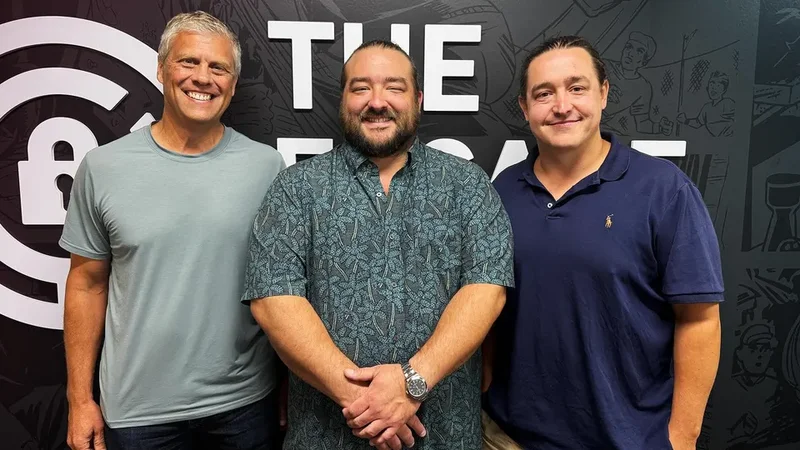
On a family trip to London, Mark Flint booked and paid in advance for an attraction he had never tried, an escape room that TripAdvisor kept ranking as the number one thing to do in the city. Back home near Nashville, that single hour of tangible discovery became The Escape Game, the company he co-founded in 2014 that now operates roughly 60 corporate-owned locations and has collected more than 400,000 five-star reviews. Flint has since committed over $40 million in a single year to new stores and upgrades, built a 82,000-square-foot factory to make every set and prop in-house, and launched a second brand, all while refusing to franchise a single location.
Dave Knox: I want to start with the origin story. What inspired you back in 2014 to launch this thing that became The Escape Game?
Mark Flint: We often look fondly back on those times. We were actually on a family vacation, planning to go to London. We had never been, and we were going with another family, so there were maybe 10 or 11 of us all together, including my wife and I and our then 13-year-old and 15-year-old.
I did the itinerary planning, and I kept seeing this thing called an escape room. I looked it up on TripAdvisor. I was planning all the great things to do in London, like the Tower of London, the churches, the castles, Oxford, the home of C.S. Lewis, and there was this thing that just kept popping up as the number one thing to do in the city. So I read the reviews, and it was booked out way ahead of time, and I said, we just have to do this. Without consulting anyone, I booked and paid in advance for this thing called an escape room.
We had a great time on that trip, but the escape room was a standout, and what was great about it is that everyone enjoyed it. It wasn’t particularly well done, it wasn’t built out like we do today, it was very rudimentary. But some of the other things we did, some of our group liked more than others. When we went shopping, part of the crowd was happy. When we were touring C.S. Lewis’ home, some were loving it and some were bored. In that escape room, for an hour, as the clock ticked down and we played a real-life game that was tangible and full of discovery and surprises, every single one of us had a great time.
So we came back to the States. I had a good friend at church whose sons I heard were entrepreneurs. I texted their dad and said, isn’t one of your sons an entrepreneur? He said, oh yeah, both of them are. So I met with Jonathan and James Murrell , and we talked about trying this thing called an escape room in Nashville. They loved the idea, the timing was perfect for them career-wise, and the very next day we started designing games in the Flint family basement. Within a few weeks we were on a plane to Budapest, which we had heard was the hotbed of escape rooms in Europe.
Fast forward, and it’s hard to believe it happened this quickly, but by April of 2014 we had opened our first location in Nashville. Now, no one would lease space to us. We had a map of the city and all the places we wanted to go, and we kept hearing no. What are you trying to do? That’s not a good fit for our space. We ended up buying an office condo and opening in Berry Hill , and the business took off like a rocket. We went straight to the top of the TripAdvisor list, which at that time was the consolidator for things to do in every city across the world. I think we invested maybe $70,000 to get it open, and our revenues in July were over $250,000. People were coming from everywhere. That was the beginning of The Escape Game.
The Experience Is The Marketing
Knox: From that moment of hitting number one on TripAdvisor, you suddenly had Escape Game stickers showing up on cars and guitar cases all over town. When the experience itself is the acquisition engine and the driver of word of mouth, with more than 300,000 five-star reviews today, what is the purpose of the marketing team?
Flint: We are always discussing that very question in our meetings. A lot of times it is, hey, let’s go back to the basics. Our mission at The Escape Game is to design and deliver epic interactive experiences for every single guest. That every single guest is really the heartbeat of our mission, so at the core, what we’re trying to do is create a great experience.
True success for us is having our guests be direct marketers. If we’ve hit the center of the bullseye, the experience was compelling and unique enough that our guests are not just saying they would recommend us to a friend or loved one, but they actually do. We do all the things with marketing that we should. We want best practices, we want to identify the important channels and resource them appropriately, optimize our digital presence, advertise where it’s effective, all the textbook best practices. But we also want to stand out with our experience, because that is not subject to the latest change in the Google algorithm. When TripAdvisor, a couple years in, basically pushed every escape game company to the bottom of their list, we were still able to generate new business because of the core experience, not just stories about the core experience.
In The Best Way, We Are Control Freaks
Knox: One of the core principles of the company has been no franchises. Every location is corporate-owned, despite the investment that comes with that. What has that allowed you to do in terms of controlling the experience?
Flint: It’s really part of our identity, and it goes back to the mission. Every company has a mission and some values and tries to adhere to them. We try to be authentically mission, vision, and values driven. When we think about executing on our mission, we don’t think we can do it well if we delegate control of the guest experience to others. So it’s not only ownership of our locations, but soup to nuts: the design, the manufacturing, commercializing the product, the locations we pick, how guests interact with us both digitally and in person, and how the experience is delivered. We are, in the best way, control freaks, because our mission demands it.
There are strategic aspects too. Certain businesses lend themselves to franchising and certain ones don’t. We’ve had no shortage of opportunities to franchise both The Escape Game and Great Big Game Show. But it comes back to genuinely caring about the guest experience, and the consistency of our stores. Out of our 60 current The Escape Game locations, I think 59 of our general managers started as a game guide. It’s not us going on Indeed searching for a GM. These are team members who came to work knowing their job was going to be game guide. If they have our values, it takes about two years, but they can elevate, and we’ll teach them everything they need to know on the technical side. What that allows us to do when we open a new store is not send a corporate team in for a month and hope it sticks. We send two or three of our best and brightest from another location, and we know we’ve got the fundamentals and the values correct.
Knox: Building on that focus, you’ve publicly said you’re spending over $40 million this year on both new stores and upgrading existing facilities so none of them become stale. We’re in an environment with a lot of macro uncertainty. What is giving you the conviction to lead with such a capital investment?
Flint: It’s a fundamental conviction that at the core level, guests love the value exchange in our experiences more than ever. Guests are paying us money and scheduling some time that we know is precious to them, and coordinating a group to come. When they experience it and we deliver the way we intend to, we continue to see the same level of joy and guest outcomes that we always have. Our guest outcomes, which we measure very precisely, are as good as they have ever been. We obviously consider our paybacks. If expected volumes are a little higher or lower in a market, what is that telling us about our investment? We’re very in tune with those numbers. But at the core, it’s the confidence that the advertising and the channels may change, but fundamentally, guests are on the better side of the exchange, and we don’t believe that’s going to change.
Especially in this recent time where experiential has had some ups and downs and market pressure, it’s a reminder to our teams that there are things we can control and things we can’t. We don’t have to be defined by what competitors are doing, or what Google’s algorithm is this month, or what AI is going to do, or when we get hit with a pandemic. We’ve never been defined by what’s going on outside of us. We need to be aware of it, and be humble, and consider that everything we do might not turn to gold. But we get to punch back. If something challenging happens, we don’t have to just sit there and take it. We get to invest in content, or change our marketing strategy, or emphasize the guest experience, or create something new. It’s about keeping a long-term view even in an environment that is always pointing you to think about the short-term crisis.
There Is No Shortcut To An Escape Room
Knox: Most operators outsource fabrication and the build. Instead, you built the Adventure Factory, over 82,000 square feet just south of Nashville, where every set, prop, and piece of technology for all your brands is made. What led you to put so much focus on owning the experience all the way down to how every piece is made?
Flint: A lot of trial and error early on. Of course, we started by making our own things. If you could see the first room we created, even the test in our basement, we were using anything we could find to make puzzles. Fast forward more than a decade and we have a very sophisticated approach. Our design process is very iterative. None of us knew anything at the beginning. We didn’t have experience designing games or video games. When we put together our best first game, it was terrible. We had our family play, it took over two hours, and we had to give help maybe 70 times. We didn’t know what to do except make detailed notes on everything that went wrong, go fix it, and try again. We went through that process way too many cycles, but that’s how we learned.
I would like to say we’re brilliant strategists who knew we didn’t want to be subject to external pressures like suppliers or government tariffs. But we did try to outsource different components to some of the bigger production shops in Orlando, and they didn’t really work well. The quality wasn’t where we wanted it, so it was more efficient to have it in-house. Looking back, there are a lot of strategic benefits. We can control timing, quality, and the design process. We already have a lot of constraints in design, and having total control over the build lets us decide how deep we’re going to go on design choices. We feel like it’s a big barrier. There’s no shortcut to building an escape room on your own at that level. There are a lot of mistakes you have to make to get there, a lot of investment, learning, and know-how. It’s a real asset.
Knox: When you walk that floor, it’s carpenters and electricians alongside engineers, technicians, and scenic artists. How have you thought about staffing those very unique talents who can imagine what these spaces will be and then use their hands to bring them to life?
Flint: We often contrast the makeup of our HQ, where our core business functions are, with our Adventure Factory team. I think, last count, there were maybe four or five professionals in our entire HQ who went to school for what they’re doing today. On the flip side, we’ve got master’s degrees and fine arts degrees and skilled professionals doing exactly what they trained for at the Adventure Factory.
We were often told your culture at the shop doesn’t have to be the same as the rest of your company. These are different kinds of people, they work with their hands, they care about different things, and that industry is a little different from your hospitality business on the front lines of the stores. We just refuse to believe that. It is more challenging to have a great culture in the shop, and it takes a little longer to find a CNC operator who has your values versus one who doesn’t. In our stores, we just need a good fit with the values, a hard worker, someone consistent who wants to be there, and we can give them everything else they need. We can’t do that with a CNC operator or a really talented paint person. They have to have acquired that skill elsewhere, so a fit with the mission, vision, and values is super important, and it just takes a little longer. It takes a very intentional commitment that our whole company is going to have the same culture, no matter the normal industry or functional differences.
Craft Meets Code
Knox: It’s been said that the heart of a great technology company is when you don’t actually see the technology, and that plays out with The Escape Game, where a guest doesn’t realize all the magic happening behind the scenes. You’ve built something called Cosmo, your operating system. What led to that, and how do you merge the craft with the code?
Flint: That operating system is really one of the answers to scaling what is a very difficult business to scale. We often talk about barriers to entry in this industry, and they’re pretty low. You and I could probably spend this afternoon and have a game designed that our families could play tonight, and it probably wouldn’t be too long before we could get some operation up and running. But to put together a sophisticated game that integrates technology, immersive sets, and multiple rooms with architectural details, is really difficult to scale. Especially so if we are working with a theme where we don’t want the technology visible to guests.
It’s in our DNA to crave information and feedback because of our passion for the guest experience. cOSmo is a tool that tries to put our team in the best position to fulfill our mission. When we’re in a creative session with our game design team, we aren’t building the design around the outputs we’re going to get from the operating system. We still insist on looking at the game over and over from every single guest’s viewpoint. But the operating system provides a lot of information. For instance, we can know which tasks require help every single time. If that’s the case, it’s very likely we missed it on the design. We want our guests to be the heroes, and we’re just the guides, and Cosmo helps us do that.
The sky’s the limit for how we can fine-tune it, but there’s also a recognition that we’re not trying to create an AI superpower with enough information that a robot could run the game without a person. We’re rejecting that premise from the beginning. What we really want to do is highlight the parts of our experience that require great interpersonal interaction, and figure out how to best inform our store team members and design team on what’s working and what’s not.
Not Everything Has To Be An Escape
Knox: You recently launched a new game, Murder with a Side of Meatballs. It’s fascinating because, unlike your name, you don’t actually escape anything. It’s about solving a mystery. What led you to believe you could stretch the premise rather than build another escape?
Flint: There’s always been a recognition that the concept of escape rooms has evolved. Very early on, when you said those words, which are kind of the name of our industry, it created visions of, I’m locked in a room, it’s a little scary, how do I get out, and I have a time limit. That appeals to some and not others. The first time my brother came to play one of our games, he asked, can I bring bolt cutters? And I said, oh no, it’s not like that.
Even our Prison Break game, which lends itself well to escaping, has a narrative and more to it than just getting out. A creative with a real bent for narrative doesn’t like the fact that it’s always the hour constraint to get out of the room. So instead of a choice to venture out from what people think of as escaping, it’s more a recognition that our concept is really an adventure our guests go on. There’s something to do, something to win, and that might be getting out, it might be saving the world within 60 minutes, it might be solving something. There’s still a chance to win and lose, otherwise it’s a show. We would call it a show if every single team won. Murder with a Side of Meatballs is getting great reviews from guests, and it’s just a recognition of that.
Knox: Continuing on that thread of game and show, in 2023 you launched a brand completely outside The Escape Game, called Great Big Game Show. What led you to launch a second brand versus just opening more Escape Games across the country?
Flint: This is one of those where even internally, among our founders, you might get a different story on the genesis. The very beginnings go back to a concept six or seven years ago where we were going to have teams play escape games against each other on a platform. We never brought it to market, but one of the game modules in that platform was a game show module. Then fast forward to the pandemic. One of the things that got us through was our remote adventures, because no one could experience escape games in person. We started doing online games, and one of the things we brought to market was a game show version where teams played against each other. That was the very first iteration that we brought to market.
In 2022 and 2023 we tested extensively and put the concept together. We didn’t know how well it would work. It was kind of a rerun of our original Escape Game creation, where we kept testing a bunch of different minigames until we got it to a place where people were really enjoying the prototype we’d built at the Adventure Factory. It’s been a huge success. That concept is really growing. We have over 24 units now, and I couldn’t be more excited about where it’s going.
Knox: As you build out this house of brands, how do you think about balancing capital between the two? Are they intentionally growing the portfolio and revenue per guest, or do they cannibalize?
Flint: We do all the things strategically that they would teach you in business school. What’s the payback of each? We’re very in tune with how we’re going to allocate capital, and always looking for signs of where to best allocate it. While the concepts are very similar, we’re in the experiential space, small box, our locations are pretty similar, the experience is an hour, and there’s a certain level of interaction between our team and guests. But there are some interesting differences, and we’re mindful of competitive positioning and where each concept is on its growth path.
For capital, we look at both payback periods and longevity. I think there’s an overemphasis on paybacks in multi-unit discussions and longevity gets missed. We are committed to investing long term and to our mission, so we look at both.. The payback matters and is very important, but we also want to understand longevity. The cost per unit and complexity of the build-outs are different in each concept, the barriers to entry are different, and the competitive profile is different. Another internal constraint we have to be aware of is, how fast is too fast, and where are we sourcing our leaders from? The Escape Game business has made a gigantic investment into Great Big Game Show that you might not see on any financials, leaning on some of our best team members to come over and run the game show operation. Great Big Game Show show feels a little older now that you mention 2023, our oldest unit is three years old, but that’s only one of them, so we’re still learning a lot. And you have to sign a lease way ahead of time, build out, and put it into the manufacturing pipeline, so it’s not like we can decide overnight. But even given those constraints, we try to be adaptable and look at each opportunity at the margin.
The Guest Is The Real Decider
Knox: For the final question, in that funnel of all the amazing ideas your team comes up with, what percent make it to being an experience someone actually sees, and how do you decide?
Flint: I love this question. It’s one of my favorite parts of what we do. Our game design team is a pretty small group, and just about everybody in the company wants that job. People will go work for the stores just for the chance to someday be considered for the game design team. Everyone thinks it’s the best job in the world, and in some ways it is.
One thing we’re insistent on with anyone in that design function is that you have to look at the game from the guest perspective, and specifically from every single guest. Not just our median guest, who is a 31-year-old female, but the 8-year-old who’s going to be there with his family, the grandparents taking their grandkids, and the corporate group doing team building. It’s hard for creatives sometimes to set aside their own preferences; what they think would be cool. We do want what they think would be cool, but that’s not what’s going to rule the day. It’s about merit, and we take the time to test all the concepts and ideas. Some die at the drawing board because we’ve learned enough to know it’s not going to work. It requires really thick skin from those bringing forth the ideas, myself included. What is fun for the guests is what matters; they are the stars and our teams, including the game designers, are the supporting cast.
The real decider is the guest. That requires a longer time to market for a new game, because if we haven’t watched the game being played a hundred times, we’re not going to see all the situations that come up. A lot of times our process is iterative, and we’re searching for anchors. At various stages we’ll say, okay, we’re going to have a slide in the Gold Rush game, we believe that’s going to be one of the most fun things to do, we’re done, that is happening. That might drive another decision. So we bounce from narrative to room layout to task back to ambiance, slowly building out the game. If someone has an idea they really want in a game, its chances of ending up exactly the way they originally envisioned it are pretty small, because more often than not we’re going to be tweaking it, since all the little things matter. But ultimately, whatever’s going to bring the most joy to the guest is what goes in the room, not who brought the idea or how cool one person thinks the task is.