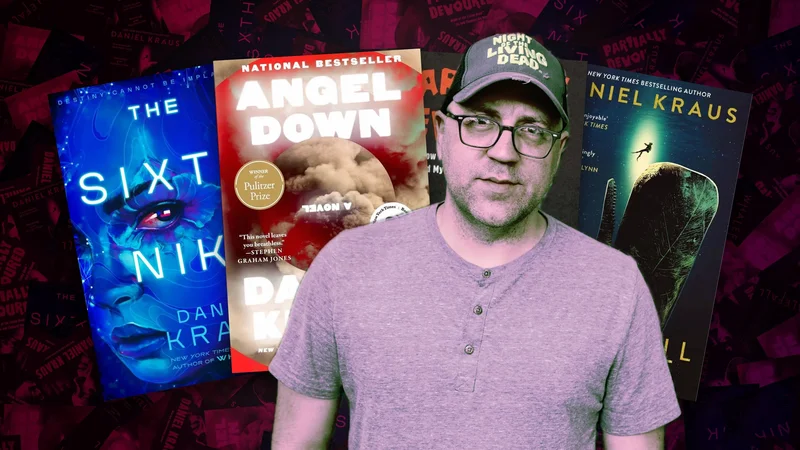
When it comes to Daniel Kraus’ writing career, “can’t stop, won’t stop” is the understatement of the century. He is hellbent on squeezing every ounce of brain matter out from the pores of his fingers and onto the page. In May, Kraus won the Pulitzer Prize for fiction for Angel Down, a supernatural WWI survival story told across a single novel-length sentence. By June, he had published The Sixth Nik, a speculative science fiction horror odyssey that makes Event Horizon look like Bluey. That was his second book in three months — he also published Partially Devoured, a minute-by-minute critical breakdown of The Night of the Living Dead. Oh, and his movie Whalefall comes out in October.
For a writer who already has more than 20 novels to his name, it is an almost absurd convergence of projects and accolades, but as he puts it, that’s his style. Range has become the defining feature of Kraus’ career. He has written with help from Guillermo del Toro (The Shape of Water) and based on notes from George A. Romero (The Living Dead). He has written horror, historical fiction, and YA adventures. He has dabbled in comics and now screenplays, with a creature feature currently in the works.
But right now: The Sixth Nik. My god, The Sixth Nik, which, line by line, is among the most gleefully grotesque and thought-provoking sci-fi books I’ve ever picked up. Trading the past of Angel Down for the future, the novel follows Sissalla, a 9-year-old empath cyborg (or “Niffakoq”) raised by Inuits to accomplish a near-impossible “chore” that will leave her dead by age 11. Aboard a “living” spaceship made of guts and flesh, Sissalla and her crew — among them a peyote-addicted doctor and an assassin named Murder 005 — navigate space to stomp out a band of terran defectors who have taken up residence on a planet with metal oceans. Along the way, they will hunt for clues in The Snarl, this future’s version of the internet, which has devolved into a wasteland eight times gnarlier than 8chan. The Pulitzer committee should avoid eating lunch before considering The Sixth Nik for next year’s prize.
How does a writer like Kraus sustain steady output while constantly reinventing the machinery of his stories? What does winning a Pulitzer do to the work and a creative’s brain? In this conversation, Kraus digs into his own astonishing year, the process behind it all, and what comes next. As he makes clear, in many ways he’s just getting started on a quest to do a little of everything.
Polygon: Most authors can't pull off what you’ve accomplished — you can’t be contained in a lane. Maybe it’s the industry? You’ve worked in middle-grade fiction, you’ve written non-fiction and film commentary, you’ve dabbled in every genre even if you’re “known” now for horror. The Sixth Nik is another notable departure. How did you get here? Why don’t more people make these types of jumps?
Daniel Kraus: I think it makes a lot of commercial sense not to. It doesn't matter if your thing is sci-fi or fantasy or literary fiction. It makes good sense to stick to what you're known for. And that goes hand in hand with the fact that that's what most people want to do. Most people have a happy place, and that's where they want to keep working. If you ask the person who only writes middle-grade, they're most likely going to say, "Well, that's what I want to write.”
What is your happy place?
My happy place is the opposite of whatever I just wrote. That's how I operate. Not just genre. It has to do with tone and style and perspective and point of view, right down to granular stuff. If I just did something with long, dense chapters, I want the next thing to have short chapters, short sentences, and a more chopped-up structure. I don't want it to be anything like what I've last written. I don't know exactly where that comes from, but that's how I read and watch movies, too. I don't ever binge stuff. I want to watch the opposite of what I've just watched and read the opposite.
My impulse to swing from Criterion Channel to Tubi suddenly feels more acceptable.
But you need all types. One can be impressed with somebody who jumps around, but I can also be impressed with somebody who is on book 27 of a series. That sounds terrible to me as a writer, but I can respect it. There's something to be said for drilling down as deep as you can. I remember hearing a jazz musician talking about spending his whole career basically exploring one note, in a weird kind of way. While that sounds like hell to me, I respect it.
Compare now to the beginning of your career: What’s the bigger rush, finally publishing your first book or winning the frickin’ Pulitzer Prize?
The Pulitzer thing is hard to get a hold on, because all these other things are kind of semi in my control: what I decide to write, where I decide to work, and what kind of things I decide to do. But something like that prize just comes out of left field. It's like getting hit by a meteor.
You had to run into the field to get hit by the meteor.
It's true: I had to do the work to get out there. But it's really a bolt from the blue, and anytime something like that happens, there's definitely skill involved, but there are a million points of luck and the right people reading the right book. I think that I will one day be very happy about it. In the short term, it has put so much more onto an already overcrowded plate that I haven't really had time to see it as anything but this kind of monster that has eaten my life. But I know it's a great honor [...] I don't expect it to really have any impact on the work, which fits into my career, where I've never really let anything dictate what I've done, for better but also for worse. It's definitely been both. But that's just the way I've chosen to go about this.
The Sixth Nik doesn’t scream, "I just won the Pulitzer."
In a good way. I couldn't be happier about it as a follow-up. It's perfect in a way, because I think half the people who found me through Angel Down are going to be really excited by it. They're going to be, "Wow, you really can't get a leash on this guy." And the other half are just going to throw it across the room: "My God, this is vile nonsense." That's very exciting to me.
Why do you think Angel Down won the Pulitzer?
I don't know. That's a great, simple question that no one's ever phrased quite so simply. I know it takes its style and its point of view extremely seriously. That's my favorite kind of book to write and my favorite kind of book to read: something that, while maybe imperfect, goes all the way with its premise and refuses to think of any kind of Venn diagram. It doesn't fully satisfy any quadrant.
That's my favorite kind of thing: something that drives to the hilt of whatever it is and is obsessive about what it is. And I think now more than ever, those kinds of pieces of art really stand out and are startling, because there are so many ways to know what people like through Likes and Favorites. It's going to become rarer and rarer to have artists who don't think about any of that, who are divorced from all of that, and just plant a flag: This is what this is going to be.
I wrote Angel Down, like I write all my books: in complete isolation. Nobody reads these books before I turn them in. No one has any impact on them until I turn them in to the editor. They just exist in these little bottles.
Whalefall and Angel Down undeniably go “all the way,” but The Sixth Nik might be your most extreme and committed-to-the-bit work. The world-building is complex, the prose deeply graphic… how do you literally prepare yourself to write through an idea like that?
I think that's a really good question for sci-fi. I've never really done anything like this before, and sci-fi, although I like it and read it, it’s one of the genres I'm less schooled in. My editor would always reference other classic sci-fi novels, and I would very rarely know any of them. Possibly because of that, I had this feeling that I really had to go to maximum strength because I don't know what's already been done. I don't want to accidentally write a book that's already been written because I wouldn't know I did. So I'm going to go maximalist on this, and hopefully, going full speed in all directions, I'll lessen the chance that I'm repeating some other sci-fi book that's already out there.
Along with that, I didn't write it like I've written anything else, which is always the point. That's why I keep moving around: I don't want to ever know how to do it. I want to have to rethink how to do it every time. For this one, I'd never set out and built a whole world before.
"I'm always looking for something that sounds difficult or impossible to do."
There’s not a history book to pick up to provide a foundation.
Or just modern day. What I didn't do — and I don't know if this is good or bad, because I've never done it before — is create a world first. I created the world as I wrote. I had a document that was basically, "Here's the world," and it was blank. Then I started writing with a basic premise in mind, and I would just keep adding to it. Sometimes, for no good reason at all, I started the book and was like, "OK, she lives in Greenland."
There's no reason at all you thought of Greenland?
I don't recall when I first started that first page that I had any reason to choose Greenland. Once you get going, you start finding opportunities. I'm sure if I had said some island in the Caribbean, I would've found different opportunities.
I found myself splitting my time. Sometimes I'd add things to the World Document, get excited by an idea there, write for a while on the World Document. Some of that would reflect back on the novel and some of it wouldn't. There are certainly tons of things in the World Document that never made it to the book. But I let the book guide the world.
That was unusual because typically I really like having borders on stuff. Usually the borders are a sort of realism. In Angel Down, you've got World War I. There are parameters to everything: the language, the weapons, the scenery. And that makes things a lot easier. It's hard in the research sense, but it's easier in the story sense for me because there's only one way you can turn, really.
In The Sixth Nik, you can go every direction. You can go interdimensionally. That could be paralyzing, to have that many options and no limits. But for whatever reason, it worked for me. I never felt paralyzed by the options. Instead, I had almost more fun than I've ever had writing a book. It made me think — and this is not the direction I'm going — Wow, I should have always been writing science fiction, because I enjoyed it so much.
In the world of this book, the social internet has devolved into this violent alternate reality known as The Snarl. It’s a scathing extrapolation of where we are now — or maybe we’re already there.
We are.
What is your experience of being online? Do you waste precious time between writing books lingering in toxic spaces?
I don't think this is ever explicitly stated in the book, but by my own account it takes place about 500 years in the future. As bleak as the book might be in some ways, I think it paints a very rosy picture of 500 years in the future. I think the real 500 years in the future won't be as nice.
Humanity in The Sixth Nik gets off the planet and explores the universe.
Exactly. I'm not sure we'll be here in 500 years. The reason [humans survive in The Sixth Nik] is because the Niffakoq were able to solve a lot of these problems. The destruction path we're headed on got pushed off an unknown number of decades or centuries. So things are actually OK. There are some horrible things, but there are some good things too in this future. Something that feels like The Snarl, as it's described in the book, will be so far beyond that in 500 years. The only reason I can get away with it is because the idea of the Niffakoq were able to push this crisis off for hundreds of years.
I think we are probably headed to what I call in the book the CC Nets, where the internet is almost unusable now, right? I heard on the radio that over 50% of the internet is already AI or something like that. It's not connecting yet with technology in our brains, but that will come. It's not super dangerous yet, but it's the next thing to it: almost useless. So I think what's going to happen are these closed-circuit internets, kind of akin to academic databases, where people are going to have smaller but more trustworthy internets. They'll be safer, but they'll be extremely limited and just reflect the people who made them.
To that end, everyone in this book has wound up in their own cult.
Yeah, exactly. Everyone's going to have their own sort of feedback loop that they can trust, but it won't really give them the scope of what's going on in the world because that got too dangerous. Thus the Snarl, and the idea that you need a guide to take you into it. I'm not very optimistic about the internet. The social-media part of it is almost pointless at this point.
You dedicated this book to Brian Duffield, who directed the upcoming adaptation of Whalefall. You obviously share a sensibility, but did Whalefall result in a tighter relationship than just director-writer for you?
Whalefall has been really life-changing, but not in the way you would think. I don't say that in a career sense, although it's certainly been beneficial. It's mostly that I met a whole bunch of people who I really like on that project. Brian is one of them, and Austin [Abrams], and [Josh] Brolin, and lots of other people who I just really like. I don't know how common that is, but I really like the people who made it. I feel like as an adult, the older you get, the less you have these moments where you make a whole bunch of friends.
You wrote Whalefall and now you're adapting a Robert McCammon horror story. Why do you want to write movies? Are you following the Steinbeck tradition?
It goes along with wanting to change genres and styles. For a little while there, I did a bunch of comics and graphic novels. Screenplays are very similar to those. For me, they operate on almost opposite sides of the brain. They don't feel like writing novels at all. It takes far less time. It's a nice palate cleanser from doing books.
Can you do both at once? Multitask?
Definitely, because they're so different, at least to me. I've got other stuff in the screenplay realm that's not announced that I'm excited about, because it's really fun. In the midst of all this serious thinking about art that I do, there's got to be room for just having fun too. The movie stuff, although I take it seriously, has a fleetness to it. You can get a lot done really fast, and then you can tear it all down and redo it. It's like you're building a tent and tearing it down. It's not like you're building a mansion, like a book. There's a rapidity to it that's very refreshing.
I think I will always consider myself a novelist first. There's not really any danger of me disappearing into Hollywood. That's not ever going to happen.
Is it fair to say your adaptation of “Yellow Jacket Summer” will be a killer bee horror movie “from the Pulitzer Prize winner of Angel Down”?
That's right. And the stuff I have coming next will be even stranger. I'm obviously not doing it for shock value because I've been doing it my whole career. I really wish we saw more of this. I wish there was some heavy literary-fiction writer who writes the next Godzilla movie. To me, it's really exciting to cross-pollinate like that. When you talk about Hemingway and Faulkner and these serious artists who went to Hollywood and made movies, or Cormac McCarthy, it's fascinating.
Of course, I heard stories when I was in my comic-book phase, I won't mention specific names, but some big esteemed writer would be brought in to write a comic-book arc and it was just a disaster. Some people can't do it. But I like the idea of people doing it.
I can see why you connected with Guillermo del Toro: He's a Best Director winner who also made Blade II. Do you think you both share a desire to match “lowbrow” with “highbrow”?
I hadn't thought of it like that, but yeah, maybe. From the very beginning of my career, that's what I was interested in. The Shape of Water is a perfect example. You're taking a matinee creature-feature concept and treating it like it's the most prestigious matter around.
You could make a good argument that Angel Down is one of those anonymous, disposable buddy-war movies or pulp books but it's treated as if it's high art. That's what's exciting. Things that obviously feel like a high-art topic and are treated that way aren't as interesting to me as an allegedly low-art concept given the gravitas it deserves because this is the art that means the most to the most people. If the premises and ideas are as strong as they are, then they should yield something of interest.
Your work with del Toro on the novel version of The Shape of Water sounds a bit like Arthur C. Clarke and Stanley Kubrick teaming on 2001 — did you learn anything about your process on that book?
Yeah, Clarke and Kubrick is the only example I can think of that's like it. It's very close to that. I'm sure I learned something from everything, but I don't know what sticks out.
I'll tell you what does stick out, though: When I did my first book with Guillermo, Trollhunters, that was an unexpectedly important project for me. The reason I liked doing collaborations for a while — I may not do it anymore — is that they pushed me out of my comfort zone. They made me rethink how I was going to write a book. Working on that book, I was suddenly confronted with a story that was much more lighthearted and kind to its characters than I had ever been up to that point. That was a really good experience for me, because it opened the door for me to give my characters moments of joy and success. I realized that not everything I write has to be so punishing.
Now, I can still do that. And The Sixth Nik is a great example of me going back to everything being rather punishing.
This year you also published Partially Devoured, an almost minute-by-minute critique of Night of the Living Dead that is also a memoir? Most people would do that as a podcast, yet having completed some of Romero’s manuscripts and being so close to the film, this might also be what you’ve been building to your entire career.
I certainly never expected to do anything in Romero's world, and I ended up doing three things. I think that chapter is probably closed at this point. But Partially Devoured is definitely a culmination of everything leading up to it. You're right, I could have made 50 podcast episodes and just rambled. The challenge is weaving it all together into one narrative. That's really what the book is. There are few movies that have been talked about as much as Night of the Living Dead, so it's a matter of taking the millions of things that have ever been said about it, and all the things I've ever thought about it, and braiding them into one cohesive story — finally collecting all these things and putting them in one place that's sort of the definitive record of everything.
I look at the book now and think: how did I even write this? It's so complicated. But that happened piecemeal over the various drafts as the woods got thicker and thicker. You don't realize you're drowning until you're in the middle of it, and then you just have to paddle your way out. It started on a total lark. I was just killing some time between doing interviews and got drawn in. Then the part of my brain that really likes a challenge was like, "Could I do a whole book like this? How long could I keep this up?" Once I mentally framed it like that, it was kind of game over, because I can't not take on that kind of challenge. It's the same thing as, can I write a whole book that's one sentence? Those sorts of feats of endurance are interesting.
You have a Johnny Knoxville brain. I mean that with great respect.
I had never thought about that. I think that's actually a really good comparison. I'm always looking for something that sounds difficult or impossible to do.
In a similar vein, The Sixth Nik is so dense and grotesque I wondered often where you even began with it. So where do you start?
You'd think after 30 books I would have a good answer for this. There's a lot of woolgathering. Sometimes it's decades, and sometimes it's none at all. Whalefall was: I had an idea and immediately started it. But I have other books that I thought about for decades. There comes a point where idea one and idea two finally hit and make a spark. Then it's suddenly moving in my head. I'm always taking notes in these little books [holds up moleskine], and all of a sudden the notes start coming faster.
Then the last step is trying it out — writing some pages. Sometimes, as I've gotten better and more confident, I will outline. I'll outline the whole thing before I've test-driven it, which is a little risky, but generally it works out for me. At some point, regardless of when it happens, I've got to sit down and go on a test drive and write 10 or 20 or 30 pages. That's always the most harrowing part of any project. I'm going through it right now on a book. I fight over that first chunk of pages for months, trying to figure out what it sounds like. Then, once I've finally got it, usually I start going really fast. The faster I'm writing, the better it is. But that first chunk is hard. It's the hardest part of all of it, unless I get it right the very first time.
You can nail it.
Sometimes I do! Whalefall was like that.
“He needs to get out of this whale.”
The voice I started writing with in paragraph one just worked. Every once in a while, everything comes together.
After writing a book where a man gets trapped in a whale, you wrote The Sixth Nik, about a young cyborg girl who travels across the universe in a living spaceship made of flesh — not that dissimilar to being inside a whale, to be honest. What’s the deal? Do you want to go inside a whale?
I know when I was writing The Sixth Nik that it gave me pause for a minute, because that was another thing I came up with on the fly: these ships are going to be biologically oriented. I did have a moment where I was like, "Oh no, are people going to say I'm going back in the whale again?"
The difference is obvious if you read them. One is all about there being no space, no movement, and no options. The other is the opposite — kind of infinite in a way. It can reformulate, it can change, and you can get lost in it for hours. It's almost like the backrooms. It just goes on and on. It's a maze in a way. So although they have some surface similarities, they don't feel the same to me at all. They don't act the same, and their meaning is very unlike one another.
I think there's a lot more to Whalefall in the sense that everyone hears the premise and has an immediate reaction to it, because there's something in our DNA about that. We understand this concept of being swallowed, and there's something intrinsically powerful about it. In The Sixth Nik, it really is sort of a garnish on a story that's not about that. But it's a good question. It's a sensible question.
You built such an elaborate world for The Sixth Nik that I’m a little sad it’s a one-off — but what direction are you swerving next? What’s completely different than a hard-R space odyssey?
I'll tell you what I can tell you. Next summer… is a sequel to The Sixth Nik.
What?! [Ed. note: I seriously flipped out at this moment. “Mind-blown” hand gesture.]
So I actually did go back. It's the only time I've ever really written a real sequel. I've got a couple other things that are split, and they were split because of size reasons, but this is the first time I've actually finished a project and then thought, "You know what? I want to go back and write a sequel to that." So there's not going to be three. There are only going to be two. But there is a sequel to The Sixth Nik.
And then I've got a Western coming out the year after that called We Who Bend the Tall Grass. I think that's all I can announce. I've got a couple other books lined up after that, and I've got a couple other scripts that will be announced eventually.
How are you this prolific? I’m asking for personal reasons.
I don't know how one does it because when you look back at it, nothing makes sense. I have this list of my books over here, and there was one year I had six things come out. I was like, how is that possible? But things work on different schedules. Sometimes you'll work on things over a period of years, and they'll all sort of come out in sequence. Honestly, I don't know. I just know that I like to have multiple things going on so there's no dead time. I turn in a book and have to wait a few months to get editor notes on it; that same day I can move to something else that's in a different stage. But I really intended to start slowing down.
Find all of Daniel Kraus' novels wherever you buy your books. *If you buy something from a Polygon link, we may earn a commission. See our ethics statement . *