Blackbox Checker
See which of your recordings are unregistered or unclaimed at The MLC, and roughly what that's costing you.
Paste a Spotify artist, album or song link, or search by name:
What each status means
Linked to a work at the MLC with every share claimed. Nothing to do here.
The MLC matches each service's copy of a recording to your work separately, so Spotify, Apple and Pandora are three different matches. Most of yours landed and a few didn't, and money is sitting behind the ones that didn't. Common, and usually the last thing left.
Linked to a work, but some of it has no owner attached and that slice is accruing in the black box. Not always wrong: if you wrote with other people, the unclaimed part may simply be theirs.
Linked to a work, but nobody has claimed any of it. All of its mechanicals are sitting unallocated.
The MLC has this recording and no work behind it, so there is nothing for the money to be paid against. The work may already be registered and simply not attached to this recording, or it may not be there at all.
This recording doesn't appear in the MLC database at all, usually because the streaming services haven't reported it yet. Register the work now and the money lands somewhere when they do, instead of in the black box.
Questions
What is âblack boxâ money?
Every stream generates two royalties. One is for the recording, the other for the work underneath it, meaning the composition. In the US that second one is collected by The Mechanical Licensing Collective, a non-profit set up under the Music Modernization Act to pay mechanical royalties to songwriters.
When they cannot match a recording to its work, or the work has shares nobody has claimed, the money still comes in. It just never goes out. It sits in an unallocated pool the industry calls the black box. This tool shows you how much of your catalog is stuck there.
Why is this money at risk, and how did you work out the number?
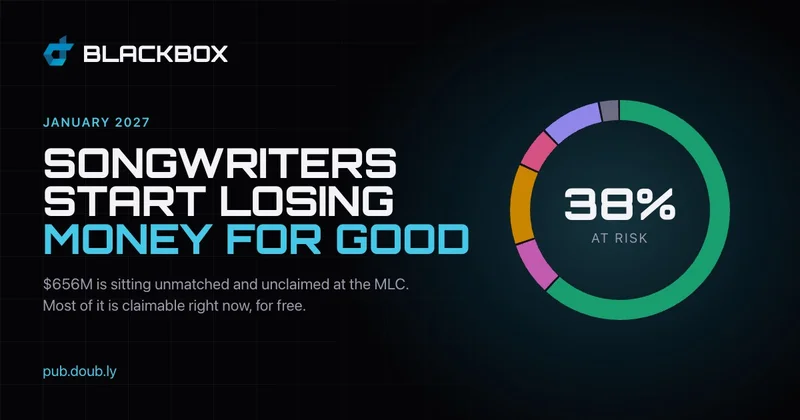
Because it does not sit at The MLC forever. Starting in early 2027 they begin distributing accrued royalties that were never matched or claimed, by market share, splitting them among the publishers and writers already collecting in proportion to what they already earn.
Claiming and matching stay open indefinitely, and anything you fix now protects every month not yet distributed. But each month that passes with your name missing from a recording is a month of its royalties paid to somebody else. The MLC's own explanation â
How we size it. We take your Spotify stream count, estimate what that means across all services, take the US portion, and multiply by the US mechanical rate. Then we keep only the part that is actually exposed. Usually that is the unclaimed percentage of the work. Where the work is fully claimed but the MLC never matched Spotify's own copy of the recording to it, the money behind those plays has nowhere to go either, so none of it is discounted.
The per-stream rate is measured from MLC distributions and historical CRB Phonorecords rates. We checked it against catalogs we administer, where the rate implied by actual payments came out around half the headline figure, so we use the measured one instead.
The MLC also publishes its own ranking of what each unmatched recording is worth, and we read that too. Where their figure is larger than ours, we use theirs. We never add the two together, because they are two estimates of the same money rather than two piles of it. This mostly shows up on quieter recordings, where a handful of streams tells us very little and The MLC is holding real money anyway, and on recordings we have no stream count for at all.
It is a range rather than a single number, give or take 35%, because every other input is an industry average rather than something we measured for you. A trailing plus sign means the top of the range is open-ended: The MLC's highest band has no ceiling, so we cannot name one either. Treat it as an order of magnitude, not an invoice.
My song is registered and fully claimed. Why does it say âNeeds matchingâ?
Because the registration is only half of what has to be right. The other half is the link between that work and each recording of it, and there is not one of those links. There is one per service.
The MLC matches each service's copy of a recording to a work separately. Your song on Spotify, the same song on Apple, and the same song again on Pandora are three different records in their database and three different matches. Usually they all find the same work. Sometimes one arrives with a slightly different title, a different duration, or no identifier, and sits unmatched while the work itself is registered with every share claimed. One song on a catalog we checked had 48 such copies across 13 services, worth over a thousand dollars, behind a work that was in perfect order.
So both things are true at once, and The MLC's own data says so: it returns this recording as registered and unmatched in the same breath. That is why it gets its own status here rather than being filed under either one.
A few stragglers is normal and it is not a sign anything is wrong with your paperwork. There is nothing to fix in your registration and nothing to change about your shares. The single step is the Matching Tool in the portal, which is usually the last thing standing between a catalog and being finished.
What about covers?
The MLC pays the people who wrote a work, not the people who recorded it. If you released a cover, somebody else wrote it, so the publishing belongs to them and there is nothing at The MLC for you to claim on that recording.
Your cover still earns mechanicals. They just belong to the original songwriter and their publisher. What you own is the recording, and those royalties reach you through your distributor instead.
We check every recording on your Spotify profile, so covers appear in this report alongside everything else. Expand any row and choose "This is a cover or isn't mine" and we will drop it from the estimate and from the coverage figures. It works for anything on your profile you don't own, not only covers: a feature credited the wrong way round, a compilation appearance, a release that was never yours. The marks stay in your browser and travel with the link if you copy it, so the number you share is the corrected one. The gaps worth chasing are the works you wrote.
Why only The MLC?
Because it is one clearly defined pool, and because the data is public. The MLC publishes its whole database every week, which is what makes a free tool like this possible.
It is not the only place your money sits. Performance royalties from ASCAP, BMI and SESAC are separate. So are sync fees from film, TV and advertising, and collections from international societies like MCPS, GEMA and JASRAC. Master recording royalties are separate again, usually larger, and they reach you through your label or distributor rather than as a writer.
We do check coverage across PROs and international societies for the catalogs we administer. None of that is in scope here. This tool does one thing (currently), on public data, for free.
We are not affiliated with The MLC. This is an independent tool built on data they publish openly, and nothing here is an official statement about your account. For that, we strongly encourage you to register and log in at themlc.com.
A recording is missing, or linked to the wrong work. Why?
We read every album and single credited to the Spotify artist you searched, then check each recording's ISRC against The MLC's weekly bulk data. A recording can be missing because it came out after the date of the snapshot shown on your report, because it is on a compilation or a track you are only featured on, which we skip on purpose since those works usually belong to someone else, or because Spotify has not assigned it an ISRC yet.
About one recording in five is linked to several works in The MLC's data. Usually the same work was registered twice, or an instrumental, a remix, or an unrelated work with a similar title got attached to the same ISRC. We report against the one whose title matches your recording, preferring a work that has an ISWC, since duplicate registrations are usually the ones that never got one. The expanded row tells you how many others we found.
Iâm a label, publisher or distributor with a lot of artists. Can I check in bulk?
Not through this page. It is built for one artist at a time so it stays fast and free. We do run catalog-wide audits across whole rosters, including the parts this tool does not reach. Contact us and tell us roughly how many recordings and works you are dealing with.