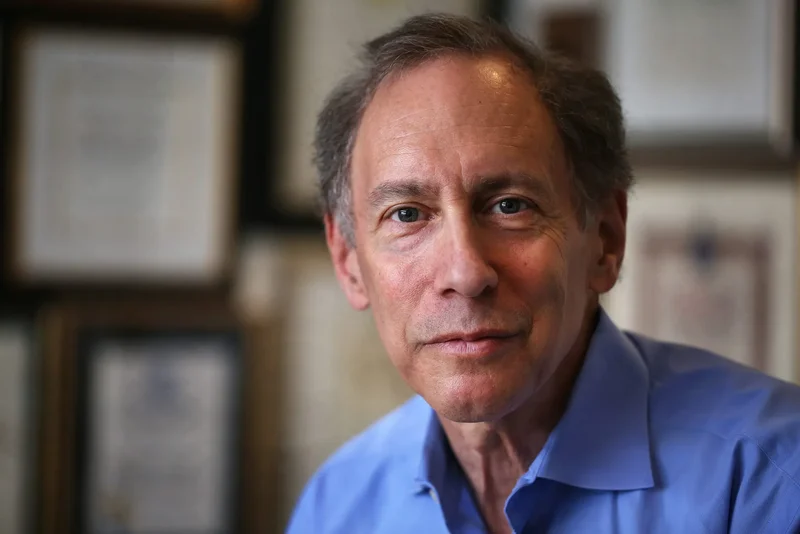
The net worths of CEOs and founders are largely at the whim of their company stock—all it takes is one breakout earnings report or blockbuster news to shake up their fortunes. Now, Moderna cofounder Robert Langer has re-entered the billionaires club following promising cancer vaccine trials that sent the company’s stock soaring.
Langer, known as the “Edison of Medicine,” witnessed his equity in the biotech business double in value, shooting his net worth up to roughly $1.7 billion, according to a Forbes analysis.
His wealth surge followed the news this Wednesday that Moderna and pharmaceutical company Merck’s mRNA cancer vaccine hit its goals in a Phase 3 trial targeting melanoma. The announcement sent Modern’s stock soaring more than 100%, valuing Langer’s roughly 3% stake past the billion-dollar threshold—a massive jump from the roughly $730 million he boasted on Tuesday.
This is the second time that Langer has made it to the billionaires club. Langer first came into 10-figure wealth back in November 2020, when Moderna shares surged after the company reported promising Phase 3 results for its COVID-19 vaccine. During the pandemic-era Moderna boom, Forbes even put his net worth as high as $4.9 billion in 2021, before plunging and knocking him out of the club.
The 77-year-old cofounder’s stake was estimated to be just $343 million when Modern’s shares were at a rock-bottom low of $29.81 in early January. Now, he’s back in the ultra-rich club again—but still urges young workers to prioritize meaningful work over money and job security.
“What you want is somebody to have a great career and be happy,” Langer said in an interview with Big Think in 2018. “So my advice to students is don’t do what’s going to make you the most money or the most security, but do something that will make you happy, whatever that is.”
Fortune reached out to Moderna for comment.
Langer turned down 20 job offers to chase his dreams—he advises workers not to ‘give up too easily’
Langer’s major piece of advice to young workers is to be “broad and open-minded” when it comes to their careers.
After all, the billionaire founder lived a whirlwind of a career, turning down lucrative job offers and weathering professional rejection before ultimately launching one of the world’s biggest biotech companies.
Langer developed his love for science while studying chemical engineering at Cornell University, later obtaining his doctorate at MIT in 1974. And upon graduating, the budding biotech pioneer was flooded with job offers. At that time the U.S. was reeling from a gas shortage, and oil companies were looking to lock down talent like Langer and his chemical engineer classmates.
Nearly all of his peers took them up on the “very high-paying jobs,” Langer explained, but he was determined to make a different impact. One job recruiter told him that if he could increase the yield on one petrochemical by 0.1%, that gain would be worth billions of dollars. But he wasn’t sold on improving oil margins for the rest of his life.
“I did get 20 job interviews from these companies, and I got 20 offers too, but I wasn’t very excited about doing that,” Langer said in the Big Think interview. “I just wasn’t excited about the impact that that would have, and I kept looking for ways where I guess I felt I could have more of an impact on the world.”
Even after turning down 20 high-paying job offers, Langer was met with rejection
Turning down those high-paying oil jobs, Langer chose a different path, joining Judah Folkman’s lab at Boston Children’s Hospital as a postdoctoral researcher. During his three-year stint he worked on ways to efficiently deliver drugs, developing a polymer matrix system for delivering large molecules like proteins into cells. The science was so new that Langer said the scientific community couldn’t believe it—and it even resulted in career roadblocks. His first nine grants were rejected, and when he went job-hunting, “no chemical engineering department in the world” would hire him.
“I ended up going into a nutrition department, but the problem there was that the people in that department didn’t think very much of what I was doing, and they basically told me I should start looking for another job,” Langer recounted. “So it was not very pleasant in the beginning. I think if I’d moved away from it, I don’t know what would have happened.”
Langer did end up snagging a faculty role at alma mater MIT in 1978, and went on to build the largest biomedical engineering lab in the world. And his most notable career break didn’t come until he was in his 60s; in 2010 he cofounded Moderna, transitioning his decorated academic career into launching a billion-dollar biotech company. Now, the $56 billion company has been credited with developing one of the first successful mRNA (COVID-19) vaccines, and is making headway with its melanoma trials. Langer says his journey required some trade-offs, but advises young professionals to stay on course to lead a fulfilling career like his own.
“If you give up too easily, that’s not good. Obviously, you don’t want to keep banging your head against the wall forever, so I think there’s some compromises you have to make,” the Moderna cofounder said. “But I think if I gave up on something like that, maybe I’d give up on other things that were important, too. I just don’t know. I’m glad I didn’t.”
breaks the traditional barrier between audience and newsroom. The show transforms
Fortune DailyFortune’s trusted reporting into actionable, conversational, and entertaining insights for an emerging class of business leaders.
Watch here.