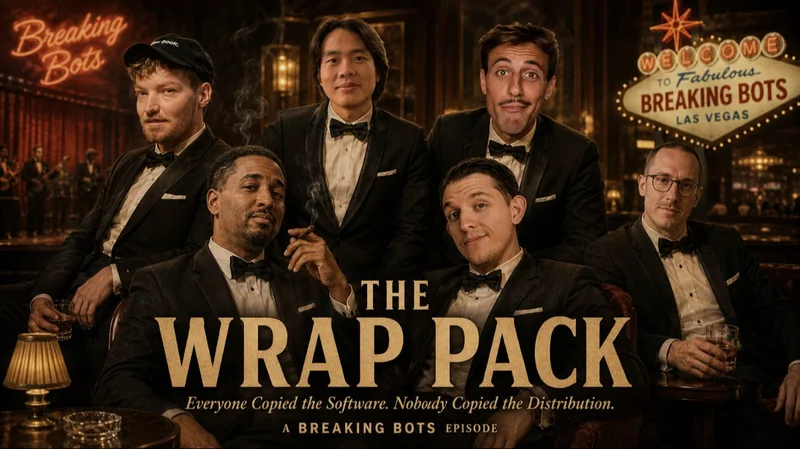
Software is completely changing. The cost of building something is a race to zero, but the cost of getting an audience and distribution isn’t getting easier or cheaper.
Software was always the hard part and the thing that companies built moats around. If you had an idea, it would take teams of overpaid people to work on many facets, rack up ridiculous bills, and use power tools to ice cakes. It was a whole ordeal, and it would take months before you had something you could use.
Due to the heavy workload required, you would end up with these Frankenstein product offerings that would never be thrown out or moved away from, ‘because we spent so much money on it.’ So what happened? Another API stitched onto the side. A new UI for this part, and a new engine in this part, and it was all stitched together with middleware that was as dodgy as your Dad trying to syphon petrol from the Valiant for the station wagon in the summer of 83.
You also ended up with some legacy database nobody wants to touch because Kevin built it in 2017, and Kevin now breeds and associates with alpacas somewhere in New Zealand, and that was software.
The game has officially changed.
AI has dramatically changed the economics of creating software. A reasonably competent person can now have an idea in the morning, build an interface, connect a model, attach Stripe, and have something functioning on the internet before lunch.
Which all sounds good in theory, but ultimately, when software isn’t scarce anymore, distribution becomes what we all need.
Meet (who I call) the Wrap Pack
I have started thinking of a particular group of founders as the Wrap Pack. Yeah, yeah, don’t @ me; I know I left a heap out, but how many examples do you really need to be able to follow along at home? I’m trying to make a point here.
They are indie hackers, developers, creators, and extremely online entrepreneurs who appear capable of wrapping practically anything in an interface, putting a price on it, and launching it before most companies have finished having meetings to discuss the other meetings.
New model idea, wrap it. Interesting API, wrap it. Site created to see if someone has already wrapped that idea yet? Wrap it. Something that takes 11 clicks, make it take 3 and then…. wrap it. An idea that lasts less time than the expiration of your fresh milk? Wrap that too, apparently. Apparently, 15 minutes of fame is down to about 98 seconds now.
Wrappers aren’t all bad, don’t get me wrong; a wrapper can provide genuinely useful UX, workflow, orchestration, integrations and convenience. Some wrappers eventually become substantial products in their own right, and it’s not what these people are wrapping that piques my interest.
I’m far more interested in the fact that some people can repeatedly make money doing it, while thousands- and that number is swelling faster than Grandma's thing she gets in her feet on hot days- of competent developers build equally good, if not better, products that vanish quicker than Michael when it’s his round at the bar.
The answer is actually simple. The Wrap Pack built an audience, and without them you’d be producing for as many people who are reading this article. Thank you for reading, BTW.
TypingMind Is a Pretty Good Example
When OpenAI released the ChatGPT API in March 2023, Tony Dinh spotted an opportunity. He created TypingMind, which was essentially a better interface for using ChatGPT. The domain was purchased on March 2. The product was released on March 6, and within seven days, it had generated more than $22,000.
But there is a detail in Tony's own account of the launch that I find considerably more interesting than how quickly he built the software. He said that 99% of the sales came from his Twitter reach, which meant the product was new, but the distribution wasn’t.
Marc Lou Built the Launchpad Before the Rocket
Marc Lou might be an even cleaner example. This guy built a flywheel of apps.
Before ShipFast became one of his major products, Marc says that in August 2023 he had shipped almost 20 side projects. Ten of them made money, and during that time, he’d amassed a following of 35,000 people.
The simple story here is this. If 2 people both launch the same thing on the same day, and the first person launches to an audience of zero, he releases software. If the same product is launched by Marc to his 35,000 (then) followers, he is launching software via an established distribution network. One likely fails, and one has a chance to succeed.
ShipFast subsequently generated $250,000 in its first five months, according to Marc, at roughly 90% profit. And then if the audience survives the product, Marc can launch something else and then something else again, and so on. Flywheel.
Pieter Levels is Yoda in Underpants On a Couch
Pieter Levels recently described the problem considerably more succinctly. Everyone can now build apps with AI, but, as he put it, almost nobody has an audience, money for advertising, or the ability to generate distribution organically.
That's the whole game hiding in plain sight.
One thing you can’t prompt:
Build me 100,000 people who trust my judgement and are interested in whatever I make next.
Pieter leveraged his audience to sell advertising space on billboards in a flight simulator game that reached $1M ARR in 17 days. He is a serial entrepreneur, and he is acutely aware of what his secret weapon is. That is why he has been so successful.
Software Might Start Looking More Like Content
This leads to the part I find most interesting. If software becomes extremely cheap to create, why should every piece of software be expected to live for ten years?
I, for one, have never watched a TikTok video and thought, ‘that’s great but what is their 10 year technical roadmap?’ Memes explode for days sometimes, and a video on YouTube is maybe good for 6 months and a game for a weekend. A branded experience might live for a campaign, so why wouldn’t software be exactly the same?
Just get the idea out, distribute it, use it, remix it, monetise it and move the heck on. We are living in an increasingly disposable world, so you either get with the times or continue to hand-wash your handkerchiefs fortnightly.
Attention has become more expensive than production. You can take that to the bank.
The Wrap Is Disposable. The Audience Isn't.
Twenty apps without distribution is just twenty cold starts, so if you make cloaks, target Harry Potter for your sales, because he or one of his oddball friends was looking for an invisible one, if I remember correctly.
I suspect we are about to see a spectacular amount of software created, and most of it won’t survive, and that’s OK; we are entering an era where it’s not supposed to all survive. It is created around a moment, a community, an audience, a meme, an event, a workflow, or an opportunity. Then attention moves somewhere else; here’s looking at you SaaS. Nobody wants to be locked into 12-month subscriptions to things that are changing faster than factual history in a Christopher Nolan movie.
The winners will be the people who are answering 2 questions:
What should I build today? And who can I put it in front of tomorrow?
AI has changed a lot of things already, but it hasn’t solved distribution to an audience. You have to earn that. At this point in time, you can’t prompt it, YET.
Let me know your thoughts.