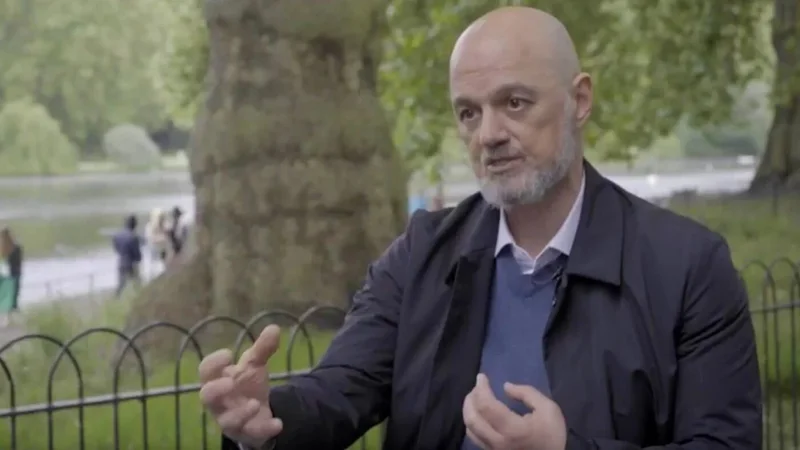
British activist Anas al-Tikriti questions UAE surveillance operation
It was a cold winter morning when British police knocked on Anas al-Tikriti’s family home in London.
The veteran anti-war activist was abroad when one of his sons called telling him officers were looking for him.
Baffled by the situation, he dismissed the call. The police then came again two days later - only this time more forcefully.
Leaving a number, Tikriti called the police back.
They said his life was in danger, and he was being served an Osman Notice - a notice given to individuals if the London Metropolitan Police fears their life is in imminent danger.
Shocked, he asked for details. Should he move his family? Relocate? Who was behind the threat?
The police offered no answers. "We can’t tell you anything," they replied, leaving him with an ominous warning and zero protection.
But ten years later, a British news crew showed him a leaked dossier containing a sustained, granular intelligence operation tracking his every move: photographs of his home and car, and WhatsApp communications between members of a surveillance team detailing his daily life - from his commute and school runs to visits to a local mosque where he was scheduled to lecture.
The state behind the operation? The United Arab Emirates.
For Tikriti - a prominent British activist, founder of the Cordoba Foundation, and outspoken critic of Gulf authoritarianism - the UAE's hostility was no secret.
The veteran activist has headed up the Muslim Association of Britain and served as a senior officer at the Muslim Council of Britain.
He had publicly supported the Arab Spring, criticised authoritarian rule in the Gulf and spoken out in support of Emirati political reformers imprisoned by the UAE.
But suspicion was one thing. Seeing evidence of what appeared to be a sustained operation to monitor him was another.
“Seeing it in black and white,” Tikriti told Middle East Eye, left him experiencing emotions he had not expected.
But as the shock subsided, another question became more difficult to ignore: "what the British authorities knew about this”.
That question now sits at the centre of Tikriti’s concerns.
He says he had little difficulty believing that the UAE might want to monitor him.
What he struggles to understand is how such an operation could allegedly take place in Britain - and whether British authorities knew about it.
“If they knew, why is it that they didn’t tell me or at least warn me or protect me?” said Tikriti.
“Or if they didn’t know, that in itself would be a catastrophe in its own right.”
‘I would be guaranteed safety’
Tikriti’s position is that whatever the UAE’s intentions towards him, his expectation of protection from the British state should have been straightforward.
He says he has never been charged with a crime or questioned by authorities and has spent his life abiding by British law.
“I expect that my civil liberties would be protected, my freedom would be guaranteed,” he says.
'A rogue, dictatorial, authoritarian regime such as the United Arab Emirates could actually reach into our society and infringe upon the civil liberties and freedoms'
- Anas al-Tikriti
For him, that includes the freedom to criticise governments and express political views without fear of being targeted by a foreign state.
“I would be guaranteed safety, at least, if nothing else, to air my views, to criticise whomever I wish to criticise whilst constantly throughout my entire life abiding by the law.”
The alleged surveillance therefore raises a broader question, he argues, about the limits of foreign influence in Britain.
“A rogue, dictatorial, authoritarian regime such as the United Arab Emirates could actually reach into our society and infringe upon the civil liberties and freedoms and rights of citizens as well as organisations,” said Tikriti.
The Iraqi activist also points to the Cordoba Foundation, the think tank he founded, and other British organisations that he says the UAE has attacked, defamed, or maligned.
His concern is consequently not limited to what may have happened to him personally.
It is whether a foreign government can target British citizens and organisations while operating within British society – and what response that should provoke from the British state.
Warning from British police
For Tikriti, the warning was both alarming and inadequate. When he received the warning, the Iraqi activist and academic had two young children.
He had been told that his life might be in danger, but was given no information about who posed the threat, where it came from or what precautions he should take.
“Besides just handing me this Osman notice, as though this is a box that we’ve ticked, nothing whatsoever,” he says.
That experience has taken on a new significance following the alleged surveillance revelations.
“Clearly the British authorities, the British police knew about something happening,” he says.
And if the threat was as serious as subsequent reports suggested, he believes there is a legitimate question over why he was not told more.
“The police not telling me that there is an actual threat, there is someone who is actually plotting against my life, I think is just absolutely unbelievable,” he says.
Why would the UAE target him?
Tikriti says he does not doubt why he attracted the UAE’s attention. His political views, he argues, put him directly at odds with the Gulf state’s leadership.
When the Arab Spring erupted in 2011, Tikriti became a prominent supporter of the movements demanding political change in countries including Egypt and Tunisia.
For the UAE and other Gulf monarchies, he says, such movements represented a direct threat to their own political standing.
“They found that extremely threatening to their own standing,” he says.
He says the UAE made its displeasure clear through various means, including withdrawing invitations for him to visit and having embassy officials contact him and tell him not to return.
“So the fact that I’m in their bad books is of no surprise to me.”
What surprised him, he says, was the extent to which the UAE was allegedly prepared to go.
He points to Emirati reformists who have spent more than a decade in prison, many of whom he says sacrificed their freedom in pursuit of democracy.
Tikriti says his decision to support them further angered the UAE publicly.
“The fact that I have stood by them, the fact that I’ve spoken up for them as much as I can has angered the United Arab Emirates,” he says.
“And apparently they want to silence me at any particular cost.”
UAE influence in Britain
Tikriti’s concerns ultimately return to Britain’s relationship with the UAE.
The two countries are close allies, with extensive economic, political and security ties.
The UAE has also become a significant presence in British public life, something Tikriti sees as part of a much bigger problem.
He points to Emirati investment in football clubs, sporting events, entertainment, financial markets and banks.
'The fact that the United Arab Emirates is one of our strongest allies is unbecoming of our own government, of our own society'
- Anas al-Tikriti
The question, he argues, is not simply whether Britain should have relations with the UAE, but what limits should accompany those relations.
“The fact that the United Arab Emirates is one of our strongest allies is unbecoming of our own government, of our own society,” he says.
He argues that Britain’s relationship with Abu Dhabi should not come at the expense of the rights of British citizens.
“If the government truly believes in freedom and civil liberties and human rights and the like, then they should take a different stand.”
For Al-Tikriti, that means investigating not only the alleged surveillance operation but the wider extent of UAE influence over British politics and foreign policy.
“I think there needs to be a wider investigation,” he says.
His own experience, he acknowledges, is minor compared with the allegations of far more serious abuses associated with the UAE elsewhere.
“My story… pales in comparison to the crimes committed by the UAE regime,” he says.
But that, he insists, is not a reason to ignore it.
It is a reason to examine what happened more closely.
‘Friends do not come without conditions’
Tikriti hopes Britain’s political leadership will confront the issue directly.
He singles out Andy Burnham, expressing hope that the prime minister of Britain will be willing to challenge the relationship between Britain and the UAE.
“We could be friends,” Tikriti says, “but friends do not come without conditions.”
Those conditions, he argues, should be simple: the UAE should respect British freedoms and citizens and refrain from interfering with their rights.
For Tikriti, the documents he was shown have changed the nature of the question.
For years, he says, allegations that he was being targeted could be dismissed or “debunked”. Now, he says, he has seen correspondence, photographs and messages that appear to document the extent of the surveillance.
The UAE’s alleged interest in him is therefore no longer the main mystery.
He already knows why he believes he was targeted.
The question that remains is what Britain knew – and what it was prepared to do about it.
“Either they support the United Arab Emirates in its dictatorial ways, and as such they should come forth and say so,” he says.
“Or if they truly believe in freedom and civil liberties and human rights and the like, then they should take a different stand.”