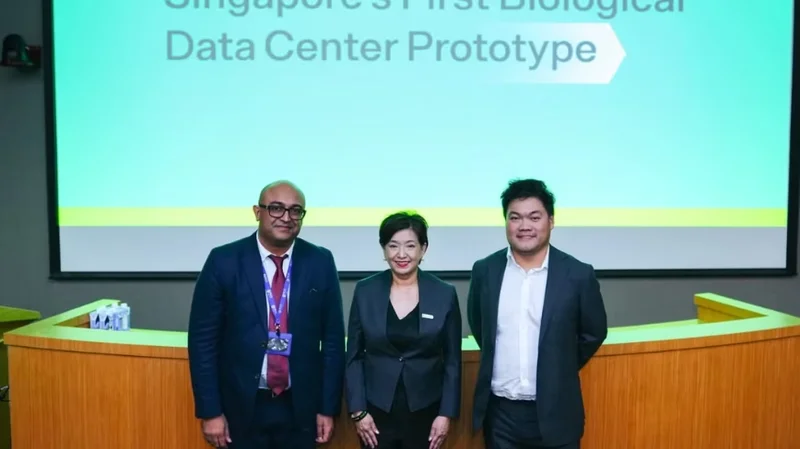
NUS Medicine, data centre operator DayOne and Melbourne’s Cortical Labs have unveiled a biological data centre prototype in Singapore, built from a 20-unit rack of neuron-powered CL1 computers. The efficiency claim central to the project comes with no published figures.
A rack of computers running on living human neurons has been switched on in Singapore. NUS Medicine, the data centre operator DayOne and Melbourne’s Cortical Labs showed the prototype to about 80 guests on 6 August.
The hardware is 20 CL1 units, which the partners describe as the first independently operated biologically integrated server rack anywhere. The neurons are grown from stem cells and cultured at the NUS Life Sciences Institute.
The argument for it is electricity. Biological computing is presented as a way to scale AI capacity at a fraction of the power that silicon servers demand.
The announcement contains no figures to support that. Cortical Labs’ own published specification puts a single CL1 at 850 to 1,000 watts, which makes this rack a device drawing up to 20 kilowatts.
That is ordinary. A conventional data centre rack sits in a similar range, and the reason is that the power goes into keeping cells alive rather than into computation, which is a different problem from the one startups are attacking elsewhere.
The efficiency belongs to the neurons, not yet to the box around them. Switzerland’s FinalSpark, which runs a remote platform of 16 brain organoids from Vevey, claims its biological processors use about a million times less energy than digital chips.
Those claims describe the cells doing the computing. The incubators, pumps and temperature control that keep them from dying are the part that shows up on the electricity bill.
Europe has been pursuing the same goal in silicon instead. The Netherlands is assembling a neuromorphic computing hub around chips that imitate neurons without needing to feed them.
Cortical Labs is clear about wanting customers rather than papers. Founder Hon Weng Chong says the prototype “shifts the conversation from research to commercial application,” naming drug discovery, humanoid robotics, cybersecurity and fraud detection.
One constraint is biological. The CL1’s life support keeps its neurons viable for up to six months, which is a maintenance schedule no silicon rack has to plan for.
The number that would settle this is watts per useful task, and nobody has published it. Investors are meanwhile pouring money into a brain-inspired version of the same promise, which runs on electricity alone.
Get the TNW newsletter
Get the most important tech news in your inbox each week.