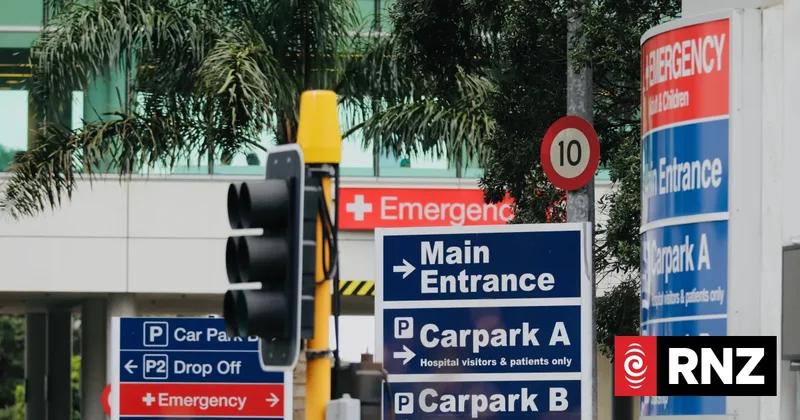
An Auckland Hospital doctor says near-constant overcrowding in the emergency department is leaving staff demoralised and putting patients at risk, while a patient advocate says Health NZ data shows some EDs are in "a state of failure".
The emergency department at the country's largest hospital met the criteria for an "escalation pathway" at least once a day on most days in 2025, according to figures released to the Labour Party under the Official Information Act.
The information came in response to a question on the number of 'code reds' across New Zealand hospitals, but Health NZ said every hospital had different triggers for code reds and the information could not be easily compared.
A spokesperson said Auckland Hospital did not have a code red scale, but instead used an "escalation pathway" which meant a clinical or operational response was triggered when the emergency department met one of three thresholds - if more than 30 people were waiting for sign-on (the time it takes for a doctor or specialist nurse to be assigned to a patient), if the ED was more than 120 percent over capacity or if four or more ambulances were unable to hand over their patient within 15 minutes.
Health NZ's figures showed the ED breached its threshold for people waiting for sign-on at least once on 281 out of 365 days (77 percent of days), its ambulance escalation trigger on 286 days (79 percent of the year), and was more than 120 percent over capacity on 117 days (32 percent of the year).
A Health NZ spokesperson said it had no way of knowing how long the measures were exceeded on any day, nor did it have a record of whether the exceedances prompted any further actions.
Auckland Hospital emergency physician Dr Mike Nicholls said the ED was the canary in the coal mine.
"The emergency department is part of a complex healthcare system and it's a useful way of looking at the healthcare system in total because often when things aren't going well in other parts of the healthcare system, we see that in the emergency department."
Nicholls said while the data provided a good picture, it was not the full one.
For example, capacity breaches recorded when the ED was more than 120 percent over capacity but not by how much or for how long, or whether more than 30 people waiting meant 31 people waiting for five minutes or 50 people waiting for 8 hours.
But there was no doubt the conditions posed a risk to patients, Nicholls said.
"Overcrowding in emergency departments is associated with increased harm for patients, including increased death. An escalation pathway is there to get everyone on the same page that we're in a really risky situation."
The situation was tough on staff, he said.
"I think everyone who works in an emergency department does so because they want to provide the best care possible. They're really people who like to be challenged, but not necessarily in this way where the situation means it's not possible to deliver the quality of care that would be possible were it not for those overcrowding issues."
Nicholls said the problem became acute when overcrowding was not just for a day or a week or a month, but ongoing.
During January, February and June, Auckland ED had breached its wait-time threshold at least once almost every day (94 percent in January and 93 percent in February and June), while it breached its ambulance escalation trigger at least once on 94 percent, 96 percent and 93 percent of days in the same months.
Nicholls said the causes were complex, but boiled down to levels of demand versus resources.
"When you're getting more than 120 percent occupancy frequently or the other findings ... most people would agree the demand is outstripping the resource and it's throughout the healthcare system."
He had not observed the same issues Christchurch Hospital was experiencing with patients treated in corridors but said there were "absolutely patients waiting in spaces that aren't designed for high quality health care" and where it was not intended patients would be "for any length of time".
"When people arrive in our emergency department, there's people waiting for often quite some time - some hours at times - and we're not able to deliver good care for them...
"That's a real problem for those patients and families, and it's a real problem for staff as well because we know we're not able to deliver the care people need. That's really quite demoralising to witness people not getting the care we know they need."
The government's six hour target (for 95 percent of ED stays to be less than six hours) was "one way to look at a very complex system", but "in an effort to simplify that information so it can be understood by a lot of people you lose something trying to reduce a problem to one number", Nicholls said.
Even when EDs were making improvements on the target, that didn't "change the fact we're still having a lot of problems with overcrowding in our emergency departments. Both things can be true".
Overcrowding exacerbated an already stressful situation, he said.
"It's more stressful for me and I think I can speak for my colleagues, it's more stressful for them and I think I can speak for patients and their whānau who are the most important people in the healthcare system - I think it is very stressful for people.
"By far the majority of the time, patients and family are really understanding and very kind to myself and colleagues, but sometimes the stress is too much for everybody and people do get upset."
Health NZ group director of Auckland operations Dr Michael Shepherd said it was incorrect to characterise the measures being met or exceeded as "breaches" or to use them as measures of activity or performance.
The thresholds were "operational management tools" to assist staff, may have only been met for a short period of time, and indicated further action was required, not that the ED's performance was impaired, he said.
Once the thresholds were met or exceeded, the response could include adjusting staffing levels and placement, prioritising workflow and reviewing admission processes.
"Like emergency departments across New Zealand and internationally, Auckland's Emergency Department continues to experience significant demand," Shepherd said.
Health New Zealand had implemented initiatives to improve patient flow, reduce delays, strengthen workforce capacity and support timely ambulance transfers, he said.
Patient Voice Aotearoa chair Malcolm Mulholland said the data showed emergency departments were in a "state of failure".
"It shows patients aren't being seen quickly enough, that there clearly are not enough beds and that ambulance ramping is becoming standard practice around the country."
The situation could be worse for regional hospitals, which were sometimes forced to close the emergency department due to staff shortages, he said.
Association of Salaried Medical Specialists executive director Sarah Dalton said it did not matter how Health NZ classified the information, the system was clearly overwhelmed.
"Whether you call it a code red, a code black, an escalation point, a breach, what all of the data tells us and what our members who are senior doctors working in emergency departments tell us is that they are not appropriately resourced to cope with the level of need."
Members also reported the vast majority of patients presenting at ED needed to be assessed at a hospital and sometimes admitted, she said.
"This isn't just people going there instead of a GP. This is people who are sick enough that they should be seen at a hospital."
It was frustrating to have the same conversations every year, Dalton said.
"It isn't a snapshot, it's an ongoing trend."
"What's the point of all of these statistics and measures if Health New Zealand and the government aren't willing to throw the resources that are needed at acute care?"