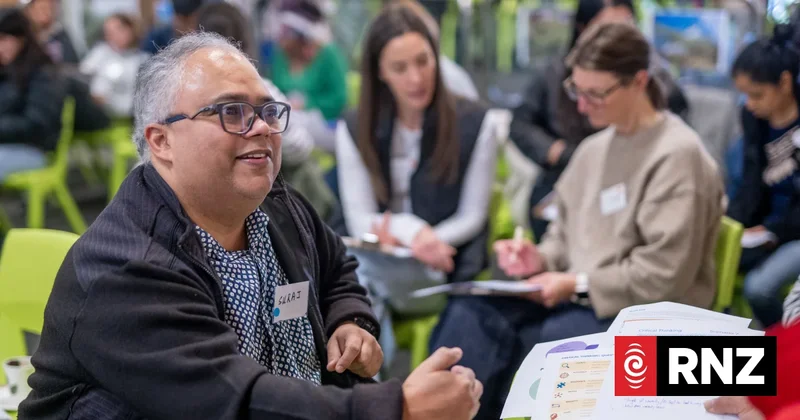
Suraj Maitra did not believe Auckland Council genuinely cared about his opinion.
"Initially, my perception of Auckland Council is that they listen and then chuck it out in the bin. My feeling was, why do I waste my time?"
But being a part of Deliberative Democracy changed his view.
"Finally, our council, the largest in the country, the richest in the country, potentially seems like it's trying to listen to ratepayers. Fantastic, good effort, ka pai."
On three Saturdays in July and August at Mount Roskill's Fickling Convention Centre, about forty Aucklanders attended a Deliberative Democracy forum on pest plants.
The group debated what steps the Auckland Council should take to stop invasive weeds like Moth plant and Woolly nightshade from spreading and to what extent landowners should be made to control them on their properties.
One forum participant, recent high school graduate Amy Burnett, said Deliberative Democracy felt similar to Model UN, but with real-life influence.
"I do Model UN, so this is like Model UN but actually existing.
"I just thought it would be fun. What else am I going to do on a Saturday? I'm not doing this every Saturday. I might as well try it."
With fewer than a third of Aucklanders voting in the 2022 and 2025 local elections, the council has been holding 'citizen juries' to ask average residents how they think the council should solve challenging issues.
The council previously held forums on turning Takapuna Golf Course into a flood storage wetland and how Auckland should manage feral cats.
Participants heard from subject matter experts and council staff before giving feedback for councillors and local board members to consider.
An 80 percent supermajority consensus on any recommendations, including how much the council's response should cost ratepayers, is required.
While Deliberative Democracy forums or citizens' assemblies weren't new, the council first started running them in 2022 to supplement standard public consultation.
North Shore councillor and Policy, Planning and Development Committee chair Richard Hills said that while elected members could ignore residents' ideas, Deliberative Democracy gave him confidence that he had seen views truly reflecting Auckland.
"Some councillors probably are not fussed at all, but there's a number of us that do really worry that we don't get voices from right across the community, especially our younger people on many issues that will affect them."
He said the council often heard from the same people during public consultation, and for more complex issues, submitters might only have one side of the story.
"It's really important that we are getting a lot of views and voices in, especially those who are most affected, who might often think they're not affected because they just haven't had access to the information."
Programme co-director and senior lecturer in global studies at the University of Auckland, Tatjana Buklijas, said council decision-makers needed to value Deliberative Democracy for it to be worthwhile.
"What needs to be done is actually to say we will take this very seriously, and if we cannot implement this decision, we will explain why. If you don't do that, it's actually eroding trust."
Auckland Council confirmed the average cost of a Deliberative Democracy process, including using a third-party agency to recruit a random, representative sample of Aucklanders, was about $60,000.
But Buklijas said other decision-making aids the council used often produce less helpful insights.
"Other ways of making decisions, calling for more expert reports, repeatedly inviting consultants, or doing different kinds of public engagement also cost money but might not actually result in good quality input from people, and then also there's also the question of the cost of non-action."
The council's head of engagement, Angeline Barlow, said it kept costs down where possible, including by using council-owned venues.
She said forum participants were given a financial incentive, but she would not confirm the exact amount.
"The costs cover the independent design and facilitation required to ensure a fair, balanced and robust process as well as things like providing compensation to participants. It's important that a fair and reasonable financial incentive to participants to recognise their time and contribution - this also changes depending on the forum itself. It also includes operational costs such as venue hire, catering and materials."