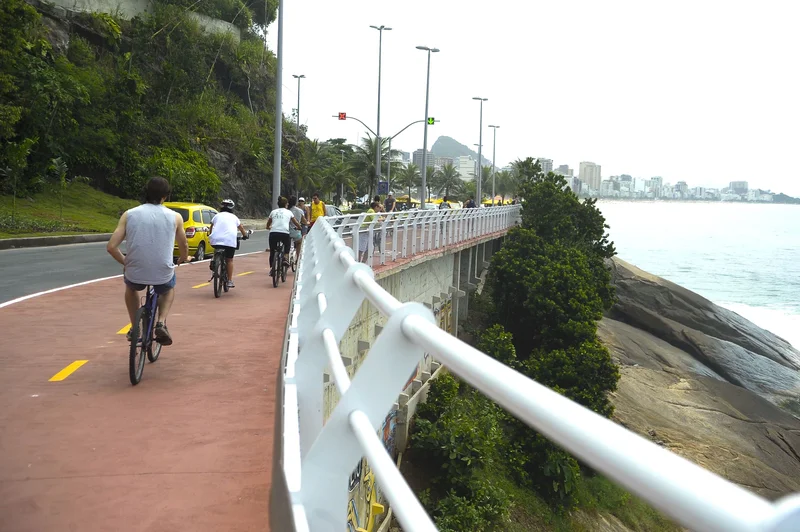
Car-Free Streets in Rio: How Residents Get Theirs Closed on Sundays
Brazil · Rio de Janeiro
Key Facts
- Programme nameÁrea de Lazer, run by the city traffic authority CET-Rio.
- WhenSundays and public holidays only, from 7am to 6pm.
- Summer hoursthe city extends the closing time to 7pm when daylight runs longer.
- Signature thresholdtwo thirds of the residential units on the street must sign the original petition.
- Also requireda written justification and original approval from the local Military Police battalion.
- Decision timeten working days, from the Regional Superintendency handling your area.
- Already closedAvenida Atlântica, Vieira Souto, Delfim Moreira and the Aterro do Flamengo.
Rio does not have car-free weekends. It has something quieter and more useful: a standing programme of car-free streets in Rio, open to any street that applies.
What the Área de Lazer Actually Is
The programme is called Área de Lazer, which means leisure area. It is run by CET-Rio, the city’s traffic authority.
The mechanism is simple. A stretch of street is closed to vehicles for a fixed window, and the asphalt becomes public space.
It is not a one-off event. The closures repeat every week, on the same days, indefinitely.
That is what makes it useful to residents. A street that joins the programme keeps its Sunday, rather than waiting for a festival.
It is also what makes it invisible to visitors. Nobody advertises it, because there is nothing to advertise.
Car-Free Streets in Rio Run on Sundays, Not Saturdays
This is the detail that trips up newcomers. The programme covers Sundays and public holidays.
Saturday is a normal traffic day. Saturday closures happen only as one-offs, tied to Carnival or a specific event.
The standard window is 7am to 6pm. Barriers go up early and come down before dark.
In summer the city pushes the end time to 7pm. Its stated reason is that the days are longer and the spaces are heavily used.
So if you are planning around it, plan for a Sunday. A search for a car-free weekend in Rio will not find one.
The Two-Thirds Signature Rule
Any street can ask to be added. The request goes to the Regional Superintendency covering your neighbourhood.
The core requirement is a petition. It must carry signatures from at least two thirds of the residential units on the street.
Note the wording carefully. It counts residential units, not residents, so a building of forty flats is forty units.
The petition must be the original document. A scan or a photocopy will not be accepted.
A written justification goes with it. You are expected to explain what the street would be used for.
The Police Sign-Off and the Ten-Day Clock
The second requirement is the one people forget. You need original written approval from the local Military Police battalion.
That is a separate approach, made before you file. The battalion covering your area is the one that must sign.
The reasoning is practical. A closed street still needs policing, and the battalion has to agree it can cover it.
Once the file is complete, the city commits to a decision within ten working days. That is two calendar weeks in practice.
The answer applies to a defined stretch, not a whole neighbourhood. Requests are handled street by street.
Where the Closures Already Run
The best known stretches are on the beachfront. Avenida Atlântica in Copacabana closes between Rua Francisco Otaviano and Avenida Prado Junior.
Ipanema contributes Avenida Vieira Souto. Leblon contributes Avenida Delfim Moreira.
Together those three form a continuous seafront run. On a Sunday morning you can cover the lot on foot or on a bike.
The fourth is inland and larger. Avenida Infante Dom Henrique closes through the Aterro do Flamengo, touching Flamengo, Glória and Centro.
The Aterro is the one locals actually use for sport. It has the space that the beachfront avenues do not.
What the City Has Not Published
There is a gap worth naming. City hall has published no traffic counts, footfall studies or business surveys for the programme.
So claims that it works, or does not, rest on impressions. Nobody has put a number on either side.
There was one explicitly experimental closure. Avenida Lúcio Costa in Recreio dos Bandeirantes ran as a pilot until 12 October 2021.
It was decided by the Barra da Tijuca sub-prefecture, with CET-Rio and the municipal guard. That was five years ago, and it is the most recent pilot on record.
For residents, the practical takeaway is unchanged. The route to a quieter street runs through the petition, not through a campaign.
How to Use It as a Visitor
You do not need to live here to benefit. The four existing stretches are open to anyone on a Sunday morning.
Start at the Aterro do Flamengo if you want space. The park side gives you room that the beach avenues cannot.
Start in Copacabana if you want people. Avenida Atlântica fills early and stays busy until the barriers come down.
Bikes are the obvious way to cover the seafront run. The three beach avenues connect into one uninterrupted stretch.
Check the calendar for public holidays too. Brazil has enough of them that a Tuesday can behave like a Sunday.
Car-free streets in Rio are not a citywide programme, and there is no map of every one of them. Each is granted street by street, which is why your neighbour’s block may have one and yours may not.
Car-free streets in Rio close to through traffic only. Residents keep vehicle access to their own garages.
Car-free streets in Rio run on Sunday hours set by the subprefecture, not by the residents who asked for them. Check the posted times before you plan around one.
Car-free streets in Rio have outlasted several city administrations. That is the strongest argument that a street granted one keeps it.
Frequently Asked Questions
Are Rio’s streets closed to cars on Saturdays?
No — the Área de Lazer programme covers Sundays and public holidays only. Saturday closures happen as one-offs, tied to Carnival or a specific event.
What hours do the closures run?
From 7am to 6pm as standard. The city extends the end time to 7pm during the summer months, when daylight lasts longer.
How do I get my own street added?
File a request with your Regional Superintendency, carrying original signatures from two thirds of the residential units. You also need a written justification and original approval from the local Military Police battalion.
How long does a decision take?
The city commits to answering within ten working days once the file is complete. The decision applies to a defined stretch of street rather than a whole neighbourhood.
Sources
This article was produced by The Rio Times’ automated newsroom system. How we use AI · Report an error