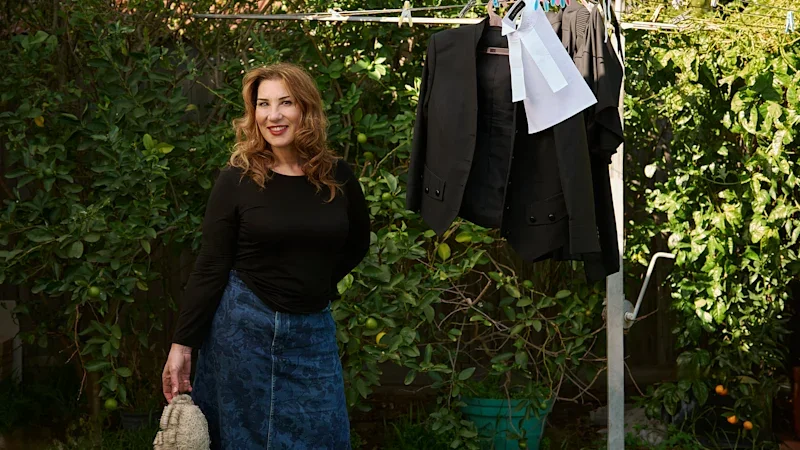
Some women, when they turn 60, throw parties, trek the Inca trail or finally learn to orgasm. Me? I was sitting the “Evidence” leg of the three-part Bar Exam to become a barrister of the Supreme Court of Victoria. Was I the oldest in the room? Some women looked more senior than me, but who knows? Maybe they just didn’t have Botox.
Once I became a barrister, despite moral ambiguity, I’d be wealthy, go to fabulous dinner parties and enjoy lovely holidays. But the pass mark is 75 per cent. To that date, my legal career had amounted to an articled clerkship in 1990. If I failed, I figured I could always write a one-woman show about the experience.
Thirty years ago, I’d given up a legal career and bounded instead into TV, all live and sweaty. As Elle McFeast I was, in my Mary Poppins way, using spoonfuls of entertainment to make insights go down. The passion and precariousness of the arts had triumphed over the security and respect of the law. But I had always been ambivalent about my choice, especially when things got tricky (Google me for the juicy details). At least I always had my law degree to fall back on, though.
As a lawyer, you increase in value with age, wisdom and experience. In the cash-strapped world of showbusiness, it’s different. In book publishing, too, it appears.
I’d pitched a memoir of my brilliant, bumpy time in TV that asked the underlying question: “What does it mean to have it all?” The famous feminist line goes: “You can have it all, just not all at once.” But I wondered whether “all” meant love/career/sex/money, like it did in the ’80s. Or if “all” was actually something else. Like acceptance. Or inner peace.
Publishers agreed it was a fabulous concept, but my social media following wasn’t large enough to guarantee sales without an accompanying live show. OMG. After 30 years, my professional relevance was being judged by an algorithm nobody can explain while playing by rules that seem to change overnight. I’m very fond of you, Instagram, but you have a cheek.
I have now lived for more years than I will. The clock is ticking, inside and out. If I wanted to change my life, I realised, it was now never.LIBBI GORE
Like many a Gen X woman, work is a huge chunk of my identity. But I’d had children in my 40s, like I was told I could, and I expected life to make room for me on the other side. At the same time, my highly successful BFF talks about retirement. She happily sports a head of beautiful silver hair. She quilts. All this makes my eye twitch. So she calls me a Peter Pan. But I will decide how I age in this country, and the circumstances by which I go grey.
I have now lived for more years than I will. The clock is ticking, inside and out. If I wanted to change my life, I realised, it was now never. I fell backwards in to the law. You only get 90 minutes for the exam.
Ironically, the first question in every evidence issue asks, Is this evidence relevant?, mirroring my existential crisis. In law, the test for relevance is easy; you just have to show the judge a logical connection to whatever you are trying to prove or disprove. You don’t pre-judge how relevant or reliable something is before you let it in. (R v Smith [2001]. Showing off now.)
But in a civil trial, under Section 135, even relevant evidence can be excluded if its prejudicial effect outweighs its value. I submit, Your Honour, that all the algorithm knows is who has paused for three seconds. It can’t be a verdict in itself.
There are many other grounds by which relevant evidence can be thrown out, lest it get in the way of a fair trial. The exam covered all of them, overtly and with tricks. It was my own intellectual City to Surf, every question a Heartbreak Hill. It was a strange thing to do, but I loved it.
But studying for the exam also gave me grist in the case of Libbi v Libbi, the trial of me inside my head. Could I untangle the competing voices that obscured my future path? I submit, Your Honour, that thinking is programmed layer upon layer, from a mixture of influences and experiences: chosen, imposed and observed. At 60, was it time to chuck some out, to give myself a fair trial?
The rules are clear. If evidence can’t be verified, throw it out. It’s hearsay. Do you really think I said this? How many drinks had you had? Not reliable. A good friend counts as a “character witness”. And the truth is, not everyone is your friend. A hostile witness. Out. Most importantly, what if the evidence keeps telling you that you’re buried rather than planted? (Thanks, Ben Crowe.) Throw it out. Negativity is inadmissible.
I did not pass the Bar Exam. However, I may be the only candidate who, after finding a question about self-incrimination so tantalising, emerged with the bones of a stand-up routine advocating why the judge should let the lying arsehole fry. That one-woman show, The Importance of Staying Relevant, had won the case inside my head. And after the show I could sell the book.
As for Libbi v Libbi, the two sides of my nature will continue in eternal litigation. This is what has fuelled and continues to fuel my creativity. But at 61, I can distinguish admissible evidence from all the other noise we think and hear about ourselves. I have a better faith in me, and I no longer rue the costs. That is the “all” that matters.