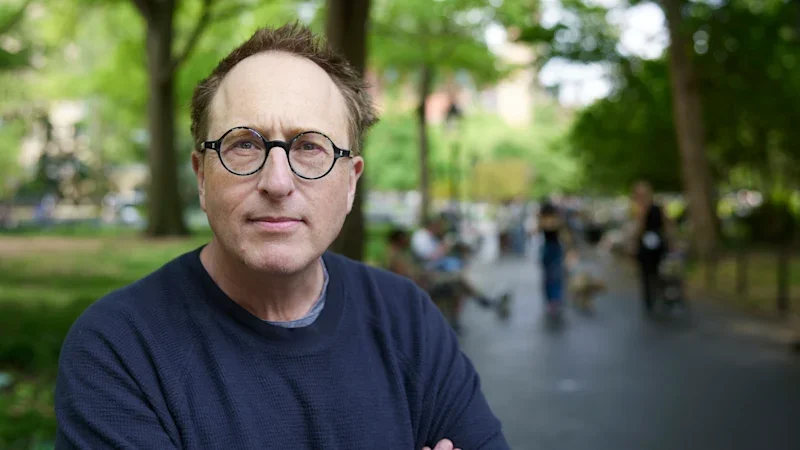
Political extremists, UFO buffs, conspiracy theorists – Jon Ronson has spent decades exploring the world of outsiders and people on the fringes of society. So at a glance, his latest subject might seem innocuous. In his first book in 11 years, the investigative journalist and bestselling author immerses himself in the world of … men.
More specifically, the increasing number of men who are “unravelling”. But it’s not the looksmaxxers or men’s rights activists that intrigued him - too obvious; Ronson’s forte is untold stories. Instead, The Castle introduces a seemingly disparate group of, mostly, more relatable characters. Which perhaps makes some of his revelations all the more unsettling.
Unsettling, of course, is Ronson’s specialty. His breakthrough book, 2001’s Them: Adventures With Extremists, chronicled five years of immersion with radical movements, and his infamous infiltration of Bohemian Grove, the secretive summer camp for some of the world’s most powerful men, alongside a then young Alex Jones, long before conspiracy culture was widespread. His 2004 book The Men Who Stare At Goats explored the US military’s exploration of psychic warfare (and was adapted into a film starring George Clooney); in 2011, The Psychopath Test, in which Ronson learns how to spot psychopaths using a famous checklist, became his most widely read book, and in 2015, he examined the world of the internet pile-on in So You’ve Been Publicly Shamed.
Ronson was toying with writing something about the current state of masculinity when an irresistible lead fell into his lap. In 2023, one of his son Joel’s friends, a nightclub promoter, received an invitation to attend a party at a “castle” (Ronson was born in Wales but has lived in the US since 2012), and they headed to an address in Connecticut.
The following morning, Ronson awoke to a slew of text messages from Joel about his night, which had taken an alarming turn. The group had been lured to the venue – which was indeed a gothic-style “castle”, albeit a gaudy American interpretation thereof – not for a party, but for what the host Chris Mark told them was a “new reality show” in which young women compete to become his “princess” and live in the castle with him. Except there was no reality show, just a room full of princess costumes and a clutch of other confused guests.
Joel and his friends hotfooted it out of the castle, confused but safe – and Ronson’s interest was immediately piqued, experiencing, he says, “that unmistakable feeling of a story beginning to take shape, a mystery that must consume me”.
The great-grandson of a famed Gilded Age steel tycoon, Mark, who describes himself as an “entrepreneur”, built his castle, it seemed, because he fancied himself as a modern-day playboy.
Ronson set up a meeting with Mark, whose first interview begins with him happily discussing his sleazy “reality show” and the many women who want to be his “princesses”, and things only get madder from there.
I won’t spoil it, but there are bonkers “business” ideas, wild claims about Mark barbecuing some of his exotic pets (and possibly causing the death of a camel), dubious ads seeking women to work for him, and worrying first-hand accounts from several women. Then there are the thousands of text messages he sends Ronson, and even overt death threats – at one point, Mark told Ronson to expect a visit from two murderers recently released from prison, hilariously named Carlos and Brandon.
“He’s a very unusual person,” Ronson says with signature bewildered understatement when we talk over Zoom. “At the beginning, I thought he was just trying to be Hugh Hefner – at the worst moment in history to be Hugh Hefner! On one level he’s extremely unusual, and on another, there is something weirdly resonant about his story, which is that he is finding that there are things he can’t do any more that he always used to be able to do. Like, you can’t lord it over princesses in your castle, like it’s the 1970s.”
Mark’s story gave Ronson something to bounce off his broader idea: many men, he says, don’t know what they are any more in our post-industrial age. He’d been reading recent non-fiction on the topic, such as Richard Reeves’ Of Boys and Men, and was inspired to examine the subject in his trademark way.
“I thought it was this really interesting subject that maybe nobody’s written about in the way that I do it, as a sort of … exciting, adventure narrative non-fiction (with) interesting characters, and me getting into scrapes. The kind of book somebody would want to read on a beach, which is what I always aspire to,” he says.
“But then I thought, how the f--- am I going to do that? What’s the story?” This was roughly around the time Joel told him about the castle.“If you believed in God, it would be like, did God give me this story?”
While Mark’s story is the most bonkers of the men Ronson meets for the book, one of my first questions to him is still, “men – what the f---?”
“I know, right?” Ronson says. “That’s what I was going to call the book!” Men, Ronson says, having become unsure of their place in the world, and are spiralling into what he calls “disinhibited behaviour”.
And while today’s unravelling men are emboldened by the dissociative anonymity of the internet, cajoled by the algorithmic funnel that often leads people into extremism, the current man situation is not unprecedented. At the heart of the book is the work of 19th-century French sociologist Emile Durkheim, who identified a similar trend as far back as 1893.
In his book The Division of Labour, Durkheim, considered the “father of sociology”, coined the phrase “anomie”, to describe a condition of “normlessness” that can occur after rapid social or economic change.
“It happens after an abrupt change in society, the death of institutions,” Ronson says. “Even if they’re institutions that you hated, that deserved to die, it … does something to you, psychologically. It makes you feel unmoored and that can either lead you into withdrawing into yourself and bowing out of society, or this other type of response where people just lash out, and I think that’s what we’re seeing.”
The current unmooring, the lack of purpose (a word that comes up frequently in Ronson’s investigations), can lead people to declare their anger or dissatisfaction publicly – which these days means online.
Among the men Ronson meets is the single dad “lawncare influencer” who, in the early days of YouTube, experienced a rapid rise to fame when he switched from lawn videos to skits featuring him and his daughters. But then Greg Chism went from YouTube pioneer, feted by the platform for his millions of views, to the subject of a police investigation.
There’s British YouTuber Andrew Gold, who once aspired to creating Louis Theroux-style TV documentaries before moving to the platform. When his early videos failed, Gold enrolled in a course, 30 Days To A Better YouTube Channel, which teaches wannabe YouTubers that growing an audience relies on identifying an “enemy” rather than a target audience. Which is how Gold went from wanting to emulate Theroux to creating extreme, hateful, content – even though he tells Ronson, “I don’t even mean it”.
And then there’s the once-feted creator of sitcoms Father Ted and The IT Crowd (and former friend of Ronson), Graham Linehan, who made a very public lurch from beloved writer to prominent anti-transgender “activist”, a trajectory that undid his career, public standing and even his marriage.
Drawing on interviews with Linehan, this chapter is nuanced and even gentle, considering Ronson has been publicly criticised by the writer for years. Linehan even detailed the breakdown of their friendship on his Substack. “I really wanted to write about somebody who’d become completely disinhibited,” says Ronson. “I could have chosen somebody else, but … I’m so much a part of his story, I’m one of his main bete noirs – and it’s such an extraordinary story. Graham’s so talented and so loved, but he had this crack that just … opened and opened and opened.
“I find it extraordinary that somebody could just allow themselves to become so completely disinhibited and not able to back down. He will say that if you’re gender-critical, the only way to survive is to break down the entire movement, but that’s bullshit – I can think of loads of gender-critical people who have had no negative impacts on their careers. But Graham chose to take it to the extreme – his life didn’t have to turn out the way that it did.”
Ronson is bracing for more public bullying from his former friend once the book is released. “But if you’re guided by fear, you’re not a journalist. I felt the same way about lots of stories in this book, but you have to keep going, even if it’s uncomfortable.”
As well as a lack of purpose, a sense of artificiality pervades the lives of the men in The Castle. “There are people creating fake lives all the way through – Chris Mark with his fake reality show, Andrew Gold and his fake venomous beliefs … and what we’re seeing over and over again is that when you create this fake life for yourself, it gnaws away at you, alienates the people around you, and it ends badly.”
By the book’s end, I found it harder than Ronson to feel much empathy towards most of these men; women, I suggest, who have not been wholly unaffected by societal change, don’t seem to lash out in similar circumstances? “I think that’s true; women have always been a lot better at socialising with each other,” Ronson says. “My wife is constantly going out for lunch with her female friends whereas I’ll go for an occasional hike with a man. It’s a good point, but I always … try to find empathy with my subjects.”
I wondered too, if Ronson himself had confronted similar feelings to some of these men; he seems more introspective than in previous books.
“Well, the book started with Joel being lured to the castle just as I’d been in hospital for the first time in my life, so there was already a … fragility to me, and this sense of the world passing me by a little bit,” he says. “I’ve always had this little private thing that each book, even if it’s barely about me, is a kind of memoir – in Them I was a young man on an adventure sneaking into Bohemian Grove. Then The Psychopath Test I’m a bit older, I’ve got a kid, the weight of the world is a little bit more on my shoulders. And maybe … like a lot of men, in my own way, I feel maybe things are drifting away from me a little bit,” he says.
Mostly though, The Castle is as wry as it is alarming, and Ronson’s enjoyment of his adventures throughout is palpable. And for anyone worried about Joel and his friends, they were fine. Via email, Joel says that while they were “a little stressed and nervous” at the castle, especially when Mark demanded they leave once they said they wouldn’t participate in his “reality show”, they got out unscathed. “After the fact, we were very pleased to have left, and I was fascinated by the experience and wanted to understand what had happened and what was going on,” Joel says.
“I don’t think the experience impacted my views on masculinity. I speculated more on Chris Mark as an individual [and] I was delighted that he was investigating Chris and the castle, and that I had helped discover a story that unfolded in such a surprising and insane way.”
And there’s more to come for fans – the author has more anecdotes and footage for his upcoming tour; he’s an old hand at creating spirited live shows. “I won’t have any mystery guests this time, as I’ve done with other tours, but I’ve got loads of video and audio,” he says,“and I enjoy doing these very elaborate stage shows.”
Given the book veers from ripping yarn to mystery tale and more, his show promises to be more than just an author Q&A. “I want it to be like a live documentary unfolding on stage,” he says.
Despite the wild stories he’ll be regaling audiences with, he does hold hope for the future of men. He has a theory that he developed, bizarrely, while covering the recent White House cage fight.
“My book ends worryingly with all of these men behaving exactly as they like, creating their own rules and everybody else can just f--- off. But I was talking to a fighter, Sean O’Malley, who would always boast about his open marriage – but it was a one-sided open marriage; he was allowed to have sex with other women, but his wife wasn’t allowed to have sex with other men,” Ronson explains.“I asked him about it, and said surely that doesn’t work? And he said ‘not any more’. His wife had basically said she was no longer prepared to let him do that. And he looked really baffled at his change in his fortune.”
It’s just a random incident, Ronson says, but during his week at the White House he noticed other examples of men seemingly “being pulled back into reality”. Maybe, he says, “the pendulum is starting to come back to the middle.”
The Castle (Viking) by Jon Ronson is out August 25.
Enter The Castle with Jon Ronson is at QPAC Concert Hall, Brisbane, October 27; City Recital Hall, Sydney, October 29 and Town Hall Melbourne, October 31 and Regal Theatre, Perth, November 2. fane.com.au