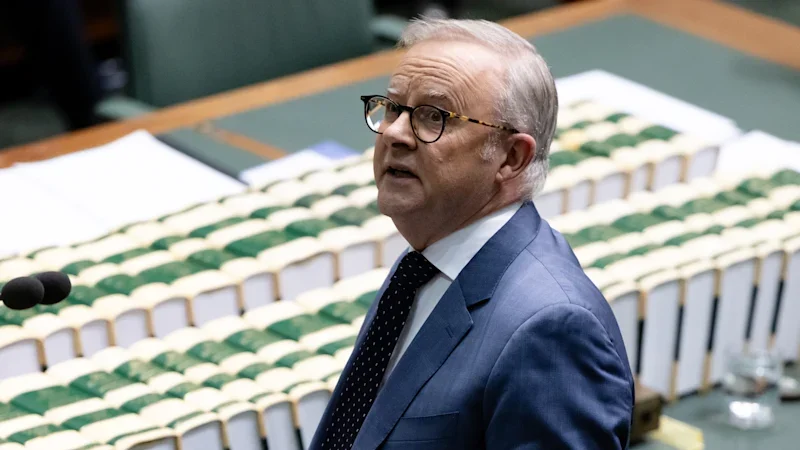
Anthony Albanese claimed a trio of policy wins this week, but it’s the longer-term pattern shifts under way within the Liberal Party and One Nation that are more significant.
First, the Liberal Party returned to the role of a constructive opposition by negotiating with Labor; second, One Nation is also looking increasingly like a mainstream party, this week releasing a policy designed sensibly to break the booming tobacco black market.
As fury over “melon-gate” died down, Albanese and Angus Taylor struck deals to cut back the National Disability Insurance Scheme, changes the rules on gambling advertising and on the News Bargaining Incentive. All three policies have been a headache for the government (gambling most of all) so doing a deal and getting them off the agenda is welcome.
This week was the first time since Taylor became leader that he has dealt himself into negotiations on controversial legislation and struck deals with the PM rather than just sniping from the sidelines (much as his two predecessors, Sussan Ley and Peter Dutton, had mostly done).
Taylor didn’t get everything he wanted, though he did secure the axing of the so-called “widow’s tax” sooner than the government had planned. This matters because while Labor controls the numbers in the lower house, the government needs either the Greens or the Coalition to pass laws in the Senate – and until now, the Coalition has been unwilling to compromise on legislation.
By dealing himself in and negotiating, the Liberal Party leader took a page out of John Howard’s playbook from when he was opposition leader in the 1980s and ensured the Coalition looked more like a mature party of government than it has for some time.
Taylor needs to do more of this sort of repair work because this week’s Resolve Political Monitor showed the Coalition is still languishing in third place with a primary vote of 23 per cent, behind One Nation on 26 per cent and Labor on 28 per cent. Support for One Nation is holding up and Pauline Hanson looks like the de facto opposition leader.
So where does this leave Angus Taylor? This week I spoke to nine Liberal MPs across the party’s conservative and moderate factions about Taylor’s future prospects as leader, and while no one is under the illusion the party is doing brilliantly, there is no will to move on him despite the poor polls. As one Liberal MP put it, “people understand stability is important, though it is a concern Angus is struggling to cut through”.
“Before the leadership change, there was an oversimplification of the problems we have, it was easier to just point to Sussan and say it was all her fault. Now Angus’ supporters are realising the problems are structural and long term.”
Those problems include a decline in support for the major parties, an ageing membership base, a policy development process that has been largely moribund since the 2022 election loss and the fracturing of parties on the right of politics.
As a second Liberal MP put it, “we have a lot of work to do, our [polling] numbers won’t improve overnight, it might be halfway through next year before we overtake One Nation or Labor”.
“We might not be as effective as last term in parliament [under Dutton] but there is a lot more policy work going on behind the scenes now. The polls might not reflect it yet, but we are moving in the right direction.”
Liberal Party founder Robert Menzies once said that opposition was a vital “period of preparation for the higher responsibilities which you hope will come”.
The lack of policy development undertaken under Dutton was a key reason why the opposition lost so badly in 2025, so that work is overdue – and welcome. A healthy democracy requires a strong opposition.
But while Taylor and his colleagues are belatedly starting to do the work required, One Nation has been stealing their supporters for more than six months, with considerable success.
One Nation’s proposal to cut the tobacco excise by 75 per cent is not costed, and it would cost the federal treasury. But it’s a move also backed by NSW Labor Premier Chris Minns, it has support from some in the Coalition and – although treasurer Jim Chalmers is determined not to shift on the issue – it is necessary.
Black market tobacco sales are booming, and according to the ABS, account for about 80 per cent of total tobacco sales. That boom has increased crime on the streets of our major cities and smoking rates are rising. At the same time, excise revenue is collapsing, with the May budget estimating $15.4 billion in tobacco taxes will be collected between 2025-26 and 2029-30 – $11.9 billion less than estimated a year earlier.
Most Australians would, no doubt, prefer to purchase legal tobacco, and Hanson tapped public sentiment perfectly, beating the Coalition to the punch with her policy, too.
Inside One Nation, another more significant development has taken place. Hanson has acquired a new chief of staff – Chris Taylor – a lawyer of 25 years’ experience who previously worked for the Australian Banking Association and as a legal adviser for former prime minister Scott Morrison.
Taylor has known Hanson and her right-hand man, James Ashby, for years, and his hiring means Ashby can now focus on building the party structures up across the country without having to also run her office.
The hiring of Chris Taylor matters because it suggests One Nation is going mainstream and support for it is being normalised. This stands alongside the recruitment of Barnaby Joyce, the by-election win in Farrer, success in the South Australian state election and expected strong showings in the WA state byelection for Secret Harbour and the looming Victorian election.
Hanson and Chris Taylor may have only four staff to work on policy and media (not counting the standard allocation of five electoral staff that all MPs get), compared to the 30 or so in Angus Taylor’s office and the 50-plus in Albanese’s office, but if it works, the party hopes it will help attract more high-quality candidates.
Ironically, once One Nation is seen as part of the “establishment”, it could lose some of the more disenfranchised voters it has attracted.
But the gamble is it will gain more supporters in net terms than it loses, which could lead to a permanent splitting of the vote between Hanson’s party and the Coalition, much as the Greens have settled into place as a balance of power party on the left, eating into Labor’s vote.
The parallels between the rise of the Greens in the late noughties and the rise of One Nation today are striking.
Few MPs have more experience than Albanese in fighting the Greens. His long-term strategy of marginalising and ignoring them, coupled with his characterisation of them as extreme (when he has to address them) at every opportunity has worked: he has held the Greens at bay in his own seat of Grayndler for decades, and the party shed seats at the last election.
Angus Taylor could find similar success by attempting to paint One Nation as an extreme or fringe party, rather than buddying up to them, as some of his MPs want. But the recruitment of Joyce and the hiring of [Chris] Taylor suggest One Nation has no plans of letting that happen.
James Massola is chief political commentator.