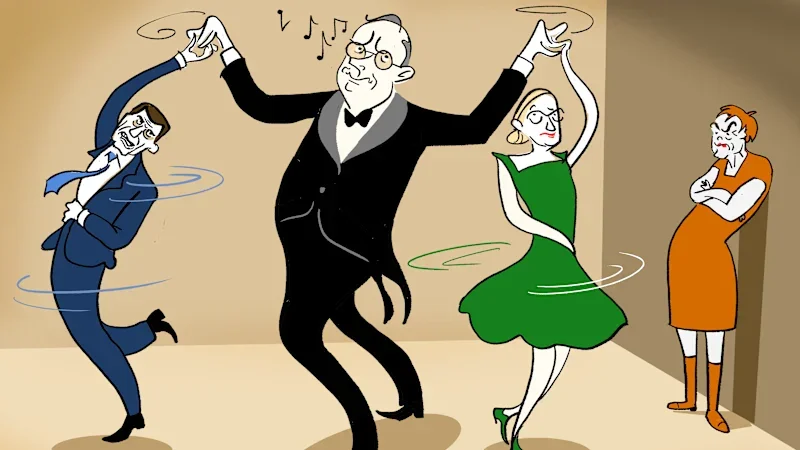
This week, the full parliamentary power of the Albanese government was on display. I’m not sure I can remember a week in which a government struck so many deals with the opposition’s help. On gambling advertising reform. On cuts to the National Disability Insurance Scheme. On the so-called “widow tax” that fell out of its changes to negative gearing. Those negative gearing changes, by the way, were passed with the help of the Greens.
These are not small changes. Gambling reform has been a pebble in the government’s shoe for months now – an issue that separates it from public opinion and divides its own members. It’s emotionally potent, too, surrounded by stories of lives destroyed by corporate predation, and – for Labor MPs – a deceased colleague’s recommendations that lay ignored for a thousand days.
Meanwhile, the NDIS cuts involve the government correcting the “design flaws” in Labor’s own system, and inspire enormous worry in people relying on the scheme. It’s not quite right to call these barnacles. But they are the kind of issues that could easily have become so. Much like the tax changes before them.
It’s a remarkable wrinkle in the fabric of this political moment. The polls say the Albanese government is under pressure, neck and neck with One Nation, its primary vote stubbornly refusing to recover to pre-budget levels. The parliament says Labor can do more or less as it pleases. That’s because its main opponent has almost no parliamentary presence. The result is that the government can now repeatedly legislate things that in any other parliament might have been a bunfight. All it has to do is ensure the proposal on offer is one that either the Greens or the Coalition can’t refuse.
So it was with the negative gearing and capital gains tax changes. The Greens made their criticisms. They launched a Senate inquiry. They secured an amendment of relatively little practical application. But there was never a world in which the Greens would vote against the package. It had wanted these tax concessions reined in for eons. The Coalition, meanwhile, having defended these tax concessions as an article of faith for decades, could only look on impotently. A reform that once spelt political death was suddenly law.
So, too, this week’s NDIS cuts. The Coalition struck its poses, this week demanding “widow tax” amendments in exchange for its support. But the truth is that the government would probably have made those amendments of its own accord. And there was never a world in which the Coalition would vote against the package. It had tried to pass cuts of its own while in government. The Greens, meanwhile, were apoplectic and irrelevant. Cuts that once seemed unachievable * – *estimated to save $37 billion over four years, in part by removing 240,000 people from the scheme – which Labor itself had opposed while in opposition, were suddenly done.
Only on the rare issue that unites the Greens and the Coalition does this get even remotely messy. Gambling advertising was meant to be one of these. That’s why we saw another Senate committee inquiry, and the injection of some harrowing evidence into the public debate. But even this apparent cul-de-sac was a mirage.
Within the Coalition lurked a serious divide on the issue, and senior Liberals retain enough of their free-market, pro-business DNA to wave through a package that still allows for plenty of gambling advertising. To be fair, the Coalition secured some significant changes. The new opt-out system that allows people to register not to see gambling advertising online is more than nothing. But it still has the Greens and allied independents screaming treason, and some Coalition MPs crossed the floor, thinking the law too weak. The Coalition didn’t exactly extract its pound of flesh. Perhaps an ounce or two.
This is the story of a series of gifts. No doubt Albanese’s gift for parliamentary strategy, honed over decades of nuts-and-bolts politics. The gift of a Senate that leans neither left nor right of Labor, but both at once, allowing the government to choose whichever path suits. The gift of an insurgent that, for all the attention it commands and for all its popular momentum, has no institutional power at all. And of course, the gift of a whopping majority in the lower house that undercuts whatever rhetorical power the Coalition might have had. All this adds up to making the other parties tools of the Albanese government rather than serious obstacles.
These gifts cannot last. Never have I known the parliament and public opinion to be so out of alignment. But it does mean, at a time the Albanese government is facing a sustained populist threat, that it has an immensely valuable weapon in its arsenal. Unlike other besieged establishment parties, it is extremely well placed to make things happen. It can decide which fights it wants to pick, which issues are most urgent and most likely to boost its standing against One Nation, then make them law. It can fight disillusionment with action.
We’ve not really seen that before. The US presidential system means they don’t have incumbents in quite the same way we do, so neither the Republicans nor the Democrats could truly resist Donald Trump’s arrival through achievement. Probably the closest case was Keir Starmer’s Labour government in Britain, but by all accounts, Starmer resoundingly failed to use his huge parliamentary majority to any serious effect.
That doesn’t mean it will work. It’s possible the government doesn’t choose wisely. It’s possible that an issue like NDIS cuts, now resolved at the federal level, becomes seriously thorny once the conflict becomes between federal and state governments as it very soon will be.
Or it’s possible none of this matters; that the populist mood has more or less issued its verdict, and cannot be assuaged by pointing to parliamentary wins. No other Western incumbent government has seen off a populist insurgency in recent times. Incumbency has always been a disadvantage in that fight. We’ll soon find out whether Labor’s approach makes it the exception.
Waleed Aly is a broadcaster, author, academic and regular columnist.
The Opinion newsletter is a weekly wrap of views that will challenge, champion and inform your own. Sign up here.