Argentina’s Deputy Economy Minister Says Inflation Is No Longer the Problem
Argentina · ECONOMY
Key Facts
- WhoJosé Luis Daza, deputy economy minister.
- Wherethe Council of the Americas conference in Buenos Aires.
- WhenThursday 20 August 2026.
- July inflation2.1 percent for the month, 33.8 percent over a year.
- The reforma bill making the central bank formally independent.
Argentina’s deputy economy minister said inflation will keep falling and is not, personally, a subject for him any more. He spoke in Buenos Aires on 20 August 2026.
What He Actually Said
The quote is worth reading closely, because the English paraphrase is blunter than the Spanish.
He said inflation will keep falling and that, for him personally, it is not a subject. He did not say it had been beaten.
He went on to say Argentina has solid fiscal accounts. Then he made the claim that matters most.
Once the independent central bank law is approved, he said, it will be a confidence shock for the economy.
That is a prediction attached to a bill that has not passed.
What the Numbers Say
INDEC, the national statistics agency, published the July Argentina inflation figures on 14 August. Consumer prices rose 2.1 percent in the month.
Over twelve months the increase was 33.8 percent. The cumulative rise for the first seven months of 2026 was 19.3 percent.
Core inflation, which strips out seasonal and regulated items, was 1.8 percent for the month and 32.2 percent over the year.
These are national figures covering the whole consumer basket. They are rates of change, not price levels.
A monthly rate of 2.1 percent, held for a year, compounds to about 28 percent.
Why Both Statements Can Be True
Argentina inflation at 33.8 percent a year would be a crisis almost anywhere else. In Argentina it is the lowest reading in years.
Officials measure Argentina inflation against where the country was, not against where other countries are. That is a fair comparison for them and a confusing one for outsiders.
July Argentina inflation also broke a three-month slowdown, ticking up rather than down. We reported that on 14 August.
So the direction Daza describes is real over a year and less clear over the most recent month.
Both things can be true at once, and the honest version says so.
The Central Bank Bill
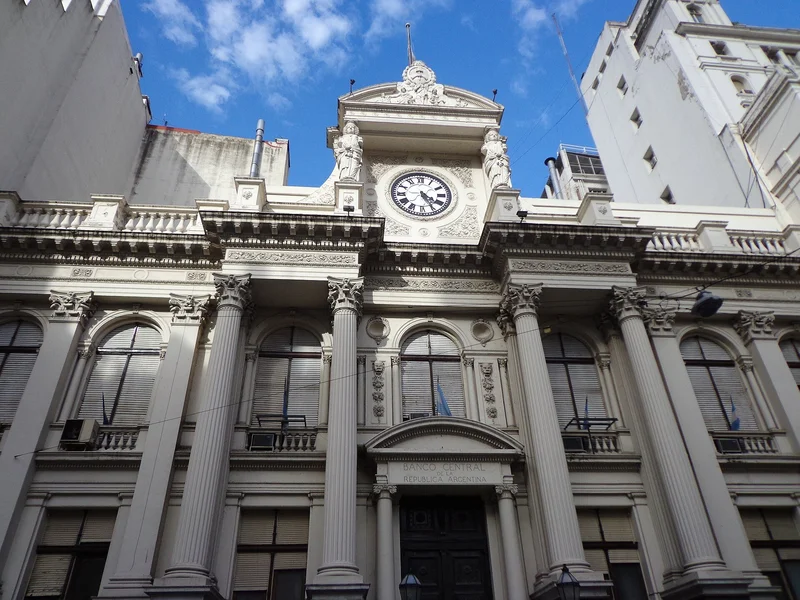
The reform Daza is banking on is a new charter for the Banco Central de la República Argentina. The aim is formal independence from the executive.
In practice that means a bar on financing the treasury and fixed terms for the board. The mandate would narrow to prices.
Argentina has tried versions of this before. The reason it keeps coming back is that the previous versions were overridden.
The bill has been moving through Congress through August. It is not law yet.
Calling its approval a confidence shock is a forecast, not a description of anything that has happened.
What a Confidence Shock Would Mean
In market language, a confidence shock means investors repricing a country’s risk quickly and in one direction.
The measurable version is the country risk spread, the extra yield Argentina pays over US Treasuries. If the reform works, that spread narrows.
It would also show up in the peso and in the central bank’s reserves. Neither has been settled this year.
Nobody has published a target. Daza did not attach a number to his prediction, and we are not inventing one.
What This Means If You Live There
For residents earning pesos, a falling rate of Argentina inflation still means prices rising. It just means they rise more slowly.
With Argentina inflation at 2.1 percent a month, an unadjusted salary loses roughly a fifth of its purchasing power over a year.
For anyone earning dollars, the calculation is different and depends entirely on the exchange rate rather than on the price index.
The practical advice has not changed. Index your contracts where you can, and check whether your rent adjusts by a formula or by negotiation.
Utility and transport tariffs are adjusted separately from the headline index. Those can move faster than the average in any given month.
How to Read Official Optimism
Governments talk their own reforms up. That is not dishonest, but it is not evidence either.
The test on Argentina inflation is simple and public. INDEC publishes a monthly number, and the central bank bill either passes or does not.
Both will be visible within weeks. Neither requires taking anyone’s word for it.
Daza’s forecast is falsifiable, which is more than most official optimism manages.
What to Watch
The August Argentina inflation print is the next hard data point, due in September. Two consecutive monthly declines would support his case.
The central bank bill’s final vote is the second. Watch whether the independence provisions survive committee intact.
The third is the country risk spread in the days after any vote. That is where a confidence shock would appear first.
We will report each as it lands.
Argentina inflation has fallen a long way from its peak, and officials are entitled to say so. The question is whether the last stretch is the hardest.
Countries that get inflation from triple digits to thirty per cent often stall there. Getting from thirty to single digits is a different problem.
Frequently Asked Questions
What is Argentina’s current inflation rate?
Consumer prices rose 2.1 percent in July 2026 and 33.8 percent over twelve months. INDEC published the figures on 14 August 2026.
Did the minister say inflation is beaten?
No. He said it will keep falling and that for him personally it is not a subject. That is a statement about direction, not about the level.
What is the central bank reform?
A bill giving the Banco Central formal independence, including limits on financing the treasury and a mandate focused on prices. It has not yet become law.
What is a confidence shock?
A rapid repricing of a country’s risk by investors. It would show up first in the country risk spread, then in the currency and reserves.
Is inflation still falling?
Over a year, yes. July itself ticked up and broke a three-month slowdown, so the most recent month is less clear than the annual trend.
Sources
This article was produced by The Rio Times’ automated newsroom system. How we use AI · Report an error