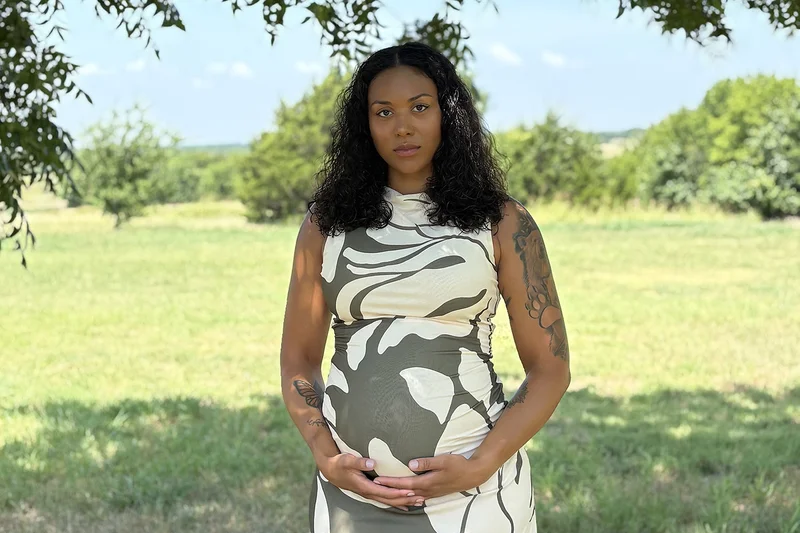
The surrogate in the center of a multi-state legal battle over a baby who was born with a rare heart condition sought to “set the record straight” on her motivations in an opinion editorial published in the New York Post on Thursday.
McKenna West, a cardiac nurse from Alaska, gave birth in Texas last week to a baby boy that she was carrying on behalf of Omar Ahmed and Nausheen Gilkar. The baby, Rumi, had surgery Monday for a rare congenital heart condition, hypoplastic left heart syndrome, which often requires lifelong medical care.
In her editorial, West said that she knew from her experience as a nurse that the baby she was carrying had a chance at survival through surgery.
“People have called this political theater. It isn’t,” she wrote. “This is about giving an innocent child a shot at the life he deserves.”
A representative for Gilkar and Ahmed declined to comment on West’s editorial in a statement to NBC News on Thursday, citing a request from the court-appointed guardian in the legal proceedings.
“The Guardian Ad Litem appointed to this case at the request of McKenna West and the Texas Attorney General has urged the parties to refrain from making statements to the press in the interest of protecting the privacy and well-being of the child,” the statement said.
The months leading up to Rumi’s birth were contentious between his parents and West after the baby was diagnosed during a 20-week anatomy scan in April, according to court documents from both parties filed in Alaska this summer.
The surrogacy agreement which West signed prior to an embryo transfer last year included a clause that the parents could ask West to have an abortion in the case of fetal abnormalities, the documents said.
West chose not to pursue a scheduled appointment to terminate the pregnancy after the heart defect was discovered, saying that she worried she would “not be able to live with” herself, according to her legal complaint seeking custody in Alaska.
West contends in the court documents that after she refused to have an abortion, Ahmed and Gilkar attempted to pressure her with legal threats over the surrogacy agreement she signed.
A counterclaim filed by the couple in July said that they initially communicated to West that she was in breach of their contract, but later sent messages that said they understood her refusal.
The next several weeks would begin a legal battle that spanned three states.
According to court documents in Alaska, the biological parents sought an order in California establishing them as the baby’s parents after West severed contact with them in May. West then filed a suit in Alaska in June to try to stop the California proceedings and asked an Alaska judge to give her custody of the baby.
The couple, based in California, filed a counterclaim in July alleging that they wanted the California order to begin setting up medical care for the baby since West refused the abortion and refused to provide updates on the baby’s health. They also asked the Alaska court to award them $100,000 in damages, the counterclaim said. West filed a motion to dismiss the counterclaims this week.
While the couple was looking to get care for Rumi at Cedars Sinai Medical Center in Los Angeles, West sought consultation from doctors in Texas. She wrote in her Thursday editorial that the hospital had excellent outcomes for the required surgery Rumi would need and that she had friends in the area.
“The contracting couple wanted me to deliver the baby at a hospital in California, but that hospital didn’t have the same perfect track record of success, and I had no one to support me there,” West wrote.
West has alleged in her editorial and in court documents that Rumi’s parents have refused to commit to providing him with life-saving care, a claim the couple has denied. Court documents in the California case are sealed, but their filings in Alaska emphasize that the parents “never said they would refuse medical treatment as recommended by a doctor for their son.”
The allegation was repeated by Texas Attorney General Ken Paxton, who asked a court to order doctors to treat the baby with the required surgery. A guardian was appointed by the court to receive all “pertinent medical information” about the baby after his birth.
The couple’s attorney previously said in a statement that the couple was focused on their baby’s health and that they are devastated to have their “family tragedy transformed into political theater.”
West has been represented by the Alliance Defending Freedom, a conservative legal organization that advertises that it was involved in overturning Roe v. Wade, and the case is being championed by Paxton, an anti-abortion Republican who is also a candidate for U.S. Senate. The case has become a political proxy fight over abortion, but West said Thursday that she isn’t trying to take someone else’s baby.
The surrogate said that she feels the baby needs an advocate “as he gets the ongoing treatment his fragile heart requires.”
Rumi underwent a complex palliative heart surgery on Monday, called a Norwood procedure, which is the first in three surgeries in the treatment for his heart condition.
West said in a statement Thursday that she was glad to hear Rumi was recovering from the surgery.
“My focus has always been on protecting this precious baby’s life,” West said.
The procedure’s in-hospital survival rate is 90% ,but the five-year survival rate ranges from 60% to 75%, according to the Cleveland Clinic. There is significant risk involved in the surgeries to treat HLHS, Dr. Scott Hadland, who is the chief of adolescent and young adult medicine at Mass General Brigham for Children and Harvard Medical School, previously told NBC News.
“A lot of kids don’t survive from one surgery to the next, and there can be a lot of impairment in terms of normal healthy development,” he said.