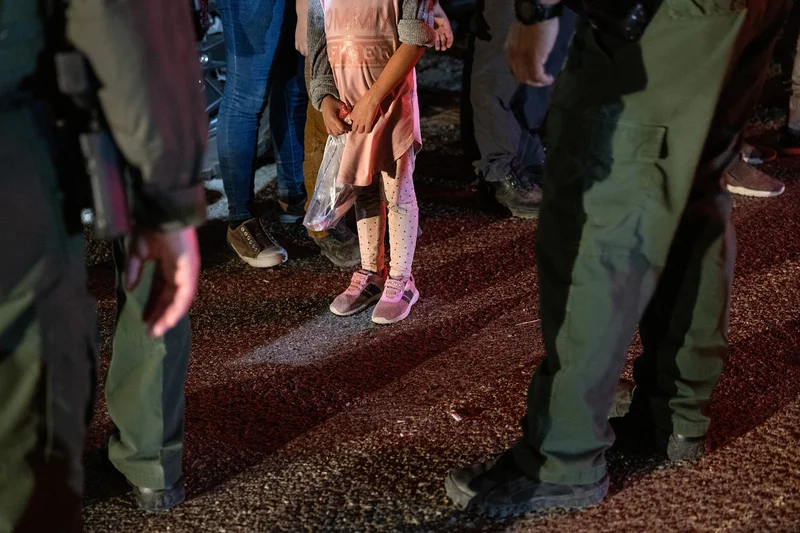
Thousands of unaccompanied migrant children facing deportation have lost their legal representation after the Trump administration tore up contracts with their nonprofit and legal aid defenders. Now the administration is recruiting active and retired military lawyers as replacements.
The Defense Department has contacted current and former military personnel to support the Department of Health and Human Services, which oversees the Office of Refugee Resettlement, responsible for housing unaccompanied migrant children, a Pentagon spokesperson told NBC News in an email.
Some of these children have been victims of human trafficking and sexual abuse as well as neglect and violence in their home countries.
The spokesperson said the Defense Department has “provided information about available opportunities” to represent unaccompanied migrant children to DOD attorneys “who have recently retired or who soon plan to retire, encouraging them to represent” the children.
The Defense Department referred further questions about compensation, incentives and other issues to HHS.
Michael Lukens, executive director of Amica Center for Immigrant Justice, whose group was among the providers of legal representation for the unaccompanied children, said military lawyers are wholly unqualified to provide these services.
“I’m very concerned about the ethics of a government attorney representing children against another branch of the government,” he said.
The Office of Refugee Resettlement, ORR, said in an email in response to NBC News’ request for comment that the agency is “committed to ensuring all eligible unaccompanied children have legal representation during immigration proceedings.”
The agency said it is “exploring opportunities to hire former or soon-to-retire Department of War attorneys who are interested in applying their legal experiences to continued public service” and is not limiting the “opportunities” to only that group.
“Experienced DOW attorneys have dedicated their careers to serving our nation and upholding the law. ORR welcomes the opportunity for these attorneys to continue that service by applying their skills on behalf of unaccompanied children,” the ORR stated.
The response did not include answers to questions about compensation being offered.
On July 31, the administration ended its contract with Acacia Center for Justice, which for years has secured legal representation and services for unaccompanied children that the 2008 Trafficking Victims Protection Reauthorization Act requires.
The center oversaw a network of more than 800 attorneys from about 100 legal service providers, distributing federal funds to them to provide the legal services under the government contract. This included representing the children in immigration court and other immigration matters, such as applying for protection as a trafficking victim.
Acacia said in a news release Aug. 4 that it declined to agree to the interim contract with DHS — which would allow the transition from Acacia to the new contractor — because the administration wanted its legal service providers to “turn over confidential client information that could be used to deport the very children we are committed to protecting as a condition of payment.”
“That would not only violate our legal ethics, but also our moral values,” Acacia said in its statement.
In July, Reuters reported immigration authorities had arrested more than 12,000 people whom the ORR tipped them to since January 2025. According to data analyzed by Reuters, ORR shared more than 460,000 leads with ICE about unaccompanied children, their sponsors and other household members.
The administration has stopped paying the attorneys, upending legal services for children with ongoing cases, but several attorneys, citing ethical and legal obligations as well as concern for the unaccompanied children, continued representing the minors pro bono or with donated funds.
Some of the legal groups have been critical of the administration’s immigration and deportation policies. The administration has sought to replace the network with groups that have ties to Trump and personnel who share his political ideologies, with some stumbles.
On Aug. 6, the Trump administration awarded a $150 million contract to a small Houston law firm with little experience in immigration and whose founder served in the first Trump administration. But last week the firm declined the offer.
Also last week, the administration announced that it was offering the organization Our Rescue a contract to provide legal representation to migrant children traveling alone with renewal options that would reach about $244 million.
Our Rescue is led by Derek Benner, who spent three decades in law enforcement, including as a high-ranking official for Homeland Security Investigations, part of ICE, at the Department of Homeland Security. His career at DHS spans several administrations, including the first Trump administration.
Our Rescue’s main focus is setting up online stings or assisting law enforcement to catch traffickers. It previously operated as Operation Underground Railroad, and its work was publicized in the 2023 movie “Sound of Freedom.” Its founder, Tim Ballard, resigned that year amid accusations of abuse in lawsuits filed by women who were part of his organization. Ballard has denied the allegations.
Our Rescue did not respond to a request for comment. Earlier this month, Benner said unaccompanied children are “among the most vulnerable in the world” and “they deserve nothing less than the full weight of our experience.”
Richard Debany, an official in the Office of Refugee Resettlement in the Department of Health and Human Services, said in a court document that Our Rescue would provide legal orientations, consultations and direct legal representation. The document did not detail the number of attorneys on staff.
The administration also has awarded a temporary, $20 million contract to U.S. Committee for Refugees and Immigrants, which helped settle white South Africans whom the administration brought to the U.S. while blocking most other refugee admissions.
In its court filing, the administration said USCRI has 57 people, including 30 staff attorneys and 17 paralegals, to deal with this work.
In its report for 2025 activities, USCRI said it provides case management and home assessments for more than 11,000 unaccompanied children, anti-trafficking services for 435 minors, and legal services in 1,770 cases for low-income refugees and immigrants across the U.S. USCRI did not respond to a request for comment.
Andrew Arthur, law and policy fellow at the Center for Immigration Studies, which advocates for more restrictive immigration policies, said using military lawyers is a “fabulous” idea.
Military lawyers “represent both defendants and the government. They’re really good courtroom lawyers. They’d probably be great lawyers for these kids,” he said, acknowledging there may be a learning curve.
Arthur questioned the need for a provider such as Acacia to organize attorneys for the children. The work should be done by pro bono lawyers, as was done in the past, he said.
“We didn’t need to spend tens of millions of dollars to have somebody oversee lining up lawyers,” he said.
**Eliminating protections **
The disruption in legal services for unaccompanied children is happening against a backdrop of increased deportation of children and other policy changes that immigration advocates say threaten or weaken the protections and the rights of migrant children.
Along with the legal services changes, the administration has been eliminating individual, more child-friendly court hearings and sending minors into mass immigration hearings with adults. Immigration courts are also deporting children who either have or are pursuing Special Immigrant Juvenile Status, which protects immigrant minors who have been victims of abuse, trafficking, abandonment or neglect in their countries. Many minors also are being detained for long stretches of time.
DHS said in response to a request for comment on providing adequate legal representation for unaccompanied children that many of the children who entered under the Biden administration were placed with “unvetted” sponsors who were traffickers and smugglers.
The agency cited some examples of child sponsors who have been arrested for crimes including the rape of an unaccompanied child, possession of child sex abuse material and enticement of a child under 16.
It did not respond to other questions regarding the children’s legal representation, detention and safety if returned to the country they left.
Bilal Askaryar, spokesman for Acacia Center for Justice, said that the administration has been able to tamp down outrage over its disruption of legal representation of unaccompanied children by “couching” it as a contract dispute.
Acacia cited in a news release the case of a deaf, nonverbal, autistic child who was kidnapped on his journey to the U.S. and held for nearly a year before his mother secured his release. Legal advocates identified his case and helped prevent his deportation. The child is now attending school, Acacia stated.
“I think if the average American understood all of the attacks that this administration is carrying out on vulnerable children, they would be as outraged as they were when zero-tolerance family separation was happening in the first Trump administration,” Askaryar said.