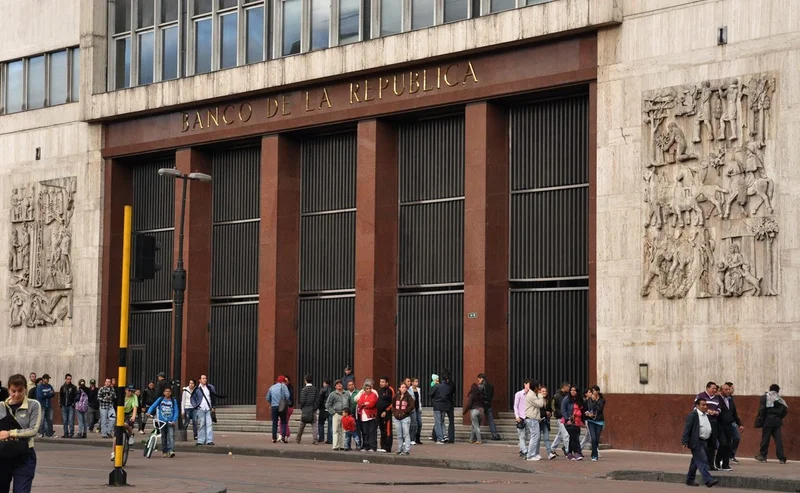
Colombia’s Own Economists Have Given Up on Cheaper Money This Year
Colombia · Economy
Key Facts
- 6.6% for end-2026.That is the median analyst forecast for total inflation in the central bank’s monthly expectations survey.
- Revised upward.The same survey read 6.3% in April, so forecasters have added three-tenths of a point.
- Rate on hold.Fedesarrollo’s August financial opinion survey has analysts expecting the policy rate to stay at 12% in September and again in December.
- A softer expectation than last month.In July the same panel had been pencilling in 12.50% for December, so the direction of travel is toward no change rather than a hike.
- Next decision: 30 September 2026.That is the next scheduled meeting of the central bank’s board.
- Where the peso sits.The official TRM was 3,053 on 20 August and the dollar closed the interbank session near 3,062 — the peso’s strongest level in more than seven years.
Two separate surveys point the same way: prices are proving stickier than hoped, and the 12% policy rate is not coming down before Christmas.
If you earn in Colombian pesos, or you are paid abroad and spend in Bogotá, Colombia inflation expectations are the number that quietly sets your year. The latest reading is not what anyone wanted. Analysts polled by the Banco de la República now put total inflation at 6.6% by the end of 2026 — up from 6.3% in April — and a separate survey of the same community says the 12% policy rate is going nowhere before December.
What the central bank’s survey actually says
The Banco de la República runs a monthly survey of economic analysts. The round that produced the 6.6% figure was fielded between 8 and 10 July and the number surfaced in the bank’s own commentary in mid-August. It is a median, meaning half the forecasters are above it and half below.
Three-tenths of a percentage point does not sound like much. In practice it is the difference between a story where inflation is converging on target and a story where it has settled into a plateau. Colombia’s target is 3%, with a tolerance band of one point either side. At 6.6%, the country would end 2026 at more than double the top of that band.
Why the interest rate is stuck at 12%
Here it is worth separating two surveys that are often blurred together. The 6.6% inflation figure comes from the central bank’s own analyst poll. The interest-rate expectation comes from Fedesarrollo’s Encuesta de Opinión Financiera, a different survey run by a Bogotá think tank.
The next rate decision falls on 30 September 2026, and Fedesarrollo’s August round says analysts expect the board to leave the rate at 12% then, and to still have it at 12% in December. Fedesarrollo’s own inflation median for end-2026, 6.53%, sits within a rounding error of the central bank survey’s 6.6%. That is actually a dovish revision: in July the same panel had expected 12.50% by year-end, which would have meant a hike.
So the market has stopped fearing higher rates. It has not started expecting lower ones.
What it costs you
A 12% policy rate feeds through to mortgage and consumer credit pricing with a lag of months. If you are shopping for a property loan in Colombia, the arithmetic in 2026 is unforgiving and it is unlikely to improve before the first quarter of 2027 at the earliest.
On the other side of the ledger, savers are being paid properly for the first time in years. Fixed-term deposits and government paper are yielding real returns even against 6.6% inflation, which is not something you could say in 2021.
And if you are converting foreign income, the peso has been firming through the month — the TRM was 3,053 on 20 August against 3,128.65 two days earlier, its strongest in more than seven years, though the dollar ticked up on the day itself. A stronger peso is good news for Colombians buying imported goods and bad news for anyone whose salary arrives in dollars.
The political layer nobody can price
President Abelardo de la Espriella took office on 7 August and has promised a tax reform, without yet publishing the bill. The central bank is independent, but its board reads fiscal policy closely, and a reform that widens the deficit would make rate cuts harder to justify.
There is also the earthquake. The 10 August quake, magnitude 7.4, killed at least 289 people and hit Chocó hardest; Colombia declared an economic emergency and has put the preliminary damage bill at US$9.57 billion. Reconstruction spending is necessary and it is also inflationary, particularly in construction materials and labour. None of that is captured in a July survey.
How to read Colombia inflation expectations from here
Two dates are worth putting in a calendar. DANE, the statistics agency, publishes the next monthly inflation print in the first week of September, and the board meets on 30 September. If inflation surprises downward and the peso holds its recent strength, the December expectation will start to move.
Until then, plan on borrowing being expensive and cash being reasonably well paid. That is an unusual combination, and it favours anyone sitting on savings over anyone trying to build with borrowed money.
Frequently Asked Questions
What are Colombia inflation expectations for the end of 2026?
The median analyst forecast in the Banco de la República’s monthly expectations survey is 6.6% for total inflation at end-2026, up from 6.3% in the April round.
Will Colombia’s central bank cut interest rates in 2026?
Analysts surveyed by Fedesarrollo in August do not think so. They expect the policy rate to stay at 12% at the 30 September meeting and to still be at 12% in December — a softer view than July, when the same panel expected 12.50%.
Is this the same survey as Fedesarrollo’s?
No. The 6.6% inflation figure comes from the central bank’s own analyst survey, fielded 8–10 July. The interest-rate expectation comes from Fedesarrollo’s separate Encuesta de Opinión Financiera for August. They are often quoted together, which causes confusion.
Connected Coverage
Sources: Banco de la República — analyst expectations survey; Portafolio — Fedesarrollo financial opinion survey; RT — USD/COP daily close
This article was produced by The Rio Times’ automated newsroom system. How we use AI · Report an error